
Why Acting Fast on House Water Leak Repair Can Save You Thousands
House water leak repair is one of the most urgent home maintenance tasks you’ll face — and the clock starts ticking the moment a leak begins.
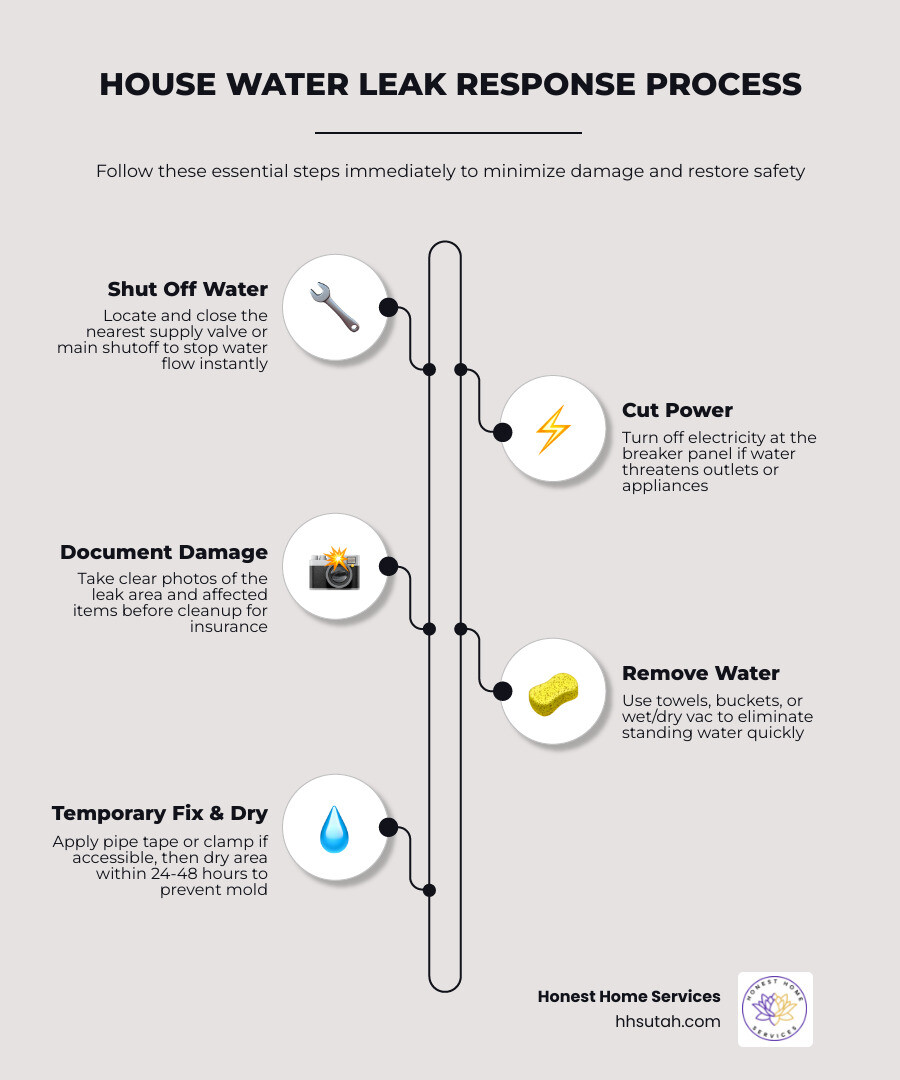
Here’s a quick overview of how to respond to a water leak:
- Shut off the water at the nearest supply valve (or the main if needed)
- Turn off electricity at the breaker if water is near outlets or appliances
- Document the damage with photos before touching anything
- Remove standing water using towels, mops, or a wet/dry vacuum
- Apply a temporary fix (pipe tape, epoxy putty, or a repair clamp) if the leak is accessible
- Dry the area within 24-48 hours to prevent mold growth
- Call a licensed plumber for anything hidden, pressurized, or structural
Water leaks are deceptively costly. The average household loses around 17 gallons of water every single day to indoor leaks — often without the homeowner even knowing. A slow drip can add $20 to $150 to your monthly water bill. And if a leak hides inside a wall or under a slab, it can silently cause mold, rot, and foundation damage for weeks or months before you see any signs.
The good news? Most leaks have clear warning signs, and many common fixes are within reach of a capable homeowner — if you catch them early.
At Honest Home Services, we’ve spent over 20 years helping Northern Utah homeowners and businesses handle every type of house water leak repair, from dripping faucets to main line failures. We’ll walk you through everything you need to know in this guide — from spotting the first warning signs to knowing when to call in a pro.
Handy house water leak repair terms:
How to Spot a Leak Before It Gets Expensive
Water is a bit like a secret agent; it’s very good at finding ways to move through your home without being noticed. However, even the stealthiest leak leaves clues. If you’re paying attention, you can catch a problem before it turns into a major renovation project.
The most obvious sign is usually your wallet. If your water bill suddenly spikes but your habits haven’t changed, you likely have a “silent” leak. Statistics show that a family of four exceeding 12,000 gallons per month during the winter likely has a serious leak issue. Other subtle clues include a persistent musty odor (the “old basement” smell), which often indicates mold growing behind drywall or under floorboards.

Common signs and symptoms of a water leak in a house
When performing a house water leak repair inspection, look for these physical symptoms:
- Ceiling Stains: Yellow, brown, or copper-colored rings on your ceiling.
- Warped Flooring: Hardwood that is cupping or laminate that feels “spongy” underfoot.
- Bubbling Paint: Moisture trapped behind the wall causes paint or wallpaper to peel and blister.
- Warm Spots on the Slab: If you have a slab foundation and feel a warm patch on the floor, you might have a hot water line leaking underneath the concrete.
- Soggy Yard: If a patch of your lawn in Salt Lake City or Davis County is lush and green while the rest is dry—or if you see puddles during a dry spell—your main water line may be leaking.
The risks of ignoring a small leak
It’s tempting to put off a small drip, but water damage is progressive. Mold can begin to grow in as little as 24 to 48 hours once moisture hits organic material like drywall or wood. Beyond the health risks of mold, constant moisture leads to wood rot, which compromises the structural integrity of your home. A single dripping faucet might seem minor, but if it drips once every second, it wastes over 3,000 gallons of water a year. That’s enough to fill a small swimming pool!
How to Detect and Locate Hidden Leaks
If you suspect a leak but can’t see it, it’s time to play detective. You don’t always need high-tech gear to find the culprit; sometimes, all you need is your water meter and some food coloring.
DIY tests for hidden house water leak repair problems
The most effective DIY tool is your water meter. Here is how to perform the water meter test:
- Turn off all water-using appliances (dishwasher, washing machine) and faucets inside and outside.
- Locate your water meter box (usually near the street or in the basement).
- Check the meter for a small “leak indicator” (often a small red or silver triangle or wheel). If it’s spinning while no water is on, you have a leak.
- If there is no indicator, record the current reading. Wait two hours without using any water and check it again. If the number has changed, water is escaping somewhere.
Another classic trick is the toilet dye test. Since 20% to 35% of all residential toilets leak, this is a prime suspect. Drop a few drops of food coloring into the tank. Wait 15 minutes. If the color appears in the bowl without you flushing, your flapper valve is worn out and needs a patch it up approach or a full replacement.
For more detailed tips, you can check out the EPA’s guide on fixing leaks at home or read our guide to water leak detection.

Where leaks usually hide in a home
Leaks love to hide in places we rarely look. Check under your kitchen and bathroom sinks for dampness or “efflorescence” (a white powdery substance on pipes). Inspect your water heater’s pressure relief valve and the base of the tank for rust or puddles. Don’t forget the attic; roof leaks or sweating pipes can cause damage long before they reach your living room ceiling.
When leak detection needs specialized equipment
Sometimes, the leak is buried deep under a concrete slab or behind a tiled shower wall. In these cases, DIY methods won’t cut it. Professional plumbers use non-invasive ways to detect water flow, such as:
- Acoustic listening devices: These amplify the sound of water hissing through a pipe.
- Thermal imaging cameras: These detect temperature differences in walls, showing exactly where cold or hot water is pooling.
- Main line camera inspections: We can run a camera through your pipes to find the exact spot of a break. You can learn more about this in our guide to leak detectors.
What Causes House Water Leaks and What to Do First
Understanding why pipes fail can help you prevent the next disaster. In Northern Utah, we deal with specific environmental factors like hard water and freezing winters that put extra stress on plumbing.
The most common causes by pipe, fixture, and location
- Copper: Over time, copper can develop “pinhole” leaks due to corrosion or high water pressure.
- PVC/CPVC: These plastic pipes can become brittle with age or crack if the ground shifts.
- PEX: Most PEX leaks occur at the crimp ring connections rather than in the pipe itself.
- Galvanized Steel: Common in older homes in Murray and Bountiful, these pipes rust from the inside out, eventually leading to clogs and bursts.
- Hard Water: The minerals in Utah water can build up in faucets and showerheads, causing seals to fail.
Immediate steps to take when you discover a leak
When you find a puddle, don’t panic. Follow these steps:
- Stop the Flow: Turn off the local shutoff valve (under the sink or behind the toilet). If you can’t find it, go to the main water shutoff for the whole house.
- Safety First: If water is near outlets or electrical panels, shut off the power at the breaker immediately.
- Clear the Area: Move furniture, rugs, and electronics. Open cabinet doors to help air circulate.
- Dry It Out: Use a wet/dry vacuum for standing water.
- Document: Take photos for insurance before you start any DIY house water leak repair.
When to call a professional plumber instead of attempting DIY
While a dripping faucet is a great Saturday afternoon project, some things require a pro. You should call Honest Home Services if:
- The leak is inside a wall or under the floor.
- You have a burst pipe gushing water.
- The leak involves a sewage or drain line.
- You notice signs of a slab leak (warm floors or foundation cracks).
- The repair requires cutting into your home’s main water line.
DIY Temporary Fixes for House Water Leak Repair
If you have a minor leak and need to buy time until a plumber arrives, there are several effective temporary fixes. Always remember that these are temporary and should be replaced with a permanent solution as soon as possible.
Essential tools and products to keep on hand
Every homeowner should have a “leak kit” ready. We recommend keeping:
- Plumber’s Tape (Teflon Tape): For sealing threaded joints.
- Self-Fusing Silicone Tape: This stretches and bonds to itself, creating a waterproof seal even on wet pipes.
- Epoxy Putty: A two-part putty that hardens like steel to plug holes in pipes.
- Pipe Repair Clamps: A metal sleeve with a rubber gasket that bolts over a leak.
Temporary repairs for copper, PVC, CPVC, and PEX
| Method | Best For | Pros | Cons |
|---|---|---|---|
| Silicone Tape | Small cracks/joints | Can be applied while wet | Temporary only |
| Epoxy Putty | Pinhole leaks | Very strong once cured | Needs dry surface to bond |
| Repair Clamp | Straight pipe bursts | Reliable and fast | Doesn’t work on joints |
| Slip Coupling | PVC/CPVC breaks | Near-permanent | Requires cutting the pipe |
How to test if the temporary repair worked
After applying your patch, turn the water back on slowly. Watch the area closely. A great trick is to wrap a dry paper towel around the repair. Even a tiny, microscopic drip will show up instantly on the towel’s texture. Check back after 30 minutes to ensure the seal is holding under full pressure.
How to fix common fixture leaks fast
- Faucets: Most drips are caused by a worn-out washer or O-ring. Replacing these costs a few cents and takes ten minutes.
- Toilets: If the toilet is “running,” adjust the float height or replace the rubber flapper.
- Showerheads: If it’s leaking at the connection, unscrew it, apply new plumber’s tape to the threads, and screw it back on.
Permanent Repairs, Cleanup, Costs, and Insurance
Once the immediate crisis is over, it’s time to think about long-term solutions and restoration.
What permanent repairs usually involve
A permanent house water leak repair usually involves cutting out the damaged section of the pipe and replacing it with new material. For copper, this means soldering (sweating) new joints. For PEX, it involves new crimp rings and fittings. In some cases, if your pipes are old and corroding, we may recommend a partial or full “re-piping” to prevent future leaks.
For main water lines, we often use trenchless repair technology. Instead of digging up your entire yard in Layton or Kaysville, we can pull a new pipe through the old one, saving your landscaping and thousands of dollars in restoration costs.
Cleanup and drying steps after fixing a leak
Cleaning up is just as important as fixing the pipe. If you don’t dry the area completely, you’re inviting mold.
- Remove standing water: Use a shop vac and plenty of towels.
- Circulate air: Use high-powered fans and a dehumidifier.
- Disinfect: Wipe down hard surfaces with a solution of 1 ounce of bleach to 4 gallons of water to kill bacteria and mold spores.
- Discard: If carpet padding or insulation gets soaked, it usually needs to be replaced as it’s nearly impossible to dry before mold sets in.
For more on cleanup, see Houselogic’s water damage guide.
What water leak repair typically costs in 2026
In 2026, the cost of house water leak repair varies based on the location and severity:
- Main Water Line Repair: Average cost is $1,025, with a typical range between $354 and $1,696.
- Hidden Pipe Leak: Finding and fixing a leak behind a wall usually costs between $500 and $1,500, depending on how much drywall needs to be removed.
- Simple Fixture Repair: Fixing a toilet or faucet usually costs between $150 and $300.
Does homeowners insurance cover water leak repairs?
This is a common question. Generally, insurance covers sudden and accidental damage — like a pipe that bursts overnight. It typically does not cover “gradual” damage caused by lack of maintenance or long-term corrosion. They will often pay for the “resultant damage” (fixing your ruined drywall and floors) but might not pay for the actual plumbing repair itself. Always keep your receipts and take plenty of photos!
Preventing Future Leaks and Knowing When to Get Help
The best house water leak repair is the one you never have to do. A little prevention goes a long way.
Smart prevention habits that reduce future leaks
- Monitor Water Pressure: High pressure (over 80 psi) stresses your pipes and causes leaks. Install a pressure regulator if needed.
- Insulate in Winter: In places like Park City or Salt Lake City, frozen pipes are a major threat. Insulate pipes in crawlspaces and attics.
- Install Smart Leak Detectors: These small devices sit under sinks or near water heaters and alert your phone the second they detect moisture. Some can even shut off your main water valve automatically.
A simple annual home leak inspection checklist
Once a year, take 20 minutes to walk through your home:
- Check under every sink with a flashlight.
- Perform a toilet dye test.
- Inspect washing machine and dishwasher hoses for cracks or bulges.
- Check the water heater for any signs of moisture or rust.
- Look at your water meter to ensure it isn’t moving when the water is off.
For a deeper dive into prevention, check out our homeowner’s guide to finding leaks.
Frequently Asked Questions About House Water Leak Repair
Can I fix a leaking pipe myself or should I always call a plumber?
If it’s a visible, non-pressurized drain pipe or a simple faucet washer, DIY is great! However, if the leak is on a pressurized supply line, behind a wall, or under your foundation, you should always call a professional to ensure the repair meets local plumbing codes.
How long can a temporary leak repair last?
Materials like epoxy putty or silicone tape are designed to buy you a few days, maybe a week. They are not meant to withstand the constant pressure and temperature changes of your home’s plumbing for the long term.
What is the most common leak in a house?
Toilets are the #1 culprit. Because they often leak silently into the overflow tube, they can waste hundreds of gallons a day without making a sound or a puddle.
Conclusion
Dealing with a house water leak repair can be stressful, but acting quickly is your best defense against high costs and property damage. From performing a simple water meter test to applying a temporary epoxy patch, you have the power to protect your home.
When the job is too big for a DIY fix, or if you just want the peace of mind that comes with expert service, Honest Home Services is here to help. We provide honest, reliable, and affordable plumbing to Northern Utah, including Salt Lake City, Davis County, and the surrounding areas. Whether you need Salt Lake City leak detection or emergency repairs, our local technicians are available 24/7 to get your home back to normal.
Don’t let a small drip turn into a big disaster. Give us a call today!