
Why Knowing How to Detect Water Flow in Pipe Systems Could Save You Thousands
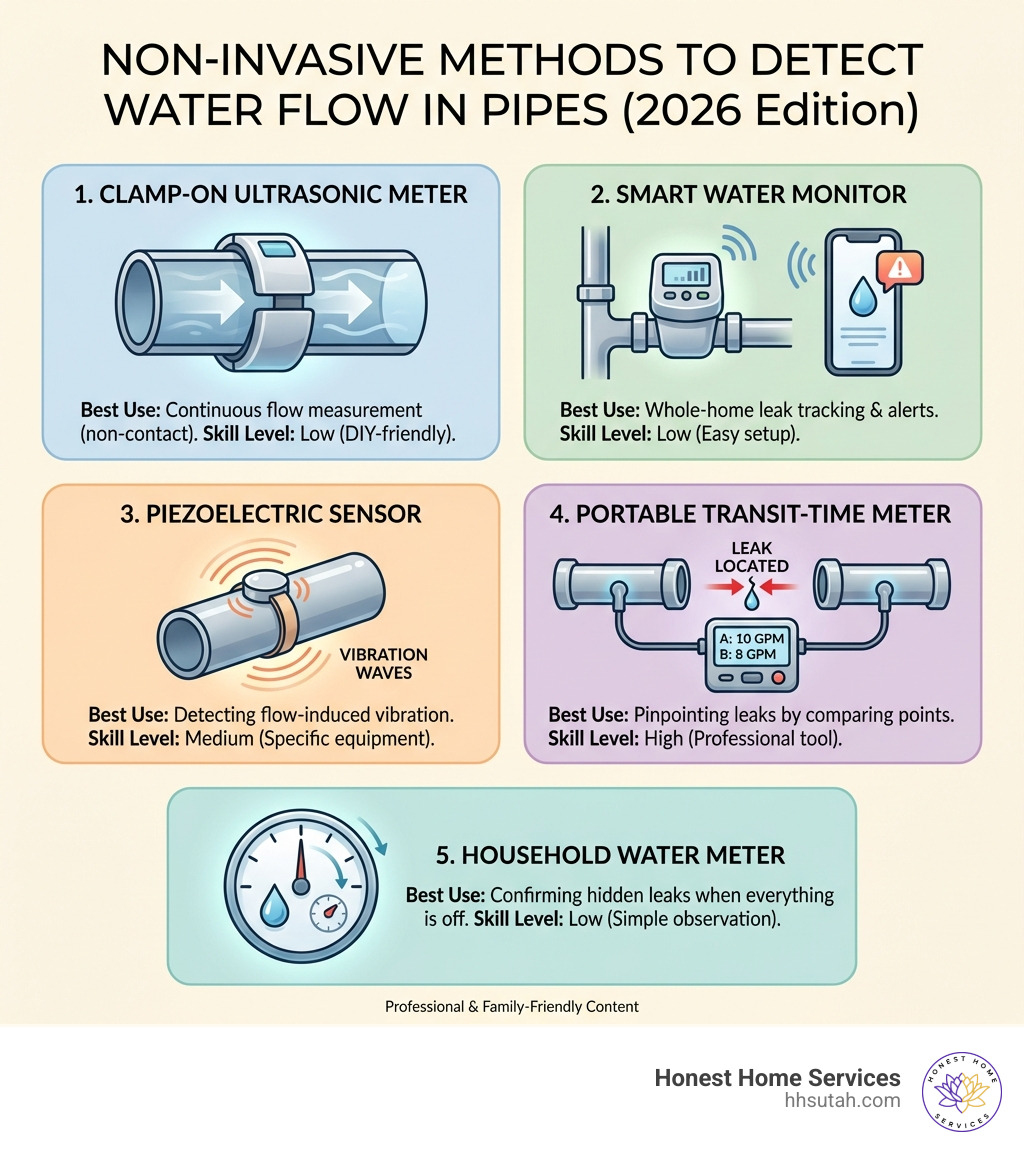
To detect water flow in pipe systems without cutting into walls or shutting off your water supply, here are the most effective non-invasive methods:
- Clamp-on ultrasonic flow meters – attach to the outside of the pipe and measure flow using sound waves
- Portable transit-time meters – compare flow volumes at different points to locate leaks
- Smart water monitors – install at the main line to track usage and send real-time alerts
- Piezoelectric vibration sensors – detect flow-induced vibrations on the pipe exterior
- Check your water meter – watch for movement when all fixtures are off to confirm hidden flow
Water is one of the most valuable resources on the planet. Yet in homes and businesses across Northern Utah, it quietly leaks, runs, and wastes — often through pipes hidden inside walls, floors, and underground. A single undetected leak or unexpected flow pattern can mean skyrocketing water bills, structural damage, or a burst pipe at the worst possible moment.
The good news? You don’t have to tear open your walls to find the problem. Modern technology makes it possible to detect, measure, and monitor water movement through your pipes from the outside — accurately, affordably, and without any disruption to your home or business.
At Honest Home Services, we’ve spent over 20 years helping Utah homeowners and businesses detect water flow in pipe systems, track down hidden leaks, and protect their plumbing before small problems turn costly. In this guide, we’ll walk you through everything you need to know.
Quick look at detect water flow in pipe:
Understanding How to Detect Water Flow in Pipe Systems
When we talk about how to detect water flow in pipe networks, we are looking at two main goals: knowing if water is moving and knowing how much is moving. While a simple flow sensor might just tell you “yes, there is movement,” a flow meter provides the actual data—velocity, volumetric rate, and mass flow.
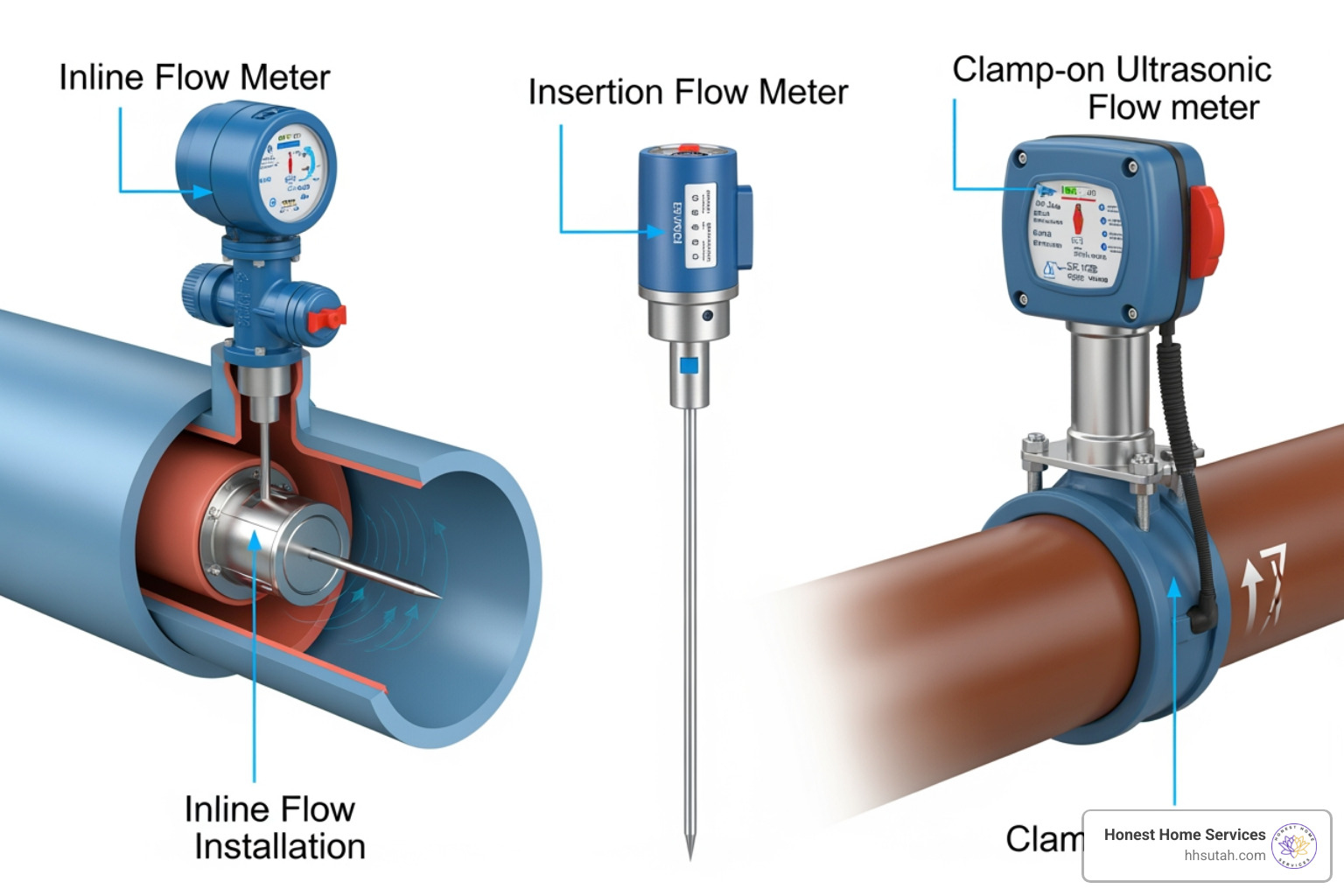
In our experience across Salt Lake City and Davis County, we see many homeowners confused by the different types of hardware. Most traditional meters are “inline,” meaning they are part of the pipe itself. However, non-invasive technology allows us to gather the same data from the outside of the pipe.
Choosing Your Method: Inline vs. Insertion vs. Clamp-on
To help you decide which method fits your home or business in Layton or Kaysville, here is a quick comparison:
| Feature | Inline Meters | Insertion Meters | Clamp-on (Non-Invasive) |
|---|---|---|---|
| Installation | Requires cutting the pipe | Requires drilling a hole | No pipe modification |
| Maintenance | High (must shut off water) | Medium (can use “hot tap”) | Low (no contact with water) |
| Accuracy | Very High | High | High to Very High |
| Best For | New construction | Large industrial pipes | Leak detection & retrofitting |
| Risk of Clogs | Possible (moving parts) | Possible | Zero |
Why You Need to Detect Water Flow in Pipe Networks
Why go through the trouble? For starters, 97% of the water on Earth is salt water. Only 3% is fresh, and much of that is locked in glaciers. Wasting water isn’t just bad for your wallet; it’s a strain on our local Utah environment.
Detecting flow is essential for:
- Leak Prevention: Identifying a running toilet or a pinhole leak in the slab before it causes mold. You can learn more about spotting-the-drip-a-guide-to-water-leak-detection to keep your home safe.
- Billing Accuracy: Ensuring you aren’t paying for water that is leaking out into your yard in Bountiful.
- Pump Protection: In industrial or agricultural settings, detecting a “dry run” (where a pump is on but no water is flowing) can prevent a motor from burning out.
- System Optimization: Helping HVAC systems run more efficiently by measuring chilled or hot water flow.
The Role of Real-Time Alerts and Monitoring
We don’t just want to know there was a leak after the basement floods. We want to know the second it starts. Modern digital water flow meters can provide 24/7 alerts for:
- Unusual flow rates (like a burst pipe).
- High water usage (someone left the hose on).
- Freeze warnings (when pipe temperatures drop dangerously low).
Recent Contactless Running Water Flow Detection and Water Flow Measurement System research shows that even simple piezoelectric vibration sensors can be calibrated to detect flow without ever touching the liquid. This technology is becoming more accessible for domestic use in places like West Valley and Murray.
Non-Invasive Technologies: Ultrasonic and Electromagnetic
If we aren’t cutting the pipe, how do we “see” the water inside? We use physics. The two heavy hitters in the non-invasive world are Ultrasonic and Electromagnetic sensors.
How Ultrasonic Sensors Detect Water Flow in Pipe Walls
Ultrasonic meters are the gold standard for non-invasive detection. They use “piezo-electric crystals” that expand or pulse when electricity is applied, sending a high-frequency sound wave (ultrasound) through the pipe wall.
There are two main ways this works:
- Transit Time: This measures the time it takes for a sound pulse to travel between two transducers. Sound travels faster when moving with the flow and slower when moving against it. By calculating the difference, the meter determines the velocity.
- Doppler Effect: This works like a radar gun. The sensor sends a sound wave that bounces off particles or bubbles in the water. The shift in frequency of the returning echo tells us how fast the water is moving.
For a deep dive into the electronics behind this, you can check out this Ultrasonic Sensing for Water Flow Meters and Heat Meters guide.
Transit Time vs. Doppler: Choosing the Right Tech
Not all water is the same. If you are measuring clean culinary water in Farmington, you need one technology. If you are measuring wastewater in a sewer line in West Jordan, you need another.
- Transit Time Flow Meters: These operate in the 1-2 MHz frequency range. They require “clean” liquids because bubbles or solids can block the signal. They are perfect for most residential and commercial water lines.
- Doppler Flow Meters: These transducers usually operate at 640 kHz to 1 MHz. They require bubbles or solids to reflect the sound. This makes them the best choice for “dirty” water, slurries, or aerated liquids.
Factors for Selecting a Water Flow Meter
Choosing the right tool to detect water flow in pipe systems depends on your specific setup. At Honest Home Services, we look at several factors before making a recommendation:
- Pipe Material: Ultrasonic waves travel differently through PVC, copper, and iron. Most modern meters can be programmed for specific materials.
- Water Conductivity: Electromagnetic (Magnetic) meters require the liquid to be conductive. They won’t work with deionized or ultra-pure water.
- Temperature and Pressure: Some sensors are rated for hot water (up to 284°F), while others are for ambient temperatures only.
- Accuracy and Turndown Ratio: High-end meters, like the KOBOLD DUK, offer a turndown ratio of 250 to 1 with accuracy as tight as ±0.7%. This means they can accurately measure both a tiny drip and a rushing torrent.
Installation Requirements for Maximum Precision
Even the most expensive meter will give you bad data if it’s installed incorrectly. To get the best results in your South Jordan or Draper home, follow these rules:
- Straight Pipe Runs: You should install the meter on a straight section of pipe. A good rule of thumb is to place it at least 10 to 15 times the pipe’s diameter away from any elbows or T-junctions to avoid turbulence.
- Remove Insulation: You can’t shoot sound waves through foam or fiberglass. We always remove a small section of insulation to mount the transducers directly to the pipe.
- Apply Couplant: We use an acoustic gel (couplant) between the sensor and the pipe. This grease helps the sound waves travel efficiently without being lost in air gaps.
Environmental and Water Quality Impacts
Over time, things inside the pipe can change how we detect water flow in pipe systems.
- Internal Corrosion: Rust or scale buildup can change the inner diameter of the pipe, throwing off calculations.
- Thermal Drift: Extreme temperature changes can affect the sensor’s accuracy.
- Particulates: If clean water becomes cloudy, a transit-time meter might lose its signal.
If you suspect a leak but can’t find it, using a portable meter to compare flow at different points is a great strategy. You can learn more about this in the guide on How to Locate a Water Leak Using an Ultrasonic Flow Meter.
Practical Applications: Leak Detection and Efficiency
Non-invasive flow detection isn’t just for scientists; it has real-world benefits for every homeowner in Northern Utah.
Pinpointing Hidden Leaks with Portable Meters
Imagine your water bill in Bluffdale doubles, but you don’t see any puddles. We can use portable ultrasonic meters to “trace” the flow. By measuring the volume at the main line and then at various branches, we can see where the water “disappears.” If 10 gallons leave the main but only 8 reach the house, we know the leak is in the service line between those two points.
This is a key part of our salt-lake-city-leak-detection service. It allows us to find the exact spot of the problem, minimizing the need to dig up your yard or tear out your drywall.
HVAC and Energy Efficiency
Flow meters are also used to calculate heat transfer. By measuring the flow rate of water through a heating or cooling plant, we can determine exactly how much energy is being used. This is vital for large buildings in Salt Lake City looking to reduce their carbon footprint and save on utility costs.
Future Trends in Flow Detection Technology
The future of how we detect water flow in pipe systems is getting smaller and smarter.
- IoT Integration: Imagine your water meter “talking” to your smart home system and automatically shutting off the main valve if it detects a burst pipe while you’re on vacation in Park City.
- Low-Cost Piezoelectric Sensors: Research into vibration-based detection is making it cheaper for homeowners to install basic “flow or no-flow” sensors on every major appliance.
- Micro-Flow Detection: Some new sensors, like the KEYENCE FD-X series, can detect flow as low as 0.1 mL/min. That is literally a single drop!
Frequently Asked Questions about Water Flow Detection
How accurate are non-invasive clamp-on flow meters?
Modern clamp-on meters are incredibly accurate, typically ranging from ±0.7% to ±2% of the actual flow rate. The key to this accuracy is proper installation—ensuring the pipe is clean, using enough acoustic gel, and entering the correct pipe wall thickness into the meter’s computer.
Can these meters detect very low flow rates?
Yes! While older mechanical meters might not spin during a tiny leak, high-end digital sensors can detect “micro-flows.” Some industrial models can detect shot amounts as low as 0.001 mL. For a homeowner, this means even a slow-dripping faucet in a guest bathroom won’t go unnoticed.
What maintenance do non-contact flow meters require?
One of the biggest advantages of non-invasive detection is the lack of maintenance. Because there are no moving parts (like a paddlewheel) inside the water stream, there is nothing to clog, corrode, or wear out. We recommend a quick “signal check” once a year to ensure the acoustic gel hasn’t dried out and the transducers are still firmly seated.
Conclusion
Whether you are trying to lower your utility bills, protect your home from water damage, or ensure your industrial equipment is running safely, knowing how to detect water flow in pipe systems is a game-changer. You no longer have to guess what’s happening inside your plumbing.
At Honest Home Services, we pride ourselves on providing the most reliable and advanced plumbing solutions to our neighbors in Salt Lake City, Provo, and throughout Northern Utah. From high-tech ultrasonic leak detection to standard pipe repairs, our expert technicians are here to help.
Don’t wait for a small drip to become a big disaster. We offer 24/7 emergency support and guaranteed customer satisfaction. Schedule your Salt Lake City leak detection today! and let us help you keep your home dry and your bills low.
You can also Grow with Us on LinkedIn! to stay updated on the latest in measurement technology and home maintenance tips.
For more information on keeping your home’s systems in top shape, check out our other guides: