

What to Do Right Now If You Have a Burst Pipe
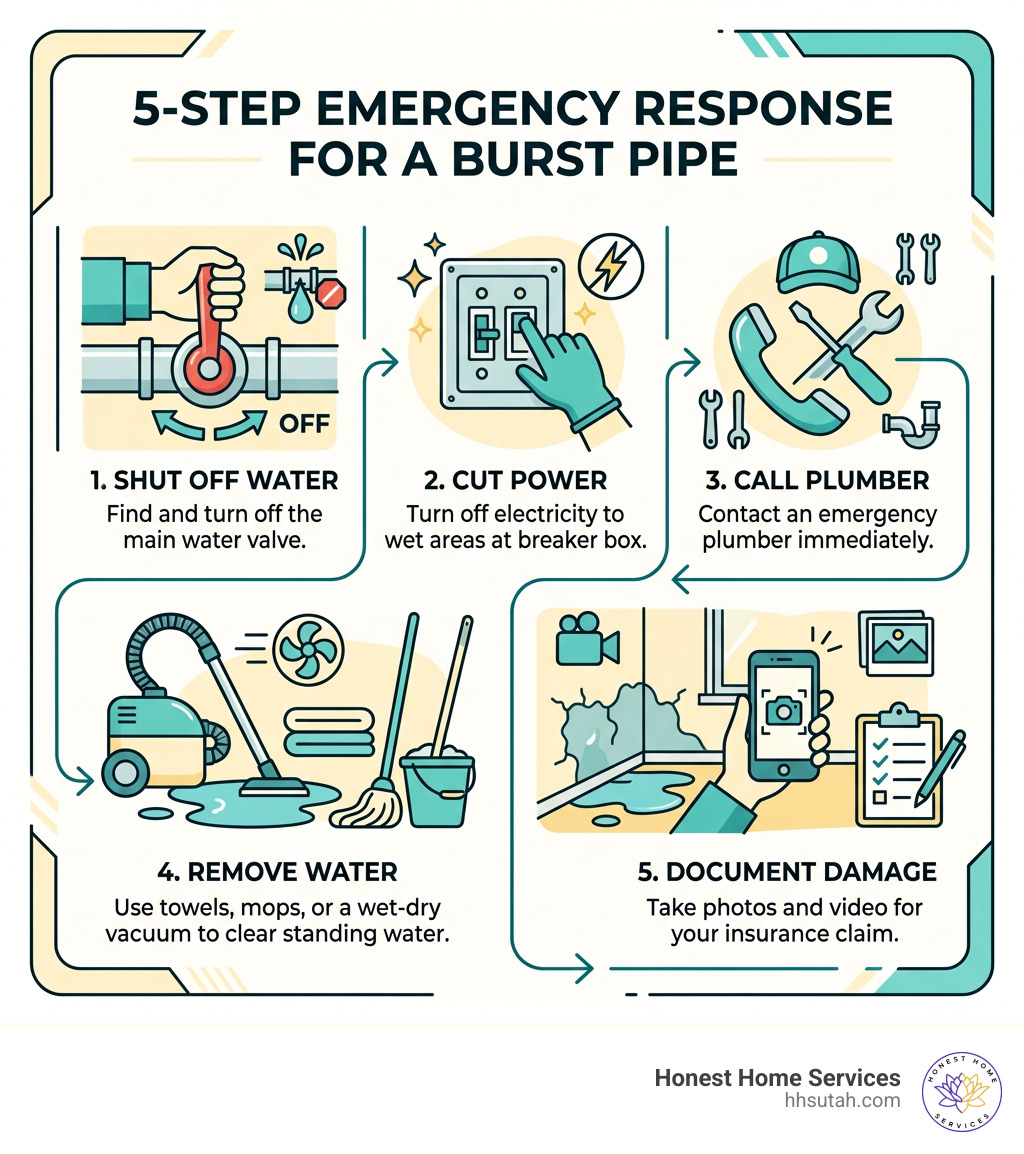
Burst pipe emergency repair is something every homeowner hopes they’ll never need — but when water is flooding your home, you need answers fast. Here’s what to do immediately:
- Shut off the main water supply valve (usually near your water meter, basement, or utility closet)
- Turn off electricity to any wet areas at your breaker box
- Call an emergency plumber right away
- Remove standing water with towels, mops, or a wet-dry vacuum
- Document all damage with photos and video for your insurance claim
Don’t wait. Mold can start growing in as little as 24 hours after water exposure, and structural damage spreads fast.
A burst pipe can go from a trickle to a full flood in minutes. The water soaks into your floors, walls, and foundation before you even realize what’s happening. The panic is real — and the damage is costly, with most repairs running between $200 and $1,000, depending on severity.
This guide walks you through every step: from stopping the water right now, to making a temporary fix, to getting your home fully restored.
At Honest Home Services, we’ve been helping Northern Utah homeowners and businesses handle burst pipe emergency repair for over 20 years — with licensed, insured plumbers available when you need them most. We’ll pick up right where this guide leaves off.
Burst pipe emergency repair vocab to learn:
Immediate Steps to Take During a Plumbing Crisis
When you hear the roar of rushing water or see a ceiling stain expanding like a dark cloud, your adrenaline hits the roof. The first few minutes are critical for how to handle a plumbing emergency effectively.
Your priority is containment. Once the main water is off, you must drain the remaining water sitting in your pipes so it doesn’t continue to bleed out of the break. Go to the lowest faucet in your home (usually a basement utility sink or an outdoor hose bib) and open it completely. Then, head to the highest faucet and open that too. This creates a vacuum break that allows the water to drain out of the system quickly. Don’t forget to flush your toilets to empty the tanks.
Next, focus on the standing water. Use a wet-dry vacuum if you have one, or a “bucket brigade” if the flooding is deep. If the water is near drywall or baseboards, use fans and dehumidifiers immediately. Mold is a fast mover, often appearing within 24 to 48 hours.
Locating and Operating the Main Water Supply Valve
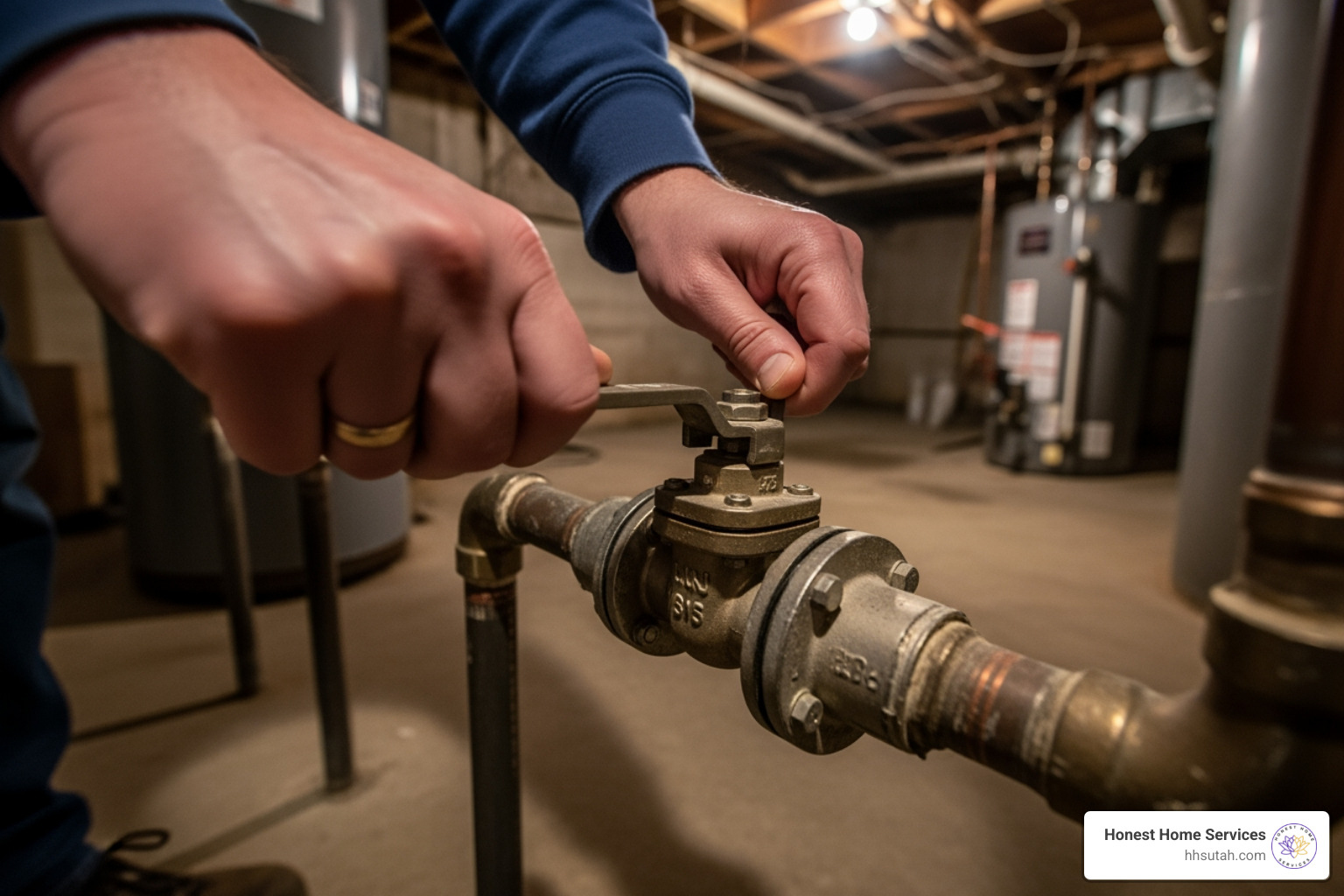
Every member of your household should know exactly where the main water shut-off valve is located. In our service areas like Salt Lake City or Layton, these are typically found:
- In the basement or crawl space, near where the water line enters the foundation.
- In a utility closet near the water heater.
- In the garage, often near the front wall.
- Outside in a “curb stop” box near the street (this may require a special T-handle key).
There are two main types of valves. Ball valves have a straight handle; if the handle is parallel to the pipe, the water is on. Turn it 90 degrees so it is perpendicular to the pipe to shut it off. Gate valves look like a circular wheel; turn these clockwise (“righty-tighty”) until they stop. Be gentle with older gate valves in historic Utah homes, as they can become brittle and snap if forced. If you can’t find your valve, check your property inspection report from when you bought the home.
Why Turning Off Electricity is Non-Negotiable
Water and electricity are a lethal combination. If a pipe bursts in a ceiling or wall near outlets, light fixtures, or your electrical panel, the risk of electrocution is extremely high.
If you can safely reach your breaker box without stepping through water, turn off the power to the affected “zones” or the entire house if the flood is widespread. Never touch electrical switches or appliances while standing in water. If the water has already reached the height of your outlets or is dripping directly into your breaker panel, stay away and call your utility company or an emergency electrician immediately. Safety always comes before property.
Identifying the Signs and Causes of Pipe Failure
Not every burst is a spectacular geyser. Some are “sneaky” leaks that degrade your home over weeks.
| Pipe Material | Pros | Cons | Burst Risk Factors |
|---|---|---|---|
| Copper | Durable, naturally antimicrobial | Expensive, prone to pinhole leaks | Corrosion, freezing, high pressure |
| PEX | Flexible, freeze-resistant | Newer material, can’t be used outdoors | Rodent damage, poor fittings |
| PVC/CPVC | Cheap, easy to install | Brittle over time | Physical impact, extreme heat, age |
Visible signs include puddles in the yard, damp spots on drywall, or discolored “bubbles” in your ceiling paint. Audible signs include a persistent hissing sound or the sound of rushing water behind a wall. You might also notice a sudden, unexplained drop in water pressure. Interestingly, even internal clogs can lead to bursts. While common bathroom clogs are often caused by hair — a topic explored in scientific research on hair-related clogs — these blockages increase internal pressure that can eventually snap a weakened joint.
Common Triggers for a Burst pipe emergency repair
In Northern Utah, the #1 culprit is freezing temperatures. When water freezes, it expands by about 9%. If that water is trapped between an ice blockage and a closed faucet, the pressure becomes immense — often exceeding 3,000 PSI — which is more than enough to split a metal pipe. You can learn more about preventing frozen pipes to avoid this winter nightmare.
Other common triggers include:
- High Water Pressure: Anything over 80 PSI puts unnecessary stress on joints and valves.
- Corrosion: Older galvanized steel pipes rust from the inside out, thinning the walls until they fail.
- Tree Roots: In older neighborhoods like Murray or Bountiful, tree roots can infiltrate sewer and supply lines, applying external pressure until the pipe cracks.
- Pipe Age: Materials like Polybutylene or Orangeburg have high failure rates and are common in older homes.
Hidden Leaks Behind Walls and Underground
Some of the most dangerous bursts are the ones you can’t see. A slab leak occurs when a pipe bursts under your home’s concrete foundation. Signs include “hot spots” on the floor, the sound of water running when all faucets are off, or foundation cracks.
At Honest Home Services, we use advanced technology like electronic acoustic detectors and thermal imaging to find these leaks without tearing up your entire home. If you suspect a hidden issue, call for leak detection in Salt Lake City before the water undermines your home’s structural integrity.
Temporary DIY Fixes While Waiting for a Plumber
If you’ve shut off the water but still have a slow drip, or if you need to restore water to the rest of the house while waiting for a pro, a temporary patch can help. These are “plumbing first aid” and are not permanent solutions.
One of the most effective temporary tools is the mechanical pipe repair clamp. This consists of a metal sleeve with a rubber gasket inside that you bolt over the leak. If you have cross-linked polyethylene (PEX) piping, you might even be able to use a push-to-connect slip coupling if you have the right tools to cut the pipe cleanly.
How to Perform a Burst pipe emergency repair with Household Items
If you don’t have a repair kit, you can get creative with common items:
- Rubber Patch and C-Clamp: Cut a piece of old garden hose or a heavy rubber glove. Wrap it tightly around the leak and use a C-clamp or hose clamps to compress the rubber against the hole.
- The Pencil Trick: For a tiny pinhole leak in a copper pipe, some homeowners have had success jamming a pencil tip into the hole and wrapping it tightly with tape. The wood swells when wet, slowing the leak.
- Duct Tape: This is a last resort. It rarely holds up under pressure, but if the pipe is bone-dry and you wrap it dozens of times, it might slow a non-pressurized drain leak for an hour.
Pro Tip: Always use sandpaper to clean the area around the leak before applying any patch. Removing corrosion and “burrs” helps the patch create a better seal.
Using Epoxy Putty and Self-Fusing Silicone Tape
For more reliable temporary fixes, every homeowner should keep epoxy putty and silicone tape in their emergency kit.
- Epoxy Putty: This is a two-part stick that you knead together until it turns a uniform color. It triggers a chemical reaction that causes it to harden into a rock-like substance in about 10–30 minutes. It can even be applied to damp pipes.
- Self-Fusing Silicone Tape: This tape doesn’t have adhesive. Instead, it chemically bonds to itself when stretched and wrapped. It creates an airtight, waterproof seal that can handle moderate pressure. For the best results, overlap your layers by at least half an inch and extend the wrap two inches past the leak on both sides.
Professional Burst pipe emergency repair and Restoration
Once we arrive at your home in Draper or Farmington, our first job is a “search and destroy” mission for the leak. We don’t just patch the hole; we assess why it happened. If one section of pipe is corroded, the rest likely is too.
Professional repair usually involves cutting out the damaged section and “sweating” in new copper or crimping in new PEX. We also check your water pressure to ensure a surge didn’t cause the break. You can read more about burst pipe repair costs to get an idea of the investment, but the cost of the plumbing fix is usually much lower than the cost of water damage restoration.
Navigating Homeowners Insurance for Water Damage
Most standard homeowners insurance policies cover “sudden and accidental” water damage — which includes a burst pipe. However, they often exclude damage caused by “gradual neglect” (like a leak you knew about but didn’t fix).
To ensure your claim is approved:
- Take Photos and Video: Capture the “geyser,” the broken pipe, and all damaged belongings before you start cleaning.
- Keep the Broken Part: Don’t let the plumber throw away the damaged section of pipe; the insurance adjuster may want to see it.
- Mitigate Damage: Insurance companies require you to take reasonable steps to prevent further damage (like shutting off the water and starting the drying process).
- Check Your Policy: Some policies have specific requirements for insurance and plumbing claims, such as notifying them within 48 hours.
Long-Term Prevention and Pipe Maintenance
An ounce of prevention is worth a gallon of floodwater. To protect your home:
- Insulate Your Pipes: Use foam sleeves or heat tape on pipes in unheated areas like garages or attics. This can save you over $500 in potential emergency costs.
- Install Smart Leak Sensors: These devices sit on the floor and alert your phone the moment they detect moisture. Some even include an automatic shut-off valve.
- Annual Inspections: A pro can spot common plumbing problems in older homes before they turn into 3:00 AM emergencies.
- Check Your Pressure: If your home’s water pressure is over 70 PSI, install a pressure-reducing valve (PRV).
Frequently Asked Questions about Burst Pipe Repair
How much does it typically cost to fix a burst pipe?
On average, a professional burst pipe emergency repair costs around $500. Minor fixes can be as low as $150 to $250, while complex repairs involving pipes hidden behind walls or under concrete slabs can reach $1,000 to $3,000. These prices generally cover the plumbing repair itself; water extraction and structural repairs (drywall, flooring) are typically billed separately.
Can I use duct tape to temporarily stop a leak?
Duct tape is generally ineffective for pressurized water lines. The adhesive fails when wet, and it cannot withstand the 40–60 PSI of a standard home water system. It is much better to use specialized self-fusing silicone tape or a pipe clamp. Use duct tape only as a very short-term “bandage” to redirect spraying water while you run to the shut-off valve.
What should I do if my pipes burst while I am away from home?
If you are away and discover a flood upon return, do not enter the home if the water has reached electrical outlets. Call your utility company to shut off the power from the outside first. To prevent this, always shut off your main water valve before leaving for vacation, or install a smart home water monitor that can shut the water off automatically if it detects unusual flow.
Conclusion
A burst pipe is a homeowner’s worst nightmare, but you don’t have to face it alone. By acting quickly — shutting off the water, cutting the power, and calling in the experts — you can save your home from thousands of dollars in structural damage and mold remediation.
At Honest Home Services, we pride ourselves on being the most reliable team for burst pipe emergency repair in Northern Utah. Whether you’re in Salt Lake City, West Valley, or Park City, our expert technicians are ready 24/7 to stop the flood and get your life back to normal. We offer fair, transparent pricing and a 100% satisfaction guarantee.
Don’t let a small leak become a big disaster. Contact our Salt Lake City leak detection experts today for an inspection, or call us immediately if you’re facing an emergency. We’re here to keep your home dry and your family safe!