

When Water Hides in Your Walls: What You Need to Know
A concealed water pipe leak detector is a specialized tool that finds hidden leaks inside walls, under floors, and below ground — without tearing anything apart.
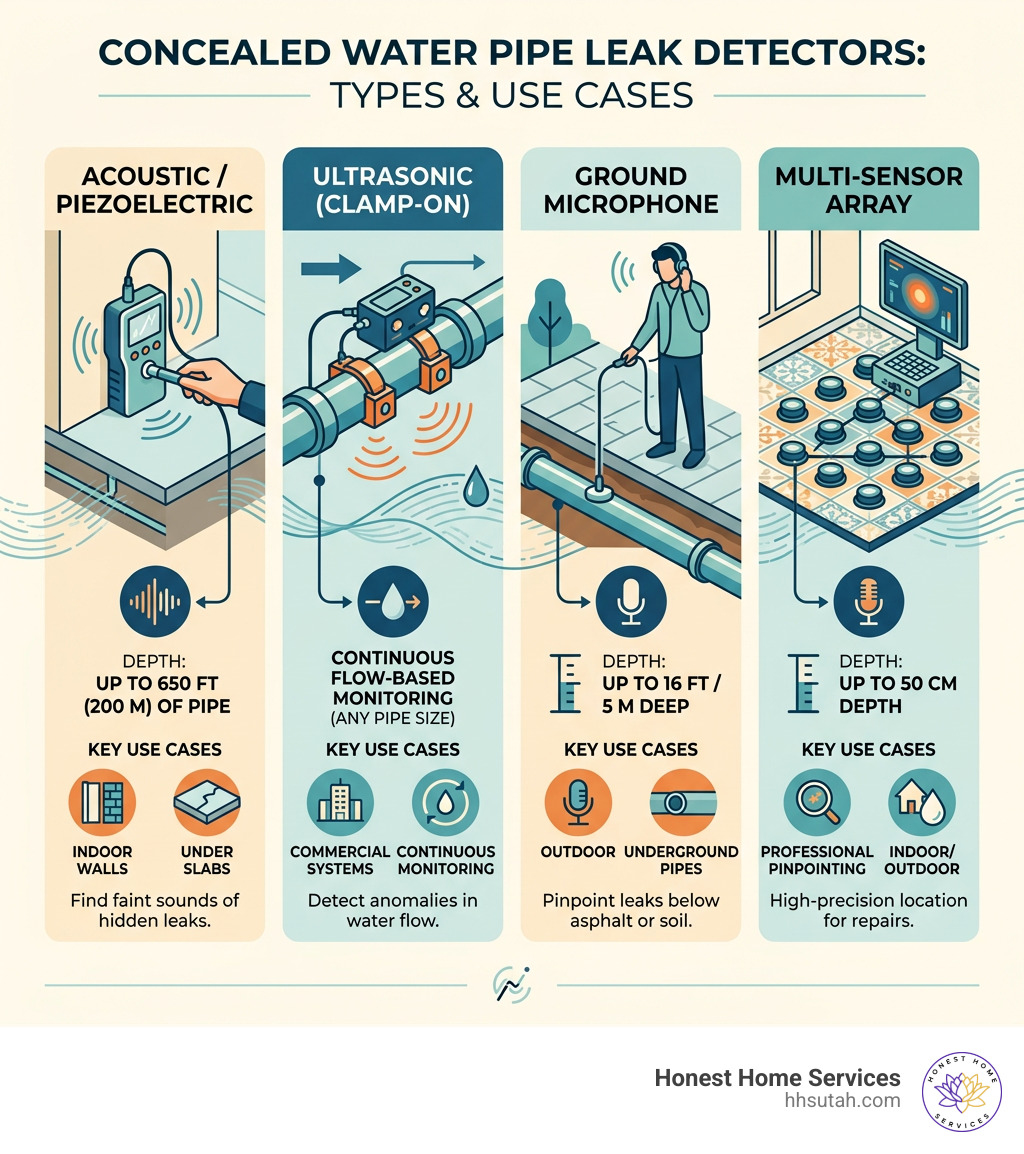
Here are the most common types and what they’re best for:
| Detector Type | Best For | Detection Range |
|---|---|---|
| Acoustic / Piezoelectric | Indoor walls, under slabs | Up to 650 ft of pipe |
| Ultrasonic (clamp-on) | Commercial, any pipe size | Flow-based, continuous |
| Ground microphone | Outdoor, underground pipes | Up to 16 ft / 5 m deep |
| Smart WiFi sensor | Ongoing home monitoring | Near pipe connection points |
| Multi-sensor array (e.g., PQWT L30) | Professional pinpointing | Up to 50 cm depth, indoor/outdoor |
Hidden leaks are sneaky. By the time you notice a damp spot or a spike in your water bill, damage may already be spreading inside your walls. Mold grows. Wood rots. And repair costs climb fast.
The good news? Modern leak detection tools make it possible to find the exact leak location before a single tile is removed or wall is opened up.
At Honest Home Services, we’ve spent over 20 years locating and repairing concealed water pipe leaks for homeowners and businesses across Northern Utah — and we know how the right concealed water pipe leak detector can save thousands in unnecessary damage and guesswork. Read on and we’ll walk you through everything you need to choose the right tool or service for your situation.
Relevant articles related to concealed water pipe leak detector:
The Hidden Threat: Why Concealed Leaks Require Immediate Action
When a pipe is tucked away behind drywall or buried beneath a concrete slab, a leak isn’t just a “drip”—it’s a silent destroyer. Because these pipes are part of what we call “hidden projects,” they are often ignored until the evidence becomes impossible to miss.
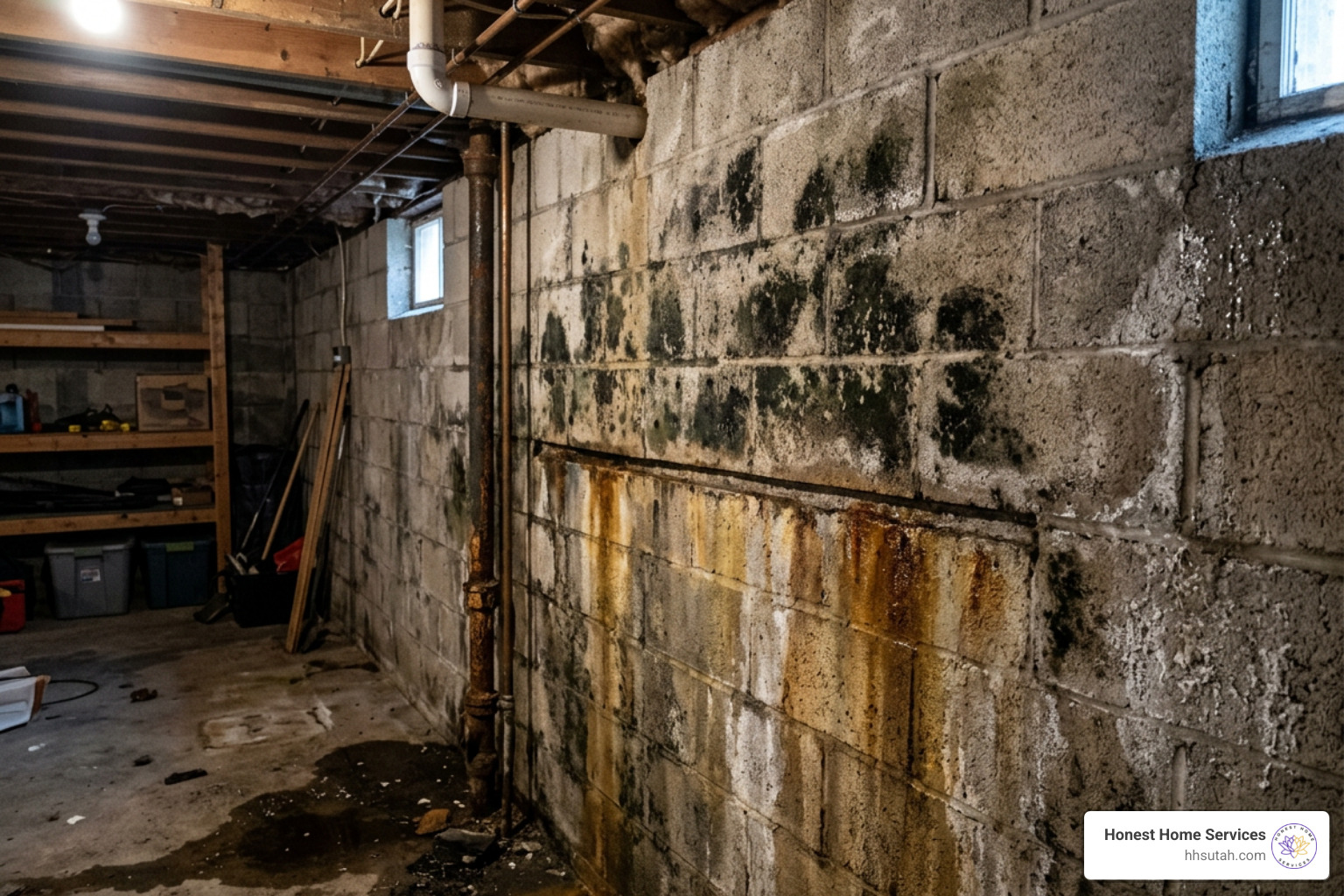
The damage caused by a concealed leak goes far beyond a high water bill. In our experience serving Salt Lake City and the surrounding areas, we see several major issues arise when leaks go undetected:
- Structural Integrity and Foundation Erosion: Constant moisture can weaken the wooden framing of your home or, even worse, wash away the soil beneath your foundation. This leads to “slab leaks,” which can cause your house to settle unevenly and crack.
- Health Hazards: Damp, dark spaces behind walls are the perfect breeding ground for mold and mildew. This can happen in as little as 24 to 48 hours, impacting the air quality for your family.
- Electrical Dangers: Water and electricity are a terrifying mix. A concealed leak near an outlet or inside a ceiling can lead to short circuits or even fire hazards.
- Water Waste: Statistics from the Environmental Protection Agency show that subsurface water loss is a global challenge. A single pinhole leak can waste hundreds of gallons a day.
If you suspect a problem, you can perform a simple DIY check before calling in the pros. Check your water meter, ensure all faucets are off, and wait about 20 minutes. If the meter is still spinning, you have a leak. For more details on this, check out our guide on spotting the drip: a guide to water leak detection.
Choosing the Right Concealed Water Pipe Leak Detector
Not all detectors are created equal. Choosing the right one depends on whether you are scanning your backyard, your kitchen wall, or a commercial warehouse.
| Feature | Acoustic Detectors | Ultrasonic Flow Monitors | Smart WiFi Alarms |
|---|---|---|---|
| Primary Use | Pinpointing exact leak spots | Monitoring usage/efficiency | Localized flood alerts |
| Environment | Indoor/Outdoor/Underground | Main lines/Exposed pipes | Under sinks/Near heaters |
| Accuracy | High (within inches) | Moderate (detects flow) | Low (detects surface water) |
| Price Range | $650 – $4,500 | $800 – $1,500 | $50 – $150 |
| Pipe Material | Best on Metal/Copper | Works on all materials | N/A |
Key Features of a Concealed Water Pipe Leak Detector
When you’re shopping for a concealed water pipe leak detector, look for these technical “must-haves”:
- Frequency Range: A good professional unit should cover 1-10000Hz. This allows the user to filter out background noise (like traffic) and focus on the specific “hiss” of escaping water.
- Piezoelectric Sensors: These are high-sensitivity sensors that convert mechanical vibrations (sound) into electrical signals.
- Battery Life: Look for at least 10 hours of operation. You don’t want the device dying while you’re halfway through a complex scan.
- Noise Filtering: Essential for outdoor use. Advanced models use AI algorithms to distinguish between a leak and a nearby pump or car engine.
Advanced Features of a Concealed Water Pipe Leak Detector
For those needing professional-grade precision, advanced models offer:
- Automatic Mapping: Some devices, like the PQWT series, can automatically generate a visual map of the leak area on a digital display.
- Dual-Mode Detection: This allows for “General Detection” to find the general area and “Locating Mode” to find the exact spot.
- Depth Capacity: While many indoor tools only reach 50cm (about 20 inches), heavy-duty locators like the RD510 can find leaks up to 16ft deep depending on the soil.
- Specialized Sensors: Square sensors are typically designed for flat surfaces like walls, while triangular sensors are better for uneven ground or yards.
Professional Technologies: Acoustic, Ultrasonic, and Thermal Methods
How do these “magic” boxes actually see through walls? They use three primary scientific methods.
- Acoustic Detection: This is the most common method. When water escapes a pressurized pipe, it creates friction against the pipe wall and the surrounding soil. This creates a vibration. Tools like the LD-15 Professional’s Water Leak Survey Instrument use aviation-grade headphones and high-sensitivity microphones to “hear” these vibrations.
- Ultrasonic Flow Measurement: Devices like the NOWi Pipe Monitor clamp onto the outside of a pipe. They use ultrasonic waves to measure the speed of the water flowing inside. If the flow never stops—even at 3:00 AM—the system knows there is a leak.
- Thermal Imaging: Sometimes, we use thermal imaging cameras to see “heat signatures.” A hot water line leaking behind drywall will show up as a bright plume of heat, allowing us to see the leak without touching the wall.
If you’re in the Salt Lake City area and need help with these high-tech methods, our Salt Lake City leak detection services are available to pinpoint the problem quickly.
Step-by-Step: How to Locate a Leak Using Professional Tools
If you’ve invested in a professional concealed water pipe leak detector, here is the general process our technicians follow to ensure accuracy.
- Step 1: Pipeline Mapping: You can’t find a leak if you don’t know where the pipe is. We use pipe locators to trace the path of the line behind the wall or underground.
- Step 2: Sensor Placement: We place the sensor (ground microphone) at intervals along the path of the pipe.
- Step 3: Signal Comparison: This is the “golden rule” of leak detection. You never judge a leak based on one spot. You compare the sound at Point A, Point B, and Point C. The leak is located where the sound is loudest and the frequency is most consistent.
- Step 4: Frequency Filtering: If there is background noise, we use band-pass filters to cut out low-frequency rumbles (like wind) and high-frequency chirps, leaving only the sound of the leak.
- Step 5: Pinpointing the “Hot Spot”: Once the loudest point is found, we mark it. This ensures that when we perform the effective pipe leak repair in Salt Lake City, the hole we make is as small as possible.
Operating Your Concealed Water Pipe Leak Detector
To get the best results from your device:
- Connect the Host: Ensure the control unit is fully charged.
- Headphone Setup: Use high-quality, noise-canceling headphones to protect your hearing and improve clarity.
- Sensor Calibration: Adjust the “gain” or volume. If it’s too high, you’ll get feedback; too low, and you’ll miss the leak.
- Matrix Sampling: For large areas, use a grid pattern. Collect data at each point and compare the synchronized results.
Frequently Asked Questions about Leak Detection
How accurate are acoustic leak detectors?
They are incredibly precise. In the hands of a trained professional, an acoustic concealed water pipe leak detector like the LD-15 can pinpoint a leak within a few inches. However, accuracy can be affected by “environmental interference” like heavy rain, thick concrete, or very deep pipes.
Can these devices find leaks in plastic pipes?
Plastic (PVC or PEX) pipes are much harder to “hear” than metal pipes because plastic doesn’t transmit sound vibrations as well. To solve this, pros often use a “pulsed water transmitter.” This device sends a physical pulse through the water column, creating a “thump” that an acoustic detector can follow even in non-metallic pipes.
What is the average cost of a professional leak detector?
Pricing varies wildly based on the technology:
- Entry-level/DIY: Basic acoustic kits can be found for around $650.
- Mid-range: Tools like the Leakpen (great for plumbers) start at $850.
- Professional Kits: Full survey instruments like the LD-15 or the PQWT multi-sensor systems can cost between $2,500 and $4,400. While the price is high, the “Return on Investment” (ROI) is huge when you consider it prevents you from digging up an entire driveway just to find one small hole.
Conclusion
Finding a leak shouldn’t feel like a guessing game. Whether you are a DIY enthusiast looking for a basic concealed water pipe leak detector or a homeowner in Northern Utah facing a mysterious wet spot in the hallway, technology is on your side.
At Honest Home Services, we believe in using the best tools for the job to keep your costs down and your home dry. We provide honest, reliable, and affordable plumbing services to Salt Lake City, Davis County, and throughout the Wasatch Front. From Bountiful to Draper, our expert technicians are ready with 24/7 emergency support and a guarantee of customer satisfaction.
Don’t let a hidden leak undermine your home’s foundation. If you suspect a problem, contact us for professional Salt Lake City leak detection and let us find the “wall whispers” before they become a flood.