

When Your Pressure Relief Valve Leaks: What It Means and What to Do
Pressure relief valve leaks are one of the most urgent warning signs your water heater or boiler can send you. That small drip or puddle on the floor is not just a minor annoyance — it is your safety system telling you something is wrong.
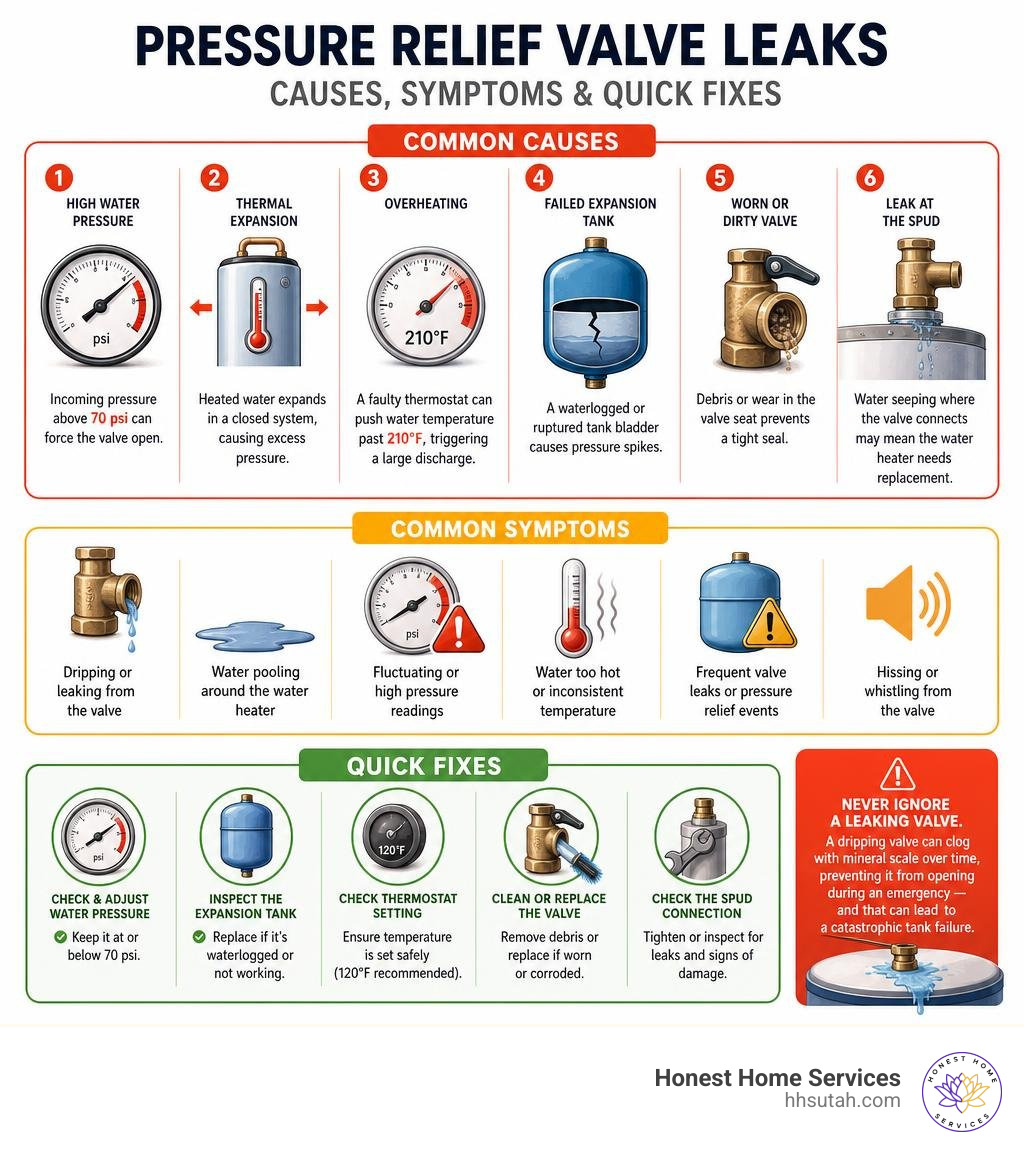
Here are the most common reasons a pressure relief valve leaks:
- High water pressure — incoming supply pressure above 70 psi can force the valve open
- Thermal expansion — water expands when heated; in a closed plumbing system, that pressure has nowhere to go
- Overheating — a faulty thermostat can push water temperature past 210°F, triggering a large discharge
- Failed expansion tank — a waterlogged or ruptured tank bladder causes pressure spikes
- Worn or dirty valve — debris in the valve seat or age-related wear prevents a tight seal
- Leak at the spud — water seeping where the valve connects to the tank may mean the water heater itself needs replacement
Never ignore a leaking pressure relief valve. A dripping valve can clog with mineral scale over time, preventing it from opening during a real emergency — and that can lead to a catastrophic tank failure.
At Honest Home Services, we have spent over 20 years diagnosing and repairing pressure relief valve leaks across Northern Utah, from simple valve replacements to system-wide pressure problems. If you are seeing water near your water heater or boiler, keep reading — we will walk you through exactly what is happening and what to do about it.
Symptoms and Dangers of Pressure Relief Valve Leaks
When a temperature and pressure (T&P) relief valve starts acting up, the signs can range from a barely noticeable dampness to a full-blown indoor water park. Recognizing these symptoms early can save you from costly water damage and dangerous system failures.
Common Symptoms of a Leaking Valve
- Intermittent Weeping or Dripping: You might notice a small puddle that appears and disappears, particularly after your household has used a lot of hot water (like after a round of morning showers).
- Constant Water Flow: A steady stream of water exiting the discharge tube indicates the valve is either stuck open, dealing with extreme pressure, or has completely failed.
- Thread Leaks: Water seeping from the threaded connection where the valve screws into the water heater tank.
- Spud Seepage: Water leaking directly from the welded collar (spud) on the water heater tank.
If you are trying to track down where the moisture is coming from, our guide on Stop the Drip A Guide to Fixing Your Leaky Water Heater can help you pinpoint the exact source.
The Real Dangers of Ignoring the Drip
It is tempting to throw a towel under a slow drip and forget about it. However, ignoring a leaking valve is incredibly risky.
As water continuously drips through the valve, it deposits dissolved minerals like calcium and magnesium—which are highly prevalent in our Northern Utah water supply. Over time, this mineral scale builds up and can completely glue the valve shut.
If the valve becomes clogged and cannot open, your water heater loses its only defense against over-pressurization. In extreme cases, this can lead to a BLEVE (Boiling Liquid Expanding Vapor Explosion). This is a highly destructive physical explosion that can literally launch a water heater through multiple floors of a home.
For more detailed technical safety warnings regarding clogged valves and scale accumulation, you can review the Relief Valve Leak Diagnosis & Repair FAQs.
Why Your Water Heater T&P Valve is Leaking
To understand why your T&P valve is leaking, we first have to look at what it is designed to do. The valve acts as a mechanical bodyguard for your water heater. If the pressure inside the tank exceeds 150 psi, or if the water temperature climbs past 210°F, the valve is calibrated to open and release water safely down the discharge tube.
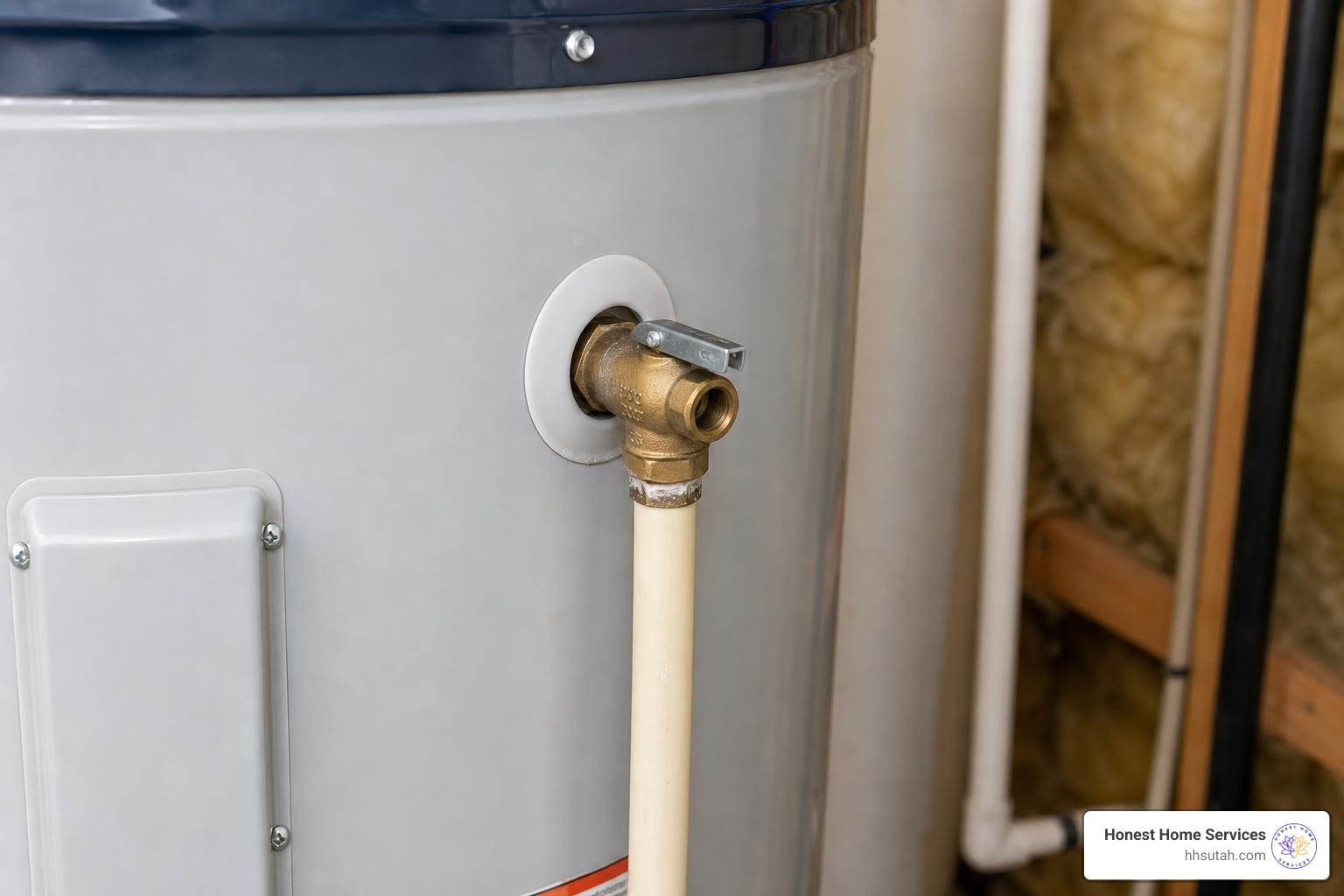
However, if the valve is opening when it shouldn’t, or dripping constantly, it is usually due to one of three systemic issues:
1. High Municipal Water Pressure
Standard residential plumbing systems are designed to operate safely between 40 and 60 psi. Anything over 70 or 80 psi is considered excessively high. We have seen homes in Salt Lake County with incoming street pressures spiking up to 110 psi! High incoming pressure pushes the water heater’s internal pressure right up to the valve’s cracking limit, causing it to weep.
2. Thermal Expansion in a Closed System
Water expands when it is heated. In the past, this expanding water could push back out into the municipal water main—this was an “open” plumbing system.
Today, modern building codes require backflow preventers or pressure reducing valves (PRVs) to protect the public water supply. This turns your home into a “closed” system. When your water heater runs a cycle, the expanding water has nowhere to go. The pressure spikes, and the T&P valve is forced to drip to relieve the strain.
This issue is often exacerbated during seasonal shifts. For instance, increased hot water demands during certain times of the year lead to more frequent heating cycles, resulting in intermittent puddles. You can read more about this in this article on Why Your Water Heater Relief Valve Leaks in Summer.
For a deeper dive into how electric systems specifically handle these pressure spikes, check out The Weeping Valve Troubleshooting Your Electric Water Heaters Pressure Relief Leak.
Diagnosing Pressure Relief Valve Leaks: High Pressure vs. High Temperature
To fix the leak, we must first diagnose whether the valve is reacting to high pressure or high temperature. They require completely different solutions.
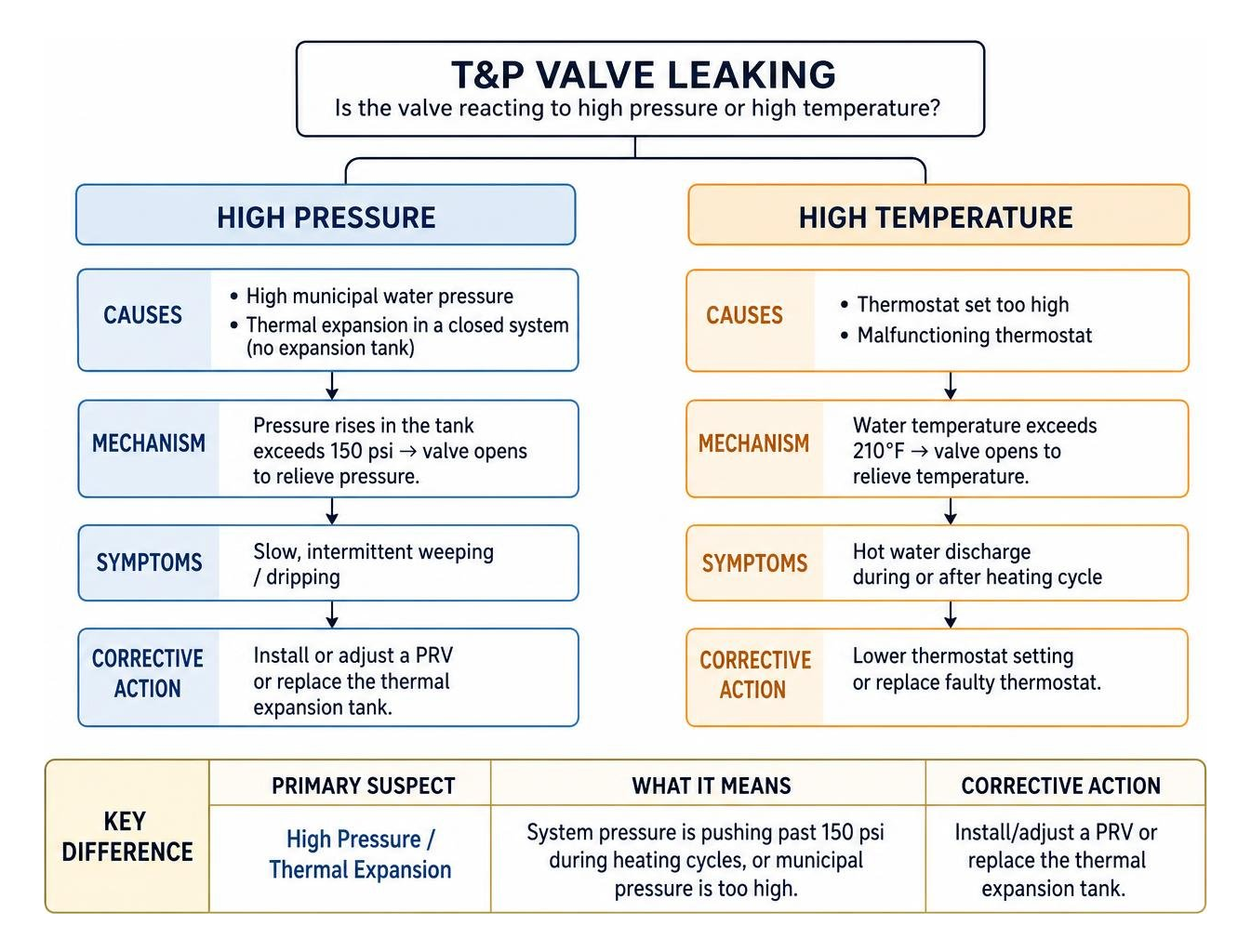
Here is a quick breakdown to help you differentiate between the two:
| Symptom | Primary Suspect | What It Means | Corrective Action |
|---|---|---|---|
| Slow, intermittent weeping / dripping | High Pressure / Thermal Expansion | The system pressure is pushing past 150 psi during heating cycles, or municipal pressure is too high. | Install/adjust a PRV or replace the thermal expansion tank. |
| Sudden, massive dumping of scalding water | High Temperature / Thermostat Failure | The water temperature has exceeded 210°F because the heating elements or burners won’t shut off. | Shut down power/gas immediately and replace the thermostat. |
| Constant, non-stop dripping | Debris or Mechanical Failure | Mineral scale or debris is trapped in the valve seat, or the internal spring has worn out. | Flush the valve seat or replace the T&P valve entirely. |
If your gas control valve or thermostat has failed, the system can quickly become dangerous. Read our troubleshooting guide on Why Your Gas Water Heater Is Leaking and How to Stop the Flood to learn how to manage gas-specific heater issues safely.
Testing Your Thermal Expansion Tank
If your plumbing system is closed, you should have a thermal expansion tank installed on your cold water supply line. This small tank is divided in two by a rubber bladder: one side is filled with pressurized air, and the other side accepts the expanding hot water.
When this tank fails, your T&P valve will start leaking. Here is how you can test your expansion tank like a pro:
- The Tap Test: Gently tap the metal shell of the expansion tank with a wrench or screwdriver. The top half (connected to the plumbing) should sound solid and dull because it contains water. The bottom half should sound hollow because it is filled with air. If the entire tank sounds dull and heavy, it is waterlogged and has failed.
- The Schrader Valve Test: Locate the small air valve (like a bicycle tire valve) on the bottom or side of the tank. Remove the plastic cap and briefly depress the center pin.
- If air hisses out, the bladder is likely still intact (though you should check the pressure with a gauge to ensure it matches your home’s static water pressure).
- If water squirts out, the internal rubber bladder has ruptured. The tank is useless and must be replaced immediately.
For more information on how a failed expansion tank can disrupt your entire plumbing system, take a look at our article on the Common Water Heater Problem.
Boiler Pressure Relief Valve Leaks: Causes and Troubleshooting
While water heater T&P valves are rated for 150 psi and 210°F, residential hydronic boilers operate under much lower limits. A standard boiler pressure relief valve is designed to open at just 30 psi.
Normal operating pressure for a residential hydronic boiler is 12 to 18 psi for a standard two-story house. If your home is larger or taller, it might require 20 to 25 psi.
If your boiler’s pressure gauge is reading over 30 psi (often creeping up to 35 or 40 psi), the relief valve will open and discharge water onto your floor. This is known as “pressure creep.”
Primary Causes of Boiler Pressure Creep:
- Waterlogged Expansion Tank: Just like water heaters, boilers rely on expansion tanks. If the bladder ruptures, the heating water has nowhere to expand, sending the pressure gauge skyrocketing.
- Faulty Automatic Fill Valve (Pressure Reducing Valve): This valve is supposed to feed domestic water into the boiler to maintain a baseline of 12–15 psi. If it gets stuck open or fails, it will continuously dump high-pressure domestic water (60+ psi) into your low-pressure boiler system.
- Internal Leak in an Indirect Water Heater: If you have an indirect water heater connected to your boiler, domestic water passes through a heat exchanger coil inside the boiler water. If a pinhole leak develops in this coil, high-pressure domestic water will leak into the boiler system, causing persistent pressure creep.
If your boiler or hydronic system is acting up, you can find helpful advice on restoring system balance in our guide Fixing the Flow What to Do When Your Hot Water Heater Needs Repair.
Immediate Actions and How to Safely Test the Valve
If you walk into your basement or utility closet and find your pressure relief valve actively leaking, do not panic. Follow these immediate safety steps:
- Keep Your Distance: If the valve is discharging a large volume of hot water, stay away. The water is scalding hot and can cause severe burns.
- Shut Down the Heat Source:
- For electric water heaters, turn off the dedicated breaker in your main electrical panel.
- For gas water heaters, turn the gas control dial to the “OFF” or “PILOT” position.
- For boilers, shut off the main power switch.
- Shut Off the Water Supply: If water is gushing continuously, close the cold water shutoff valve located above the water heater.
- Call a Professional: If you cannot safely isolate the system, call us immediately for emergency assistance.
We discuss how to handle these stressful situations step-by-step in our survival guide on Handling Emergency Water Heater Repairs.
How to Safely Test Your T&P Valve Manually
Industry standards suggest testing your T&P valve at least once a year to ensure the internal mechanism moves freely.
Warning: If your valve is older than five years and has never been tested, lifting the lever can actually cause it to start leaking permanently. This happens because old sediment gets trapped in the valve seat when it snaps shut. Only perform this test if you are prepared to replace the valve if it fails to reseal.
To test the valve safely:
- Ensure a proper metal or CPVC discharge tube is installed and directed toward a floor drain or bucket.
- Gently lift the manual metal lever on top of the valve. Water should flow out of the discharge tube.
- Release the lever. The valve should snap shut cleanly, and the water flow should stop completely within a few seconds.
When to Replace the Valve vs. Fixing the System
Plumbing industry guidelines recommend replacing your water heater’s T&P valve at least once every five years as a preventive maintenance measure. However, you need to know when a simple valve swap is enough, and when you are dealing with a larger systemic issue.
When to simply replace or reseal the valve:
- The valve is old or failed the manual test: If your system pressure is perfectly normal but the valve won’t stop dripping, the internal spring or seal has simply worn out.
- Thread leaks: If water is seeping from the threaded connection, you can unscrew the valve, clean the threads on the tank, apply fresh Teflon tape and pipe joint compound, and thread it back in.
- Standard maintenance cycle: If it has been five years since your last replacement.
When you must address an underlying system problem:
- The new valve continues to leak: If you replace the valve and the new one immediately starts dripping, your system pressure or temperature is too high. Replacing the valve again will not solve the problem.
- Spud leaks: If you see water seeping from the welded spud where the valve connects to the tank, this cannot be repaired. Because the spud is welded directly to the tank during manufacturing, a leak here indicates the tank’s inner lining has failed, and the entire water heater must be replaced.
For a complete breakdown of how to tackle these repairs yourself or when to hand the wrench over to an expert, read Fix Broken Water Heater Issues Like a Pro.
Frequently Asked Questions
What causes sudden pressure relief valve leaks on a water heater?
A sudden leak is usually caused by a rapid spike in either pressure or temperature. This can happen if your home’s pressure reducing valve (PRV) suddenly fails, allowing high municipal water pressure to flood your plumbing system. Alternatively, a failed thermostat can cause the heating elements to run continuously, rapidly heating the water past 210°F and forcing the valve to open to prevent an explosion.
To keep your system running smoothly and prevent these sudden spikes, make sure to follow The Essential Gas Water Heater Maintenance Checklist.
Can I plug a leaking pressure relief valve?
Absolutely not! Plugging, capping, or blocking a leaking pressure relief valve is one of the most dangerous things you can do in your home. The valve is leaking because it is trying to relieve dangerous pressure or temperature. If you plug the outlet, that pressure will continue to build inside the tank until the steel ruptures, resulting in a catastrophic explosion. If your valve is leaking, leave the discharge pipe completely open and call a licensed plumber to resolve the root cause.
For more safety tips and solutions to common water heater failures, check out our guide on The Top 7 Gas Water Heater Problems and How to Solve Them.
How often should a pressure relief valve be replaced?
It is standard industry practice to replace pressure relief valves at least once every five years as a preventive maintenance measure. Even if the valve is not actively leaking, the internal spring can weaken over time, or mineral scale can build up and prevent the valve from operating during an emergency. Replacing this inexpensive safety device regularly is cheap insurance against catastrophic tank failure.
If you are curious about local pricing for water heater maintenance and valve replacements in Northern Utah, take a look at our breakdown of Hot Water Heater Salt Lake City Costs Repairs and Recommendations.
Conclusion
A leaking pressure relief valve is a clear sign that your water heater or boiler needs attention. Whether the issue is a simple worn-out valve, high municipal water pressure, or a failed thermal expansion tank, ignoring the drip can lead to expensive water damage or dangerous system failures.
At Honest Home Services, we provide honest, reliable, and affordable plumbing, heating, and AC services to homeowners across Northern Utah. Our team of local, expert technicians is proud to serve:
- Salt Lake City & Salt Lake County
- Davis County (including Clearfield, Layton, Kaysville, Farmington, and Bountiful)
- West Valley, Murray, West Jordan, South Jordan, Bluffdale, Herriman, and Draper
- Park City, Tooele, Lehi, and Saratoga Springs
We back our work with a guarantee of customer satisfaction and fair, transparent pricing. Don’t let a small drip turn into a major emergency. Contact us today to schedule your expert diagnostic and repair service at Salt Lake City Water Heater Repair.