

What to Know About Hot Water Heaters in Salt Lake City
If you’re dealing with a hot water heater Salt Lake City problem — whether it’s cold showers, strange noises, or a leaking tank — here’s a quick overview of your options:
Quick answers for Salt Lake City homeowners:
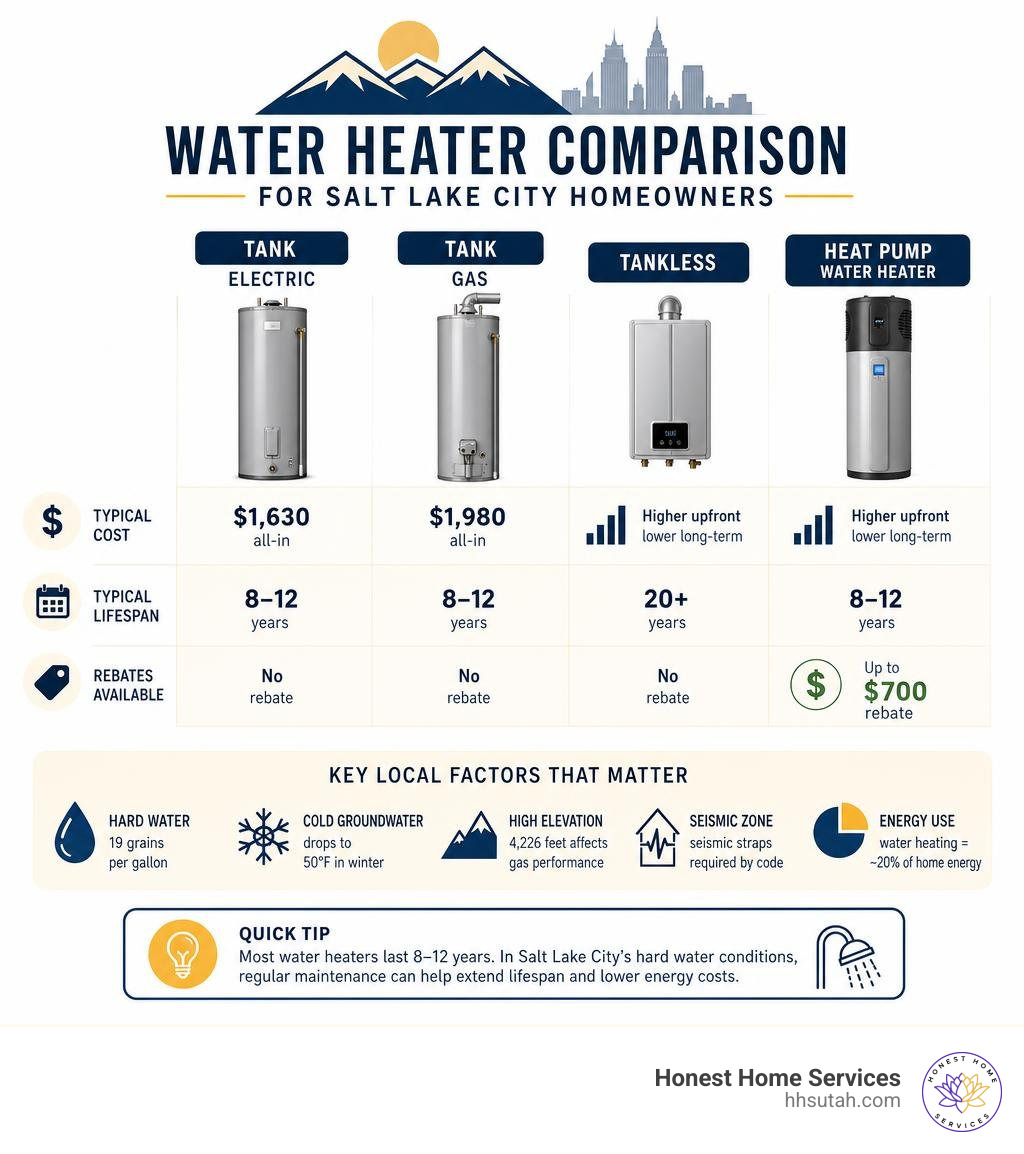
| What You Need | Typical Cost Range | Key Local Factor |
|---|---|---|
| Water heater repair | $38 diagnostic + parts/labor | Hard water accelerates wear |
| Tank replacement (40 gal electric) | ~$1,630 all-in | Seismic straps required by code |
| Tank replacement (50 gal gas) | ~$1,980 all-in | Altitude calibration needed |
| Tankless installation | Higher upfront, lower long-term | 20+ year lifespan |
| Heat pump water heater | Higher upfront | Up to $700 rebate from Rocky Mountain Power |
Salt Lake City homeowners face a specific set of challenges that most generic guides don’t cover — hard water at 19 grains per gallon, winter groundwater that drops to 50°F, an elevation of 4,226 feet that affects gas appliance performance, and mandatory seismic strapping requirements due to the Wasatch Fault. On top of that, water heating accounts for roughly 20% of your home’s energy use, so the unit you choose and how well you maintain it has a real impact on your monthly bills.
Most water heaters last 8 to 12 years — less in Salt Lake City’s hard water conditions — so whether you’re facing an emergency or planning ahead, understanding your options can save you hundreds of dollars.
At Honest Home Services, we’ve spent over 20 years helping Utah homeowners and businesses with hot water heater Salt Lake City repairs, replacements, and installations — and we’re committed to transparent pricing and work that’s done right the first time. Read on for a practical breakdown of everything you need to make a confident decision.
Important hot water heater Salt Lake City terms:
Local Challenges Affecting Your Hot Water Heater Salt Lake City
Living along the Wasatch Front comes with beautiful mountain views, but it also presents a unique set of geographical and environmental conditions that can wreak havoc on your plumbing appliances. If you’ve lived in Salt Lake City, Bountiful, or Sandy for any stretch of time, you already know that our utility appliances have to work a little harder than they do in other parts of the country.
Understanding these local factors is crucial when diagnosing issues or selecting a new unit. Many common system failures are directly tied to these local conditions, which we detail in our guide on The Top 7 Gas Water Heater Problems and How to Solve Them.
- Cold Winter Groundwater: During our freezing Utah winters, the groundwater entering your home can drop to a chilly 50°F. This means your system has to raise the water temperature by roughly 70°F just to reach a standard comfortable shower temperature (120°F). This extreme temperature difference puts massive thermal stress on tank metals.
- High Altitude Performance: At an elevation of 4,226 feet (and even higher in places like Park City), the air is thinner. Gas burners require precise oxygen-to-fuel calibration to ignite cleanly and vent carbon monoxide safely. Standard out-of-the-box gas systems must be adjusted for altitude during installation to prevent yellow-burning flames and soot buildup.
- Wasatch Fault Zone Risks: Salt Lake City and surrounding areas like Draper, Sandy, and Murray sit directly on or near the Wasatch Fault. This geographical reality means earthquake safety is not just a recommendation; it is heavily regulated by local building codes to prevent gas lines from snapping and water tanks from tipping over.
The Impact of Utah’s Hard Water
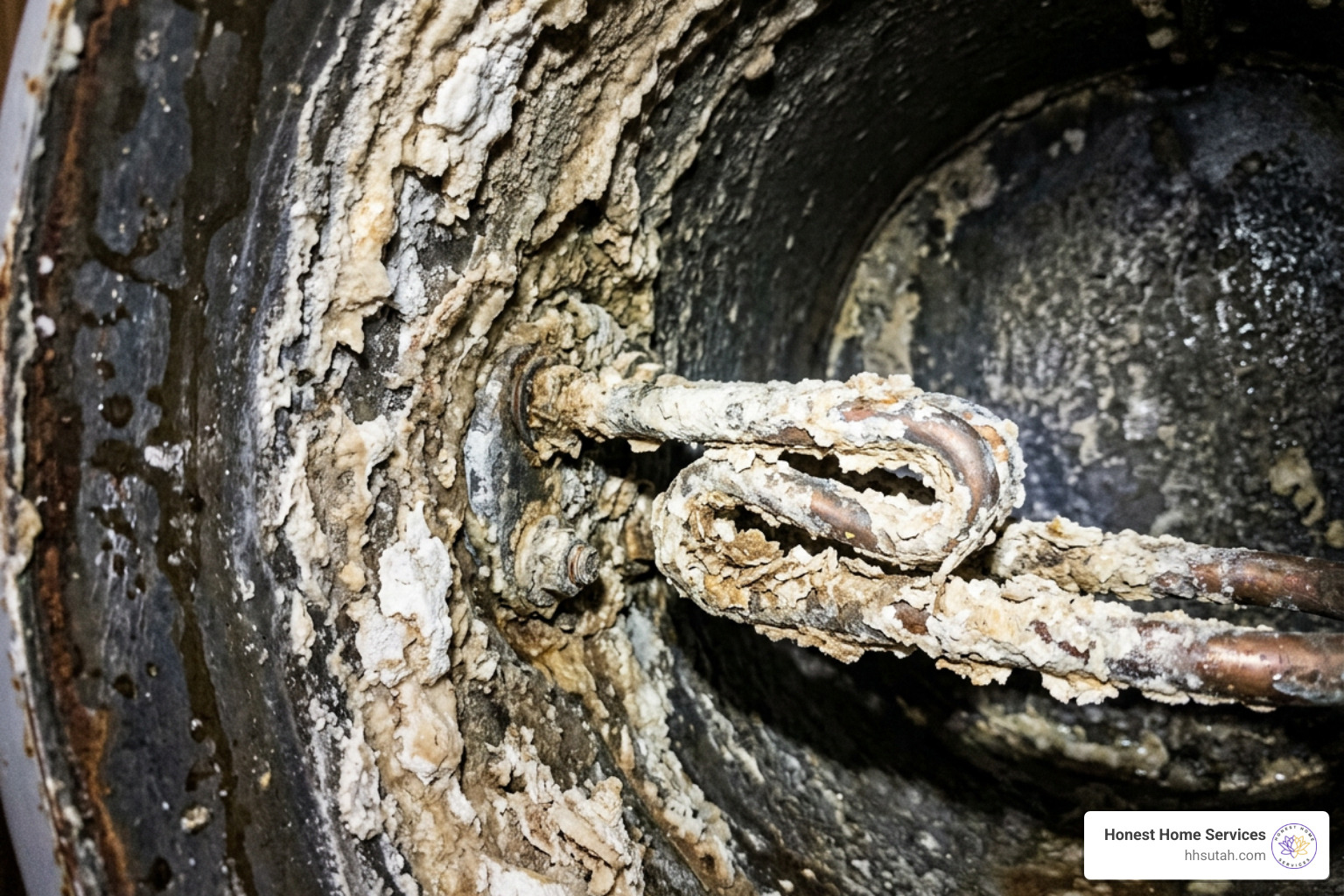
Perhaps the single greatest threat to your hot water system in Northern Utah is the hard water. Salt Lake City’s municipal water measures around 19 grains per gallon (gph) of water hardness. This means our water is heavily saturated with dissolved minerals, primarily calcium and magnesium.
When water is heated, these dissolved minerals solidify and settle to the bottom of your tank, forming a thick layer of rock-like mineral scale. This mineral scale acts as an insulating blanket between the burner or heating elements and the water itself.
- Shortened Lifespan: Because of the scale barrier, your system has to run much hotter and longer to heat the same amount of water. This constant overheating fatigues the steel tank, eventually causing the protective glass lining to crack and the tank itself to rust out.
- Higher Energy Bills: A mere 1/4-inch of scale buildup can reduce your water heating efficiency by up to 40%. Since water heating accounts for roughly 20% of your home’s energy use, hard water is directly driving up your monthly utility bills.
- The Solution: To combat this, we highly recommend scheduling an annual tank flush. Flushing the system removes the loose sediment before it can bake into rock-hard scale. If you want to tackle this yourself or understand the process better, take a look at our step-by-step instructions in Don’t Get Left in the Cold: How to Service Your Gas Water Heater.
Seismic Strapping and Local Building Codes
In Salt Lake County and Davis County, municipal building inspectors do not play around when it comes to safety standards. Because of our seismic activity risks, Utah state building codes mandate double seismic strapping on all storage tank water heaters.
- What is Seismic Strapping? This involves securing your heavy, water-filled tank to the structural wall studs of your home using heavy-duty metal straps. One strap must be positioned within the upper third of the tank, and the second strap must secure the lower third. This prevents the tank from tipping over during an earthquake, which could rupture gas lines or electrical connections and cause devastating fires or floods.
- Expansion Tanks: Modern local codes also require the installation of a thermal expansion tank. Because water expands when heated, and modern plumbing systems use backflow preventers (creating a “closed system”), this small expansion tank absorbs the excess pressure, protecting your main tank from bursting.
- Permitting Requirements: Whether you are doing a standard replacement in Farmington or Layton, local municipalities require a plumbing permit and a post-installation safety inspection. Working with a licensed professional ensures your installation meets all local safety codes. Our team at Honest Home Services provides reliable, code-compliant installations throughout Davis County and surrounding communities, ensuring your system is safe and fully up to code.
Water Heater Repair vs. Replacement Decisions
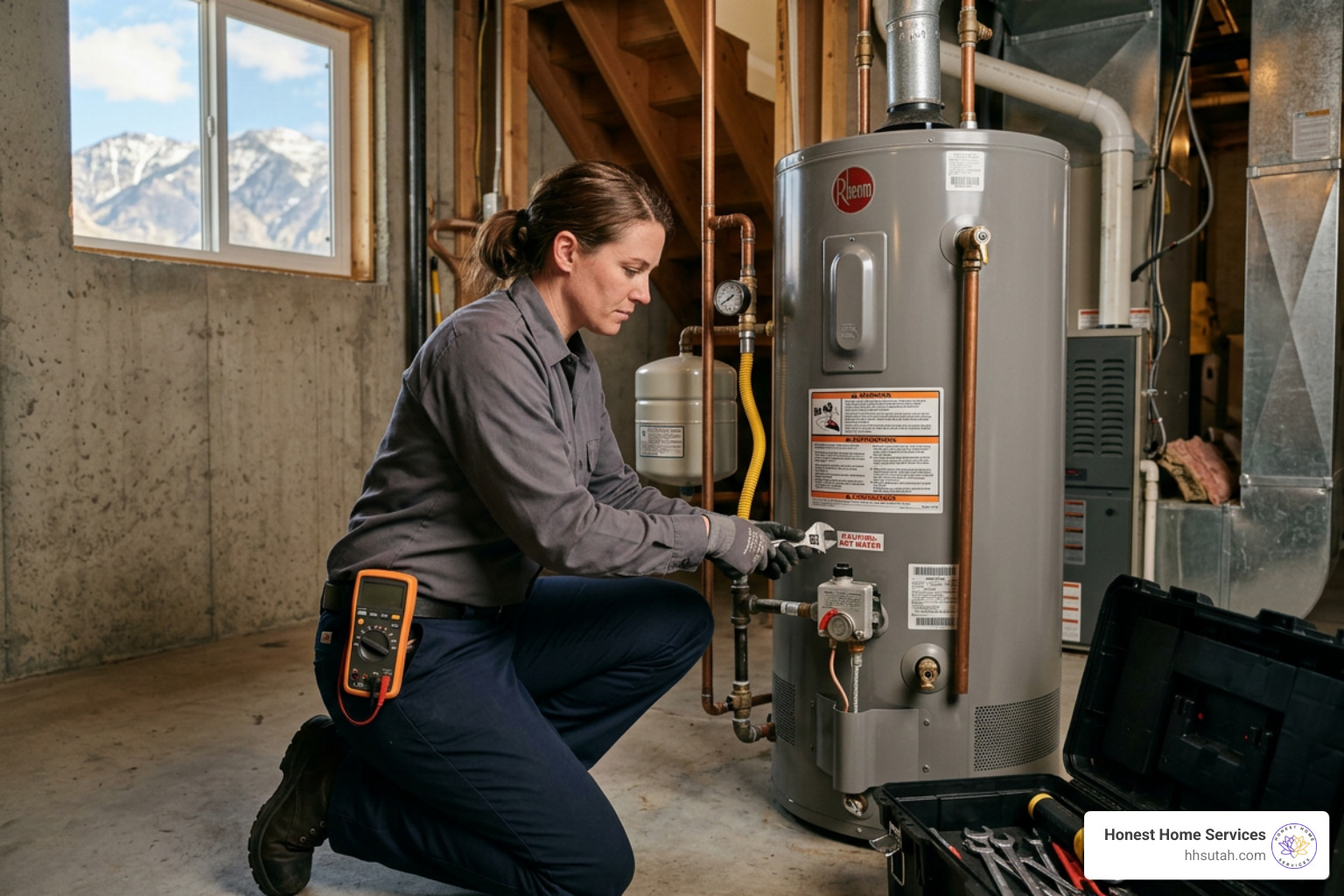
When your shower suddenly turns icy, the immediate question is: Can I fix this, or do I need to buy a whole new unit?
Making the wrong choice can be incredibly costly. Spending $400 to repair a 10-year-old system that rusts out and floods your basement two months later is a nightmare scenario. Conversely, replacing an entire unit when all you needed was a $150 thermocouple replacement is a waste of hard-earned money.
To help you navigate this decision, we’ve outlined the major financial and mechanical factors to consider, which we expand upon in our detailed guide on How Much Will Your Broken Water Heater Cost to Fix?.
- The 50% Rule: If the cost of the repair exceeds 50% of the cost of a brand-new system (including installation), replacement is almost always the smarter financial move.
- Age of the Unit: Standard storage tanks have a reliable lifespan of 8 to 12 years in Salt Lake City. If your system is over 10 years old and requires a major repair (like a new gas control valve or electric heating elements), you are likely better off investing that money into a new, energy-efficient model.
- The Location of the Leak: This is the ultimate deciding factor. If your system is actively leaking from the main steel tank body, it cannot be repaired. The tank has corroded through, and your only option is immediate replacement. However, if the leak is coming from a loose connection pipe, a faulty temperature and pressure (T&P) relief valve, or a drain valve, these can be easily and affordably repaired. For a deeper dive into diagnosing active leaks, read our troubleshooting guide on Why Your Gas Water Heater is Leaking and How to Stop the Flood.
Signs You Need a New Hot Water Heater Salt Lake City
Your system will rarely fail without giving you a few warning signs first. Paying attention to these subtle clues can help you schedule a replacement on your own terms, rather than dealing with an emergency flood situation.
- Rusty or Discolored Water: If your hot water runs red, brown, or rusty, but your cold water runs crystal clear, it is a sign that the sacrificial anode rod has failed and the interior steel tank is actively corroding. Once the tank begins to rust, structural failure is not far behind. Learn more about this transition in From Cold Showers to Comfort: Understanding Hot Water Heater Repair & Replacement.
- Rumbling, Popping, or Clanging Noises: As we mentioned, hard water sediment bakes onto the bottom of the tank. When water gets trapped beneath this hardened layer of scale, it boils and steam pockets escape, creating loud, unsettling popping or rumbling sounds. This means your tank is overheating and working under extreme stress.
- Frequent Repairs: If you have had to call a plumber three times in the last year to fix the pilot light, replace elements, or swap out thermostats, your system is telling you it’s ready to retire.
Professional Hot Water Heater Salt Lake City Services
When your system completely gives up, you shouldn’t have to wait days for a resolution. Cold showers in the middle of a Utah winter are more than just uncomfortable; they can quickly become a safety hazard for families with young children or elderly relatives.
- 24/7 Emergency Support: Water heater emergencies don’t wait for convenient business hours. A ruptured tank can dump 50 gallons of water into your basement in minutes, causing thousands of dollars in property damage. That is why we provide reliable, around-the-clock emergency support across Salt Lake, Davis, and Summit counties. For immediate assistance with sudden failures, read our advice on Handling Emergency Water Heater Repairs and check out our specialized Emergency Water Heater Repair: Fast, Reliable 24/7 Service options.
- Fast Diagnosis & Transparent Options: Our certified local technicians will arrive promptly, evaluate the system, and provide you with clear, upfront options. We never push for a replacement if a reliable, long-lasting repair is possible. We believe in providing The Best Local Hot Water Repair Services with complete honesty and zero high-pressure sales tactics.
Comparing Water Heater Types and Costs
If its time to replace your system, you are no longer limited to the exact same style of tank that was installed when your home was built. Todays market offers incredibly efficient options that can slash your energy bills while providing endless hot water.
However, each system has distinct advantages and upfront cost profiles. To understand the overall financial picture, check out our resource on Don’t Get Burned: Understanding Gas Water Heater Service Costs or read about finding a Hot Water Cool Price: Discovering Affordable Water Heater Service.
For a fast, professional installation quote across the Salt Lake Valley, you can reach out to our team for a transparent, upfront estimate tailored to your home’s specific needs.
Here is a quick comparison of the three primary residential water heater types:
| Feature | Traditional Storage Tank | Tankless (On-Demand) | Hybrid Heat Pump |
|---|---|---|---|
| Upfront Cost | Low ($1,600 $2,800) | Moderate to High ($3,500 $6,000) | High ($3,000 $5,000) |
| Energy Efficiency | Standard | High (Up to 34% more efficient) | Extremely High (2-3x more efficient) |
| Average Lifespan | 8 to 12 Years | 20+ Years (with maintenance) | 10 to 15 Years |
| Space Required | High (Requires dedicated floor space) | Extremely Low (Wall-mounted) | High (Requires 450-700 cubic feet) |
| Utah Rebates | Minimal (Up to $350 for gas) | Variable (Federal Tax Credits) | High (Up to $700 + Tax Credits) |
Traditional Storage Tank Systems
These are the classic metal cylinders most of us have in our utility closets or basements. They work by constantly keeping 40 to 80 gallons of water heated to your set temperature, 24 hours a day, so it is ready when you turn on a tap.
- Gas vs. Electric: Gas models are highly popular along the Wasatch Front because natural gas is historically more affordable than electricity in Utah. They also heat water twice as fast as electric models. Electric models, however, have lower upfront installation costs, do not require combustion venting, and are highly reliable.
- Sizing Guidelines: Getting the right size is critical. A tank that is too small means running out of hot water mid-shower, while a tank that is too large means wasting money heating water you never use. Generally, a 40-gallon tank is ideal for 1 to 3 people, while a 50-gallon tank is recommended for households of 3 to 5.
- Professional Sizing: When we install a tank, we calculate your home’s “First Hour Rating” (FHR) to ensure the system can handle your households peak demand (such as running the dishwasher and taking a shower simultaneously). If you are in Farmington or nearby areas, our team is ready to assist with professional sizing and same-day replacement options.
Energy-Efficient Tankless Systems
Tankless water heaters completely eliminate the storage tank. Instead, when you turn on a hot water tap, cold water flows through a highly efficient heat exchanger that heats the water instantly using a powerful gas burner or electric elements.
- Endless Hot Water: Because they heat water on demand, you will never “run out” of hot water. You can run back-to-back showers for a large family without a single drop of cold water.
- Space-Saving Design: Tankless units are about the size of a carry-on suitcase and are mounted directly to the wall, freeing up valuable floor space in tight basements or utility closets.
- Long Lifespan: Because they do not hold water constantly, they are far less prone to rust and corrosion. A well-maintained tankless system can easily last 20 years or longer.
- Conversion Considerations: Converting from a traditional tank to a tankless system requires professional retrofitting. This involves upgrading your gas line to handle the higher BTU demand and installing specialized PVC venting through an exterior wall. For expert tankless installations in Salt Lake, our certified technicians can guide you through the entire conversion process, ensuring a seamless transition to endless hot water.
Hybrid Heat Pump Water Heaters
Hybrid heat pump water heaters are the absolute gold standard when it comes to energy efficiency. Instead of directly generating heat using electrical resistance elements, they act like a refrigerator in reverse-pulling heat from the surrounding air and transferring it into the water tank.
- Unmatched Efficiency: According to the U.S. Department of Energy, heat pump water heaters are 2 to 3 times more efficient than standard electric models. Over a five-year period, a hybrid heat pump can save a typical Utah family thousands of dollars in utility bills.
- Space and Climate Needs: Because they extract heat from the surrounding air, they require a decent amount of open space to operate efficiently-usually at least 450 to 700 cubic feet of unconditioned space (like a basement or garage). They also produce a low hum, similar to a refrigerator, and blow out cool exhaust air.
- Incentives and Rebates: Because these systems are incredibly eco-friendly, they qualify for massive incentives. In Utah, Rocky Mountain Power offers rebates of up to $700 for upgrading to a hybrid heat pump, and you may also qualify for substantial federal tax credits under the Energy Efficient Home Improvement Credit. To learn more about how these modern systems work, check out our comprehensive guide: Everything You Need to Know About New Water Heaters.
Frequently Asked Questions About Salt Lake City Water Heaters
Why is my water heater making a loud popping noise?
This is the classic “popcorn” sound of sediment buildup, which is incredibly common in Salt Lake City due to our hard water (19 grains per gallon).
Over time, calcium and mineral scale settle at the bottom of the tank, trapping a layer of water beneath it. When the burner ignites, this trapped water boils, turns to steam, and violently escapes through the hardened sediment crust, creating a loud popping, crackling, or rumbling noise.
This noise is a warning sign that your system is overheating, wasting energy, and suffering thermal stress. To resolve this and prevent tank failure, your system needs a professional flush to clear out the accumulated sediment. For a complete guide on diagnosing and resolving these noises, see Fixing the Flow: What to Do When Your Hot Water Heater Needs Repair.
What rebates are available for water heaters in Utah?
Utah homeowners have access to several excellent rebate programs that can dramatically lower the cost of upgrading to an energy-efficient system:
- Dominion Energy Rebates: If you install a qualifying Energy Star-certified natural gas storage tank, you can receive a rebate of up to $350.
- Rocky Mountain Power Rebates: If you transition to a highly efficient electric hybrid heat pump water heater, you can receive a rebate of up to $700.
- Federal Tax Credits: Under the Inflation Reduction Act, homeowners can claim a federal tax credit of 30% of the total cost (up to $2,000) for installing a qualifying heat pump water heater.
Our team at Honest Home Services will gladly help you navigate these applications and ensure you select qualifying equipment to maximize your savings.
How long do water heaters typically last in Salt Lake City?
While the national average lifespan for a standard storage tank water heater is 8 to 12 years, the lifespan along the Wasatch Front is often on the shorter end of that range due to our exceptionally hard water. Without regular maintenance, a tank in Salt Lake City can fail in as little as 6 to 8 years.
However, with proper preventative maintenance—specifically, flushing the tank annually and replacing the sacrificial anode rod every 3 to 5 years—you can easily extend the life of a traditional tank to 12 or 15 years. Tankless systems, which do not store water and are less prone to rust, regularly last 20 years or longer when properly descaled.
Conclusion
Your home’s water heater is a quiet workhorse, running 24/7 to provide comfort and cleanliness for your family. When it starts to fail, you deserve a local partner who will provide honest answers, transparent pricing, and expert craftsmanship without any high-pressure sales tactics.
At Honest Home Services, we are proud to serve the entire Northern Utah region, including Salt Lake City, Sandy, Draper, Bountiful, Layton, and Park City. Our team of licensed, local technicians understands the unique challenges of Utah’s hard water, high altitudes, and seismic codes. Whether you need a quick emergency repair, an annual sediment flush, or a complete transition to an energy-efficient tankless or hybrid heat pump system, we are here to help.
Don’t wait for a cold shower or a flooded basement to take action. Contact us today to schedule an inspection or to get a clear, upfront quote on a new system. For more information on our services, visit our dedicated Salt Lake City Water Heater Repair page and let us restore comfort to your home today.