

Why Your Electric Water Heater’s Safety Valve is Dripping
Electric water heater pressure relief valve leaking is a common issue that signals either normal thermal expansion or a serious safety problem. Here’s what you need to know immediately:
Quick Diagnosis Guide:
- Occasional drips during heating = Likely thermal expansion (may need expansion tank)
- Continuous flow = Faulty valve, excessive pressure, or overheating
- No drips when lever lifted = Valve is stuck and needs immediate replacement
- Water pooling at base = Check if leak originates from valve discharge pipe
Common causes:
- High water pressure (over 80 psi)
- Missing or failed expansion tank in closed system
- Sediment buildup causing overheating
- Faulty thermostat or heating element
- Worn or corroded valve
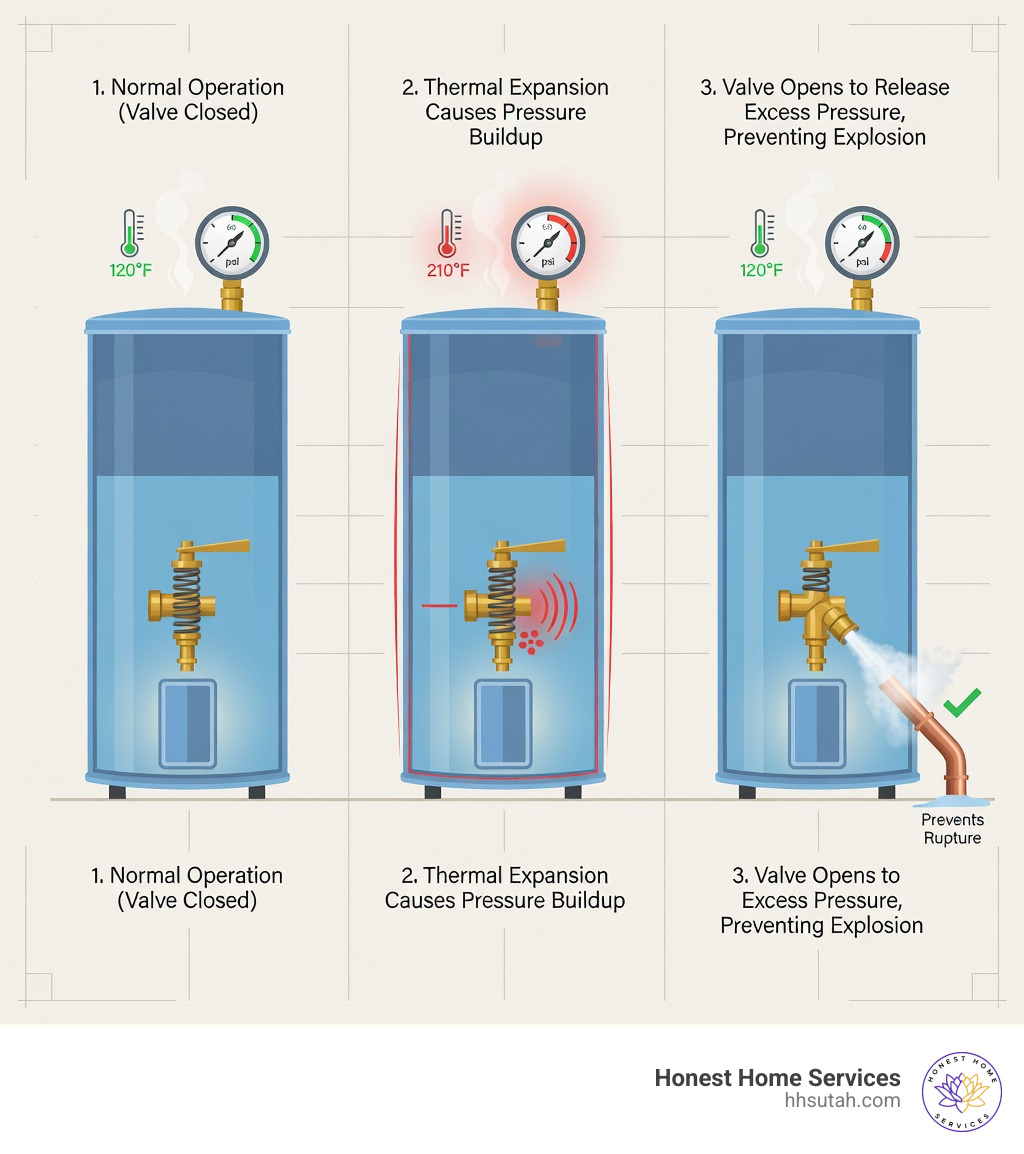
The peace and quiet of your home can be shattered when you discover water pooling around your water heater. That small valve on the side of your tank—the temperature and pressure relief (T&P) valve—exists to prevent catastrophic tank explosions by releasing water when pressure exceeds 150 psi or temperature exceeds 210°F. When it leaks, it’s either doing its job protecting you from dangerous conditions, or the valve itself has failed.
At Honest Home Services, we’ve diagnosed and repaired electric water heater pressure relief valve leaking issues for over 20 years across Northern Utah, helping homeowners distinguish between normal safety releases and urgent system failures. Our licensed technicians understand the unique challenges of hard water areas and closed plumbing systems common in Utah homes.
Quick look at electric water heater pressure relief valve leaking:
Understanding the T&P Valve and Why It Leaks
Think of the Temperature and Pressure (T&P) relief valve as the ultimate “safety fuse” for your water heater. Without it, a malfunctioning electric water heater could theoretically turn into a pressurized rocket, launching through your roof—a scenario we’ve seen in safety demonstrations that we definitely don’t want to see in your Salt Lake City basement!
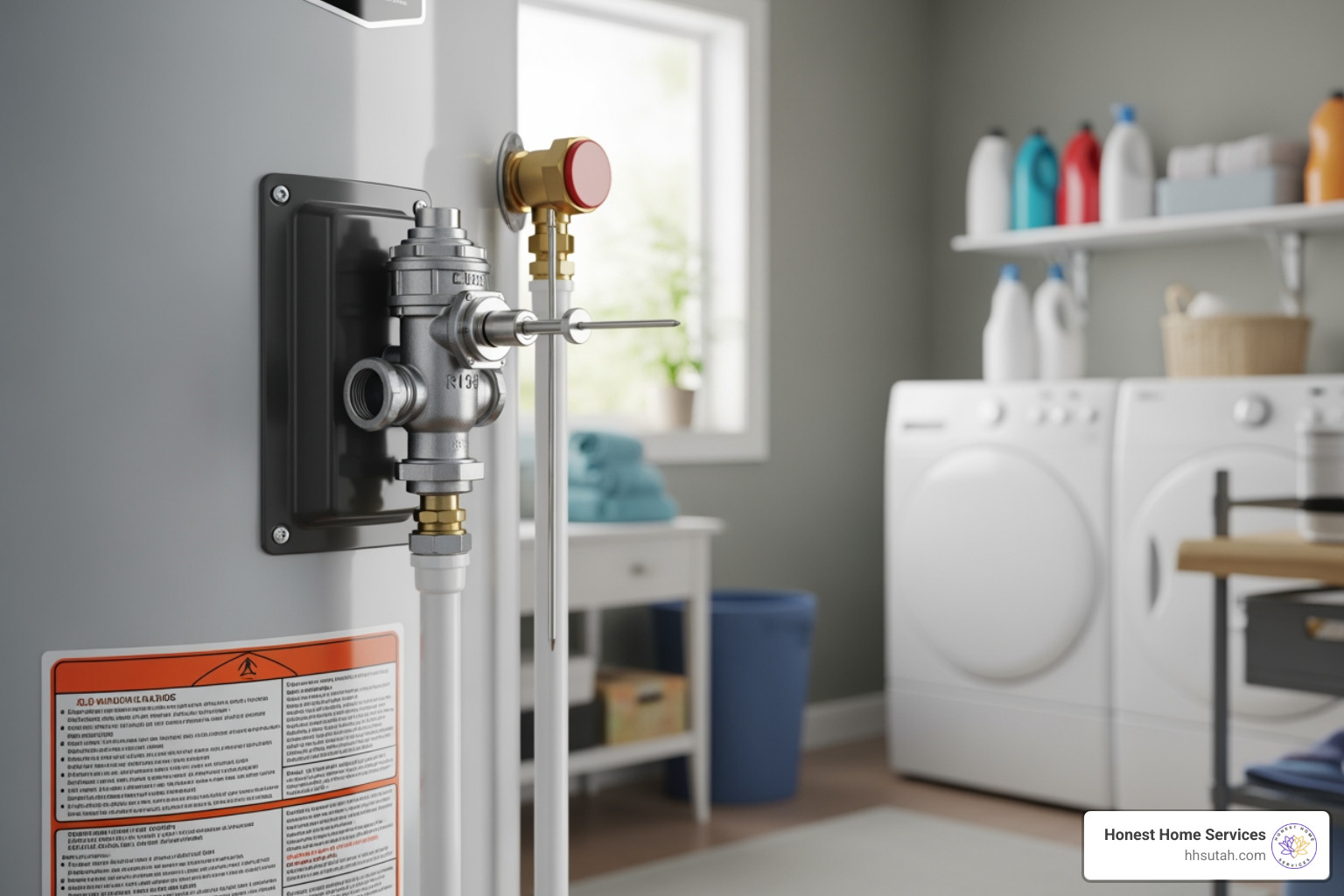
The T&P valve is typically located on the top or high on the side of the tank. It features a metal probe that extends about six inches into the hottest water at the top of the tank. This probe is calibrated to respond to two specific danger zones:
- Pressure: When internal tank pressure hits 150 psi.
- Temperature: When the water temperature reaches 210°F.
When either of these limits is breached, a spring-loaded mechanism inside the valve lifts, allowing water to escape through the discharge pipe. This discharge pipe should always point toward the floor or into a drain pan to prevent scalding water from spraying anyone nearby. If you see an electric water heater pressure relief valve leaking, it means the spring is either being pushed open by those forces or the seal has simply worn out.
How the Valve Protects Your Home
The primary job of the T&P valve is explosion prevention. In an electric water heater, if the thermostat fails and the heating elements stay “on,” the water will eventually boil. Since water expands as it heats and has nowhere to go in a sealed tank, the pressure would eventually exceed the tank’s structural integrity. The T&P valve provides that “exit strategy” for the pressure.
While it is a safety device, it is not meant to be a source of drinking water. In fact, if you are looking for Emergency Drinking Water Guidelines, you’ll find that while water heater tanks can be a source of water during a disaster, you should access it via the drain valve at the bottom, not the T&P valve.
Common Causes of an Electric Water Heater Pressure Relief Valve Leaking
When we arrive at a home in Layton or Kaysville to look at a “weeping” valve, we usually find one of four culprits. Identifying which one it is helps us determine if we’re fixing the valve or fixing the whole plumbing system.
| Symptom | Likely Cause | Fix |
|---|---|---|
| Drips only when the heater is running | Thermal Expansion | Install/Replace Expansion Tank |
| Constant, steady drip | High Home Water Pressure | Adjust/Install Pressure Reducing Valve |
| Intermittent gush of hot water | Faulty Thermostat/Overheating | Replace Thermostat or Element |
| Small, crusty drip with visible buildup | Sediment or Worn Valve | Flush Tank and Replace Valve |
High Water Pressure and Thermal Expansion
This is the most common “non-broken” reason for an electric water heater pressure relief valve leaking.
1. High Main Pressure: Many municipal water systems in Utah provide water at very high pressure (sometimes over 100 psi). If your home doesn’t have a working Pressure Reducing Valve (PRV), that high pressure is constantly pushing against the T&P valve’s spring. Over time, it will start to “weep.”
2. Thermal Expansion in a Closed System: In the old days, when water heated up and expanded, it could just push back into the city water main. Today, most homes have “closed systems” due to check valves or pressure regulators. When the water expands as it heats, it has nowhere to go, so the pressure spikes. If you don’t have a thermal expansion tank, your T&P valve is the only thing left to handle that extra volume.
For more details on how these systems work, you can read more info about common water heater problems.
Sediment and Internal Component Failure
Hard water is a fact of life in Northern Utah. Over time, minerals like calcium and magnesium settle at the bottom of the tank, forming a thick layer of “scale.”
- Sediment Interference: Pieces of this sediment can actually travel up and get lodged in the T&P valve’s seal if the valve is ever opened (even for a test). Once a tiny grain of sand-like sediment is in there, the valve can never close fully again, leading to a persistent leak.
- Heating Element Overdrive: If your lower heating element is buried in sediment, it has to work much harder to heat the water. This can lead to localized boiling and steam pockets, which create pressure spikes that trigger the valve.
How to Safely Diagnose Your Leaking Valve
Before you start poking around your water heater, safety is paramount. We’re dealing with high voltage (usually 240V) and scalding water.
- Cut the Power: Go to your circuit breaker panel and find the switch for the water heater. Turn it off.
- The Visual Inspection: Look at the discharge pipe. Is it wet? Is there a puddle? If the pipe is bone dry but there is water on the floor, the leak might actually be coming from the top of the tank or a fitting, and gravity is just pulling it down to the valve area.
- The Bucket Test: Place a bucket under the discharge pipe. If the valve is dripping, notice the temperature. If it’s lukewarm, it might just be a worn-out seal. If it’s steaming hot, the heater might be dangerously overheating.
- Pressure Check: You can buy a simple water pressure gauge at a hardware store in West Valley or Murray for about $10. Attach it to a hose bib or your washing machine faucet. If your home’s static pressure is over 80 psi, that’s your problem right there.
If you’re unsure about what you’re seeing, it’s always safer to seek more info about water heater repair services from a pro.
Diagnosing an Electric Water Heater Pressure Relief Valve Leaking
If your pressure is normal (around 50-60 psi) and the water isn’t boiling, the valve itself is likely the failure point. Try “snapping” the valve:
- Quickly lift the silver lever on the T&P valve.
- Let a little water gush out into your bucket.
- Let the lever snap back into place.
Sometimes, this gush of water flushes out any sediment that was preventing a seal. Warning: If the valve is old and corroded, snapping it might make the leak worse or cause it to get stuck wide open. Be ready to shut off the main water valve to the heater if this happens!
Step-by-Step Guide to Replacing a Faulty Relief Valve
If the “snap” didn’t work and your pressure is fine, it’s time for a replacement. This is a task many DIY-savvy homeowners in Draper or Herriman can handle, but it requires precision.
Tools Needed:
- Pipe wrench or large adjustable wrench
- Teflon tape or pipe joint compound
- A bucket
- A replacement T&P valve (must match the BTU/Wattage and PSI/Temp ratings of the old one)
Replacing an Electric Water Heater Pressure Relief Valve Leaking
- Shut Off Utilities: Turn off the power at the breaker and turn off the cold water supply valve at the top of the heater.
- Drain the Tank Partially: You don’t need to drain the whole tank. Attach a garden hose to the drain valve at the bottom and let out about 2-5 gallons. This lowers the water level below the T&P valve so you don’t have a flood when you unscrew it.
- Remove the Discharge Pipe: Use your wrench to unscrew the vertical pipe attached to the valve.
- Unscrew the Old Valve: Use your pipe wrench to turn the valve counter-clockwise. It might be stubborn if it’s been there for a decade!
- Prepare the New Valve: Wrap the threads of the new valve with Teflon tape (wrap clockwise) or apply pipe dope.
- Install: Screw the new valve in by hand, then tighten with the wrench so the opening points downward.
- Reattach Discharge Pipe: Screw the discharge pipe back into the new valve.
- Refill and Test: Turn the water supply back on. Do not turn the power back on until the tank is completely full! Open a hot water faucet elsewhere in the house to bleed out the air. Once water flows steadily, the tank is full. Check the new valve for leaks.
For a deeper dive into ensuring your system is running efficiently, check out more info about fixing the flow.
Preventing Future Leaks with Maintenance and Expansion Tanks
We often tell our customers in South Jordan and Bluffdale that a little prevention goes a long way. You shouldn’t have to replace your T&P valve every year.
- Annual Flushing: Once a year, drain a few gallons from the bottom of your tank to remove sediment. This prevents the “sand” that ruins T&P seals.
- Anode Rod Inspection: The anode rod prevents the tank from rusting. If the anode rod is gone, the tank (and the valve fittings) will start to corrode.
- Expansion Tanks: If you have a “closed system” (which most Utah homes built after 2010 do), a thermal expansion tank is a must. It’s a small blue or white tank that sits above your water heater. It contains a rubber bladder that absorbs the extra pressure of expanding water, so your T&P valve doesn’t have to.
The Importance of Regular Maintenance
Regular maintenance isn’t just about the valve; it’s about the life of the whole unit. An electric water heater in Salt Lake County usually lasts 8-12 years. With regular flushing and anode rod swaps, we’ve seen them last 15 or more.
If you’re not comfortable doing this yourself, you can find more info about servicing your water heater to keep your warranty valid and your home safe.
Frequently Asked Questions about Relief Valve Leaks
Is it normal for the valve to drip occasionally?
“Occasional” is the keyword. If it drips a tiny bit only when the heater is recovering after a long shower, it’s likely thermal expansion. However, in a perfectly designed system with an expansion tank, it shouldn’t drip at all. If it’s a constant “weeping,” it needs attention.
Can a faulty heating element cause a leak?
Yes! If a heating element “shorts out” but continues to draw power, it can heat the water uncontrollably. If the thermostat can’t shut it off, the water will boil, creating steam pressure that forces the T&P valve open. This is a high-priority repair.
When should I call a professional plumber?
You should call us at Honest Home Services if:
- The valve is gushing water rapidly.
- You smell a “sulfur” or “burnt” smell near the electrical panel.
- Your water pressure is over 80 psi and you don’t know how to adjust the regulator.
- The tank itself is leaking from the bottom (this usually means the tank has rusted through).
For help with any of these issues, see more info about who to call for repairs.
Conclusion
An electric water heater pressure relief valve leaking is your water heater’s way of talking to you. It’s either saying, “I’m old and I need a new seal,” or it’s screaming, “Help! The pressure in this house is too high!” Ignoring that “weeping” valve can lead to water damage, high utility bills, or in extreme cases, a dangerous pressure buildup.
Whether you’re in Bountiful, Clearfield, or Park City, Honest Home Services is here to help. We provide reliable, affordable plumbing solutions with a focus on honesty—we won’t sell you a new water heater if a simple $15 valve replacement will do the trick.
If your valve is doing more than just weeping, don’t wait for a flood. Contact our expert technicians for Salt Lake City Water Heater Repair today, and let’s get your home’s “safety fuse” back in working order!