

What to Do When You Have a Gas Hot Water Leaking Problem
If you have a gas hot water leaking issue, here’s what to do right now:
- Turn off the gas – rotate the control knob to “Pilot” or “Off”
- Shut off the cold water inlet – turn the valve clockwise until it stops
- Identify the leak location – top, side, or bottom of the tank
- Drain the tank if water is pooling – attach a garden hose to the drain valve
- Call a licensed plumber if the leak is from the tank itself, or if you smell rotten eggs
Coming home to a puddle under your water heater is a stressful moment. The good news? Not every leak means disaster. Some are simple fixes — a loose fitting, a worn valve — that you can handle yourself in under an hour. Others, especially on older tanks, are a sign that the unit is failing and needs to be replaced before it causes serious water damage to your home.
Either way, acting fast matters. A single drip wastes over 1,600 gallons of water per year (according to the EPA WaterSense program) and costs you money every day it goes unaddressed. A slow tank leak can silently rot your floors, feed mold growth, and — if the gas supply is involved — create a genuine safety hazard.
This guide walks you through exactly how to find the leak, stop it safely, and decide whether a repair or a full replacement is the smarter move.
At Honest Home Services, we’ve been diagnosing and fixing gas hot water leaking problems for homeowners and small businesses across Northern Utah for over 20 years. We know what causes these leaks, what’s actually worth repairing, and when it’s time to cut your losses and upgrade.
Explore more about gas hot water leaking:
Identifying the Source of Your Gas Hot Water Leaking
Before you panic and start shopping for a new unit, we need to play detective. Not all moisture around a water heater is a “leak” in the traditional sense, and where the water is coming from tells us everything about how to fix it.
Start by grabbing a flashlight and some paper towels. Wipe down the tank and the floor so you can see exactly where new moisture appears. Gravity is tricky; water can leak from the top of the tank, run down behind the insulation jacket, and pool at the bottom, making it look like the tank has burst when it’s actually just a loose pipe.
For a deeper dive into these initial steps, check out Stop The Drip A Guide To Fixing Your Leaky Water Heater.

Is Your Gas Hot Water Leaking or Just Condensation?
Believe it or not, your water heater can “sweat.” This is especially common in Northern Utah during our colder months. When the tank fills with icy cold water from the city lines and the gas burner kicks on, the temperature difference can create condensation on the outside of the tank or inside the flue.
High-efficiency gas units are particularly prone to this as they extract more heat from the combustion gases, leaving behind harmless water vapor. To test this, wipe up the puddle and turn the thermostat to “Pilot.” If the area stays dry for several hours while the burner is off, you likely have a condensation issue rather than a structural leak. If the water returns, it’s time for Expert Leak Detection Services | Honest Home Services.
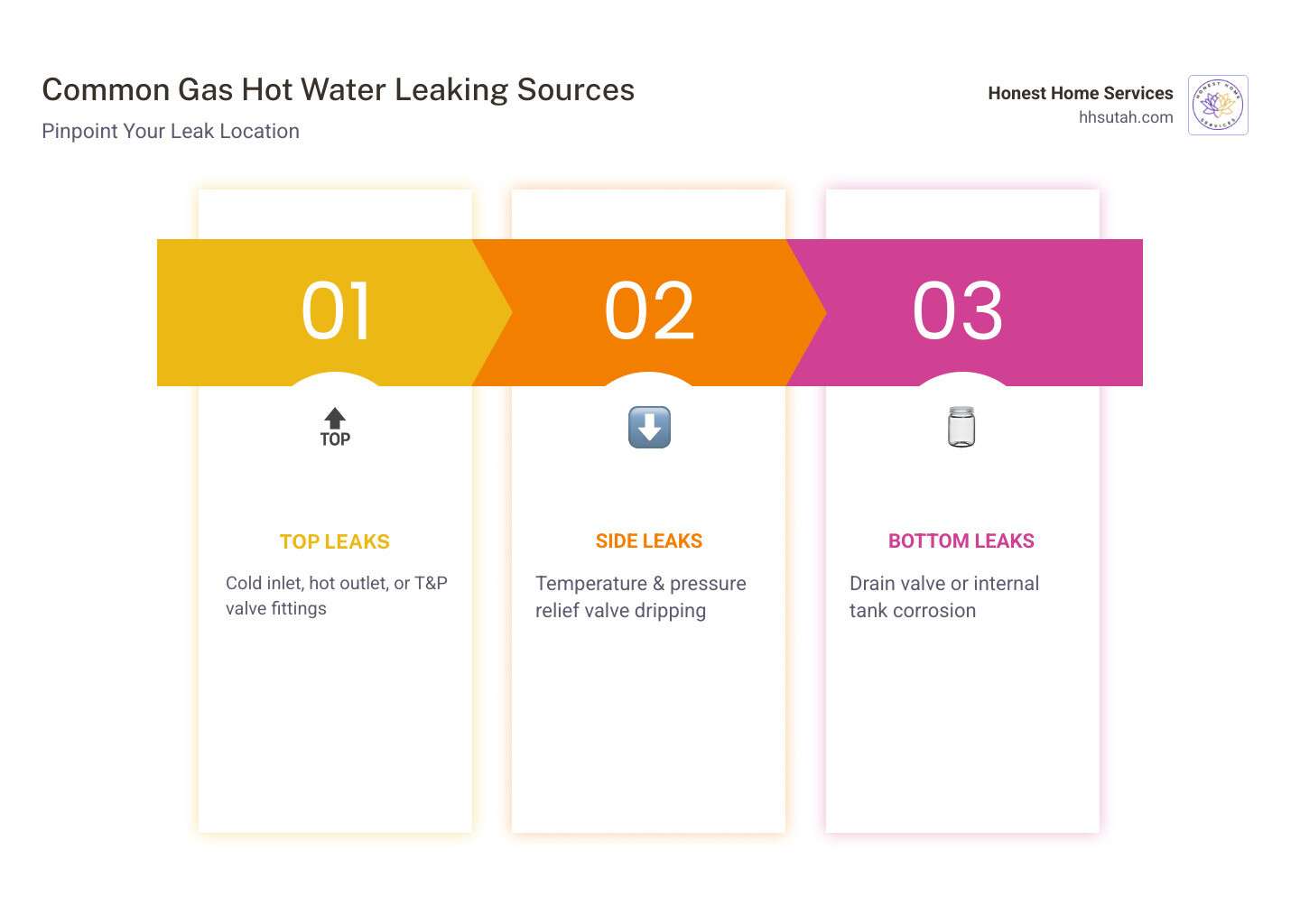
Locating the Leak: Top, Side, or Bottom?
Where the water originates is your best diagnostic tool:
- Top of the Tank: Check the cold water inlet and hot water outlet pipes. These often use flexible connectors that can loosen over time due to thermal expansion.
- Side of the Tank: This is almost always the Temperature and Pressure (T&P) Relief Valve. If you see water dripping from the discharge pipe on the side, the tank is either overheating, over-pressurized, or the valve itself has failed.
- Bottom of the Tank: This could be a faulty drain valve (the plastic or brass tap at the base) or, more seriously, an internal tank crack. If water is seeping from under the tank jacket and you see rust in the water, the inner glass lining has likely failed.
Understanding these locations is a Common Water Heater Problem that helps us determine if we’re looking at a $50 repair or a full replacement.
Emergency Steps: What to Do When Your Water Heater Leaks
If you find a significant amount of water—more than just a damp spot—you need to act quickly to protect your home. Standing water can quickly ruin drywall and flooring in your utility room or garage.

How to Safely Shut Off the Gas and Water
Safety is our priority. Since we are dealing with a gas hot water leaking situation, we have two systems to disable:
- The Gas: Locate the gas control valve on the front of the heater. Turn the knob to the “Pilot” or “Off” position. If the leak is severe or you smell gas, find the shut-off valve on the gas line itself (usually a lever) and turn it so it is perpendicular to the pipe. This stops the burner from firing, which is crucial if you plan to drain the tank.
- The Water: Look for the cold water pipe entering the top of the heater. There should be a handle (either a wheel or a lever). Turn it clockwise or perpendicular to the pipe to stop the flow of new water into the leaking tank.
For more on managing these systems, see Handling Water Heater Repairs Who To Call For The Job.
Draining the Tank to Prevent Flooding
A standard residential water heater holds 40 to 50 gallons of water. If the tank is cracked, that water is going to end up on your floor. To prevent this, attach a garden hose to the drain valve at the bottom of the unit and run the other end to a floor drain or outside.
Open a hot water faucet somewhere in the house (like a kitchen sink) to allow air into the system—this acts as a “vacuum break” and lets the water flow out of the hose. If you don’t do this, the water will struggle to drain, much like holding your thumb over the top of a straw. This is a vital part of Fixing The Flow What To Do When Your Hot Water Heater Needs Repair.
Common Causes and DIY Fixes for a Leaky Tank
Many gas hot water leaking issues don’t require a brand-new heater. If your tank is less than 8 years old, there’s a good chance a simple component has reached the end of its life.
Common Causes of Gas Hot Water Leaking
Why do these units start dripping in the first place?
- T&P Valve Issues: This safety valve is designed to “weep” if the pressure exceeds 150 psi or the temp goes above 210°F. If it’s leaking constantly, it might just be stuck open by mineral deposits.
- Sediment Buildup: In areas like Salt Lake County, hard water minerals settle at the bottom. This sediment creates “hot spots” that stress the metal and can cause the bottom of the tank to leak.
- Thermal Expansion: As water heats, it expands. If your home has a “closed system,” that extra volume has nowhere to go but out of a weakened seal.
Learn more about these issues in The Top 7 Gas Water Heater Problems And How To Solve Them.
Fixing the Drain Valve and Pipe Fittings
If the leak is at the top, try tightening the compression nuts with a pipe wrench. If the threads look corroded, they may need to be unscrewed, cleaned, and resealed with Teflon tape or pipe dope.
If the leak is coming from the drain valve at the bottom, check if it’s a plastic “builder-grade” valve. These are notorious for cracking. Sometimes, a simple garden hose cap screwed onto the end of the valve can stop a drip temporarily. However, the real fix is replacing the valve with a high-quality brass version. For more troubleshooting tips, see Why Your Water Heater Is Giving You The Cold Shoulder.
Repair vs. Replace: Evaluating Your Water Heater’s Lifespan
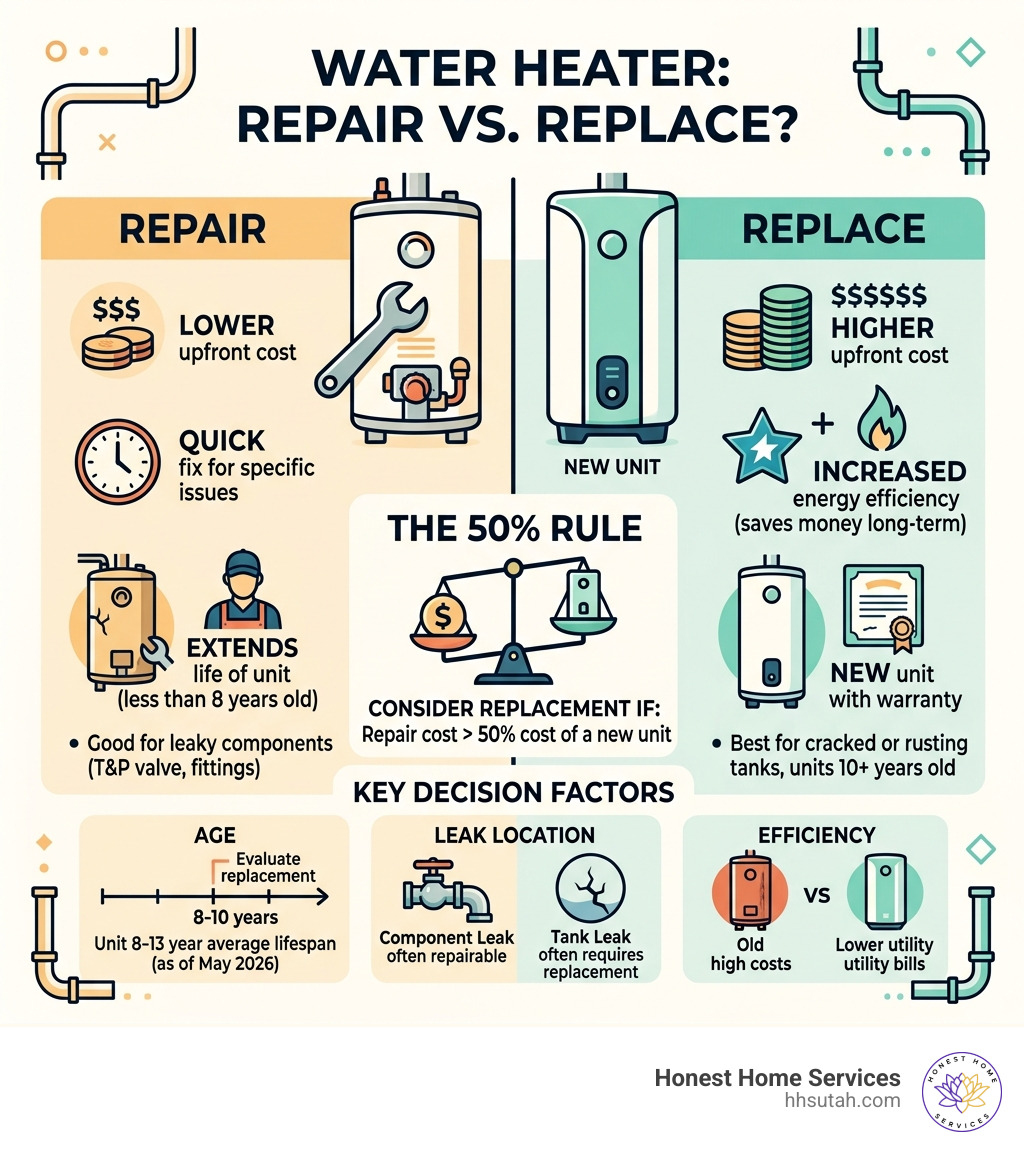
This is the “million-dollar question” for most homeowners in Davis and Salt Lake Counties. Should you spend $300 on a repair or $1,500+ on a new unit?
When a Leaking Tank Means It’s Time for a New Unit
As of May 2026, standard tank water heaters are expected to last between 8 and 13 years. If your unit is over 10 years old, any leak from the tank itself is usually a sign of terminal internal corrosion.
We generally recommend the 50% Rule: If the repair cost is more than half the cost of a new, energy-efficient unit—and the heater is over 8 years old—replacement is the smarter financial move. Modern units are safer, meet updated building codes, and are significantly more efficient, saving you money on your monthly gas bill. For a detailed breakdown of what you might expect to pay, read Dont Get Burned Understanding Gas Water Heater Service Costs.
Preventive Maintenance to Avoid Future Floods
You wouldn’t drive your car for 10 years without an oil change, but most people treat their water heaters that way! A little maintenance goes a long way in preventing a gas hot water leaking disaster.
The Role of the Anode Rod and Sediment
Your water heater has a “secret weapon” called an anode rod. This rod is made of magnesium or aluminum and is designed to be “sacrificial.” This means the water eats the rod instead of the steel tank. These rods usually last 3-5 years. If you replace the rod before it’s gone, you can potentially double the life of your tank.
Additionally, you should flush your tank annually. If you hear “popping” or “knocking” sounds (like popcorn) when the heater is running, that’s air bubbles escaping from under a layer of sediment. Flushing removes these minerals, prevents overheating, and keeps your tank quiet and efficient. Check out our Gas Water Heater Anode Guide for a step-by-step walkthrough.
Frequently Asked Questions about Gas Water Heater Leaks
Is a leaking gas water heater an emergency?
Yes. Beyond the risk of flooding your home, a leaking gas unit can lead to pilot light failure or, in rare cases, gas leaks if the control valve is damaged. If you see a significant puddle, treat it as an emergency. We offer 24/7 support across Northern Utah for exactly this reason.
Can I still use my hot water if the tank is leaking?
We don’t recommend it. If the tank’s structural integrity is compromised, the pressure of a hot shower could cause a small crack to become a major rupture. It’s safer to keep the water off until the unit is inspected.
How much water is wasted by a single drip?
A leak that drips just once per second wastes 8.64 gallons of water per day. That’s over 3,150 gallons a year, which can add roughly $35 to your annual utility bill—not to mention the environmental impact here in our beautiful Utah desert.
Conclusion
A gas hot water leaking problem can be daunting, but now you have the tools to handle it. Whether it’s a simple fix like tightening a fitting or a more involved task like replacing a T&P valve, catching the problem early is the key to preventing property damage.
If you’ve walked through these steps and still have water pooling, or if your tank is reaching that 10-year mark, don’t wait for a flood. Honest Home Services provides expert, affordable water heater solutions throughout Salt Lake City, Layton, Bountiful, and the surrounding areas. We pride ourselves on fair pricing and local expertise.
If you need a hand, we are here for you with 24/7 emergency support. Let us help you get your hot water back on track safely and efficiently.