
Stop Sewer Backflow Before It Floods Your Home
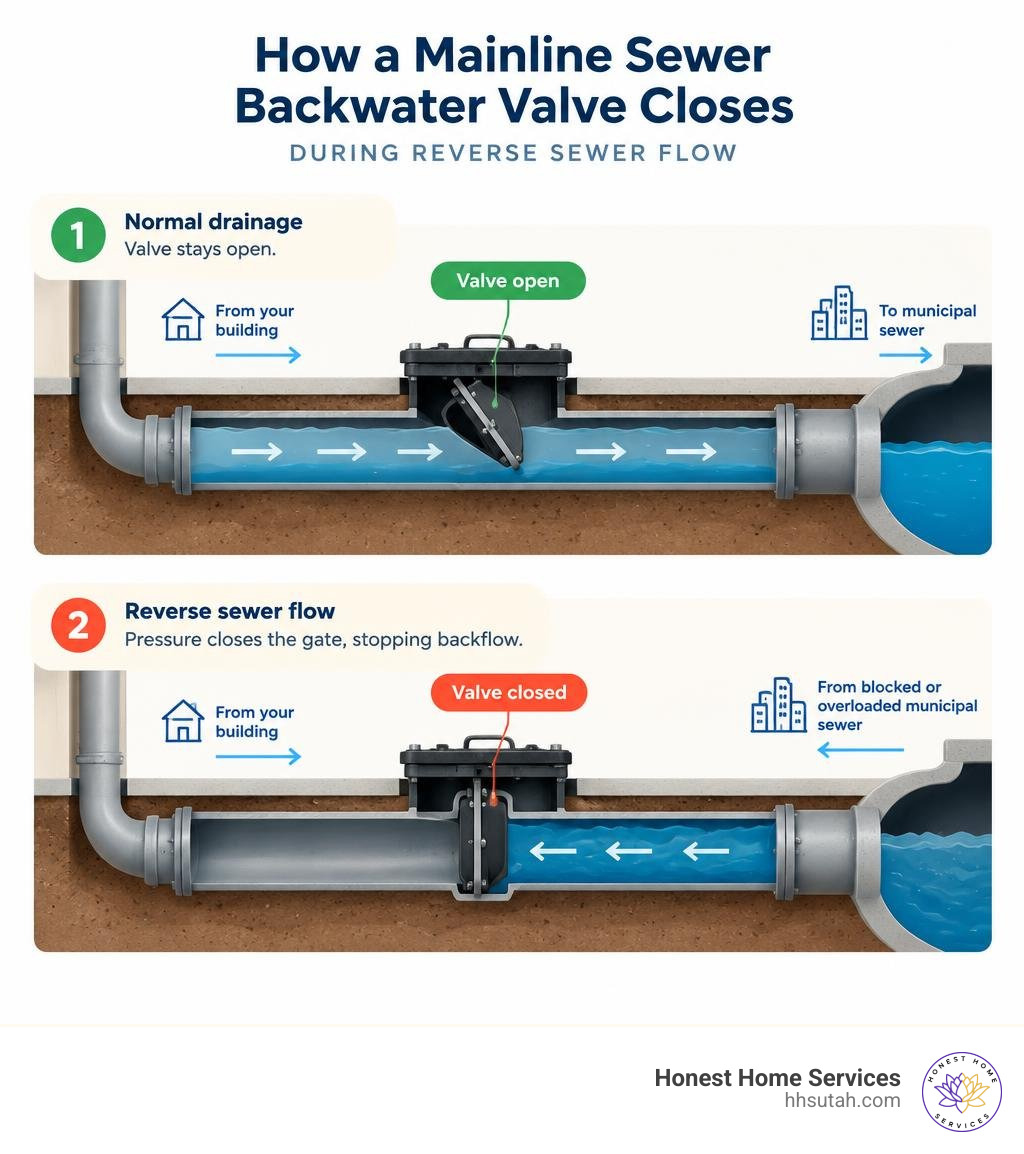
A mainline sewer backwater valve helps stop wastewater from flowing backward through your building sewer and into low fixtures such as basement floor drains, showers, and toilets. It stays open during normal drainage, then closes when pressure reverses from a blocked or overloaded municipal sewer.
If your property has a basement, sits lower than nearby sewer infrastructure, or has had a sewer backup before, the practical next steps are:
- Have the sewer lateral and pipe slope inspected.
- Install the correctly sized, code-approved valve in an accessible location.
- Check the valve regularly and after major storms or suspected main-line problems.
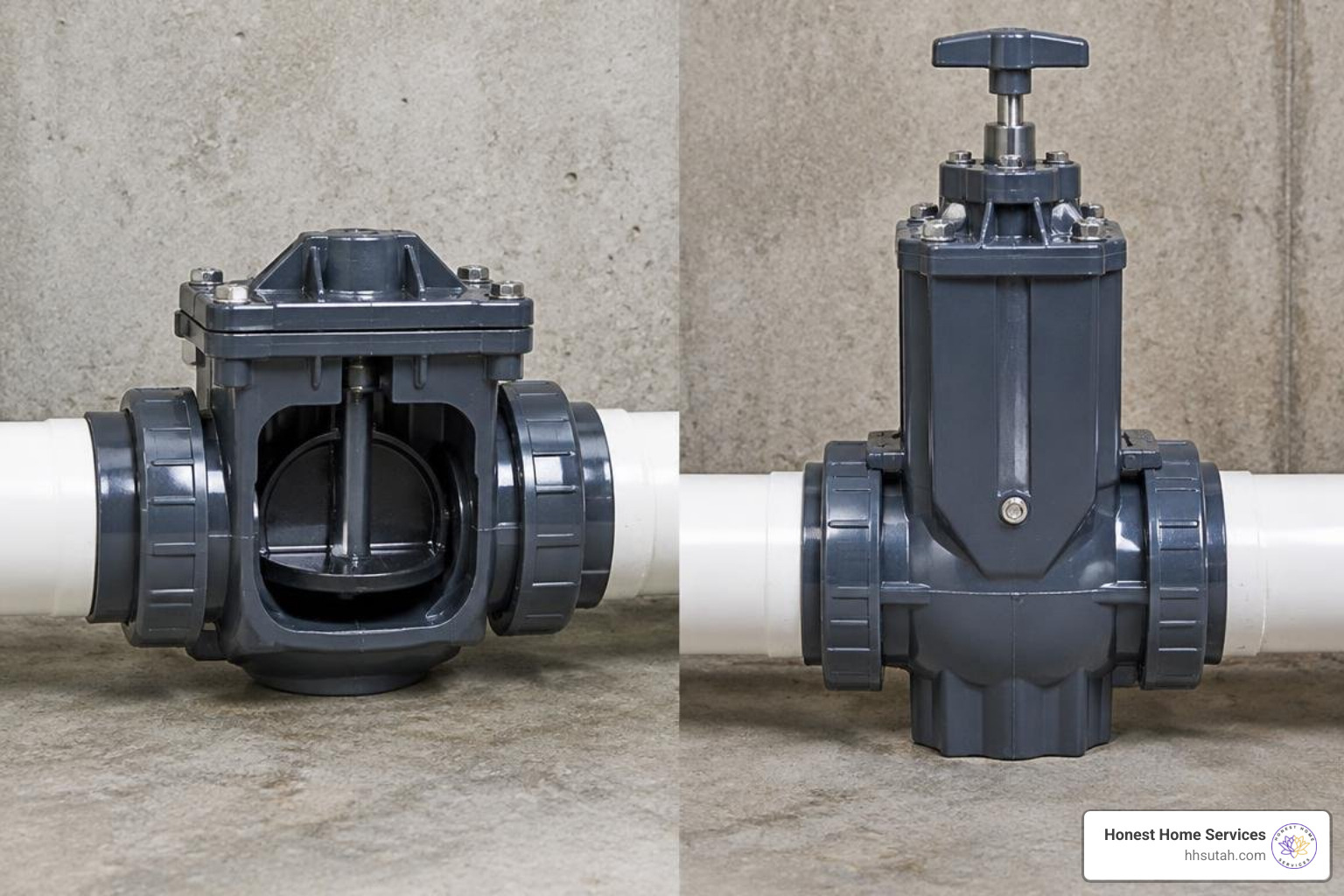
Unlike a basic flap that can sit in the wastewater stream, many Mainline models use a normally open gate. That design supports normal flow and sewer-gas venting while keeping the gate ready to seal when reverse flow occurs. A clear inspection cover and built-in cleanout can also make it easier to spot debris and rod the line without harming the valve.
At Honest Home Services, we bring more than 20 years of plumbing and sewer repair experience to mainline sewer backwater valve planning, installation, and maintenance for Northern Utah homes and businesses. Next, learn how the valve responds when the city sewer becomes blocked or overloaded.
Mainline sewer backwater valve word roundup:
How a Mainline Sewer Backwater Valve Protects Your Home
When municipal sanitary systems experience rapid snowmelt, cloudburst storms, or downstream blockages, the city main surcharges. This surcharge turns your home’s drainage path into a high-pressure reverse conduit. Without backflow mitigation, untreated sewage is pushed backward into your private lateral line, erupting through basement floor drains, showers, and toilets. Learning how to prepare for main line sewer backups is essential for any property with fixtures below street grade.
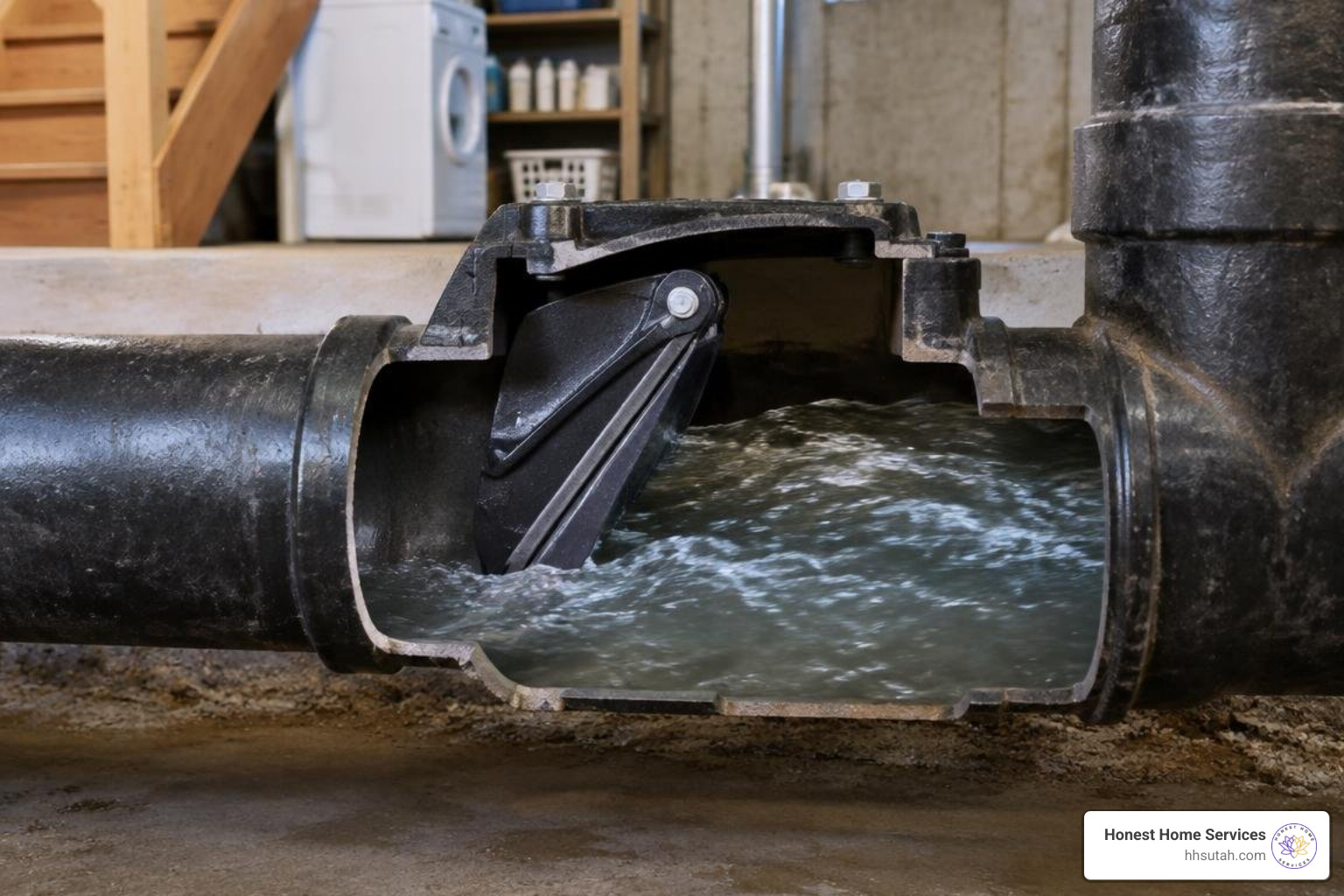
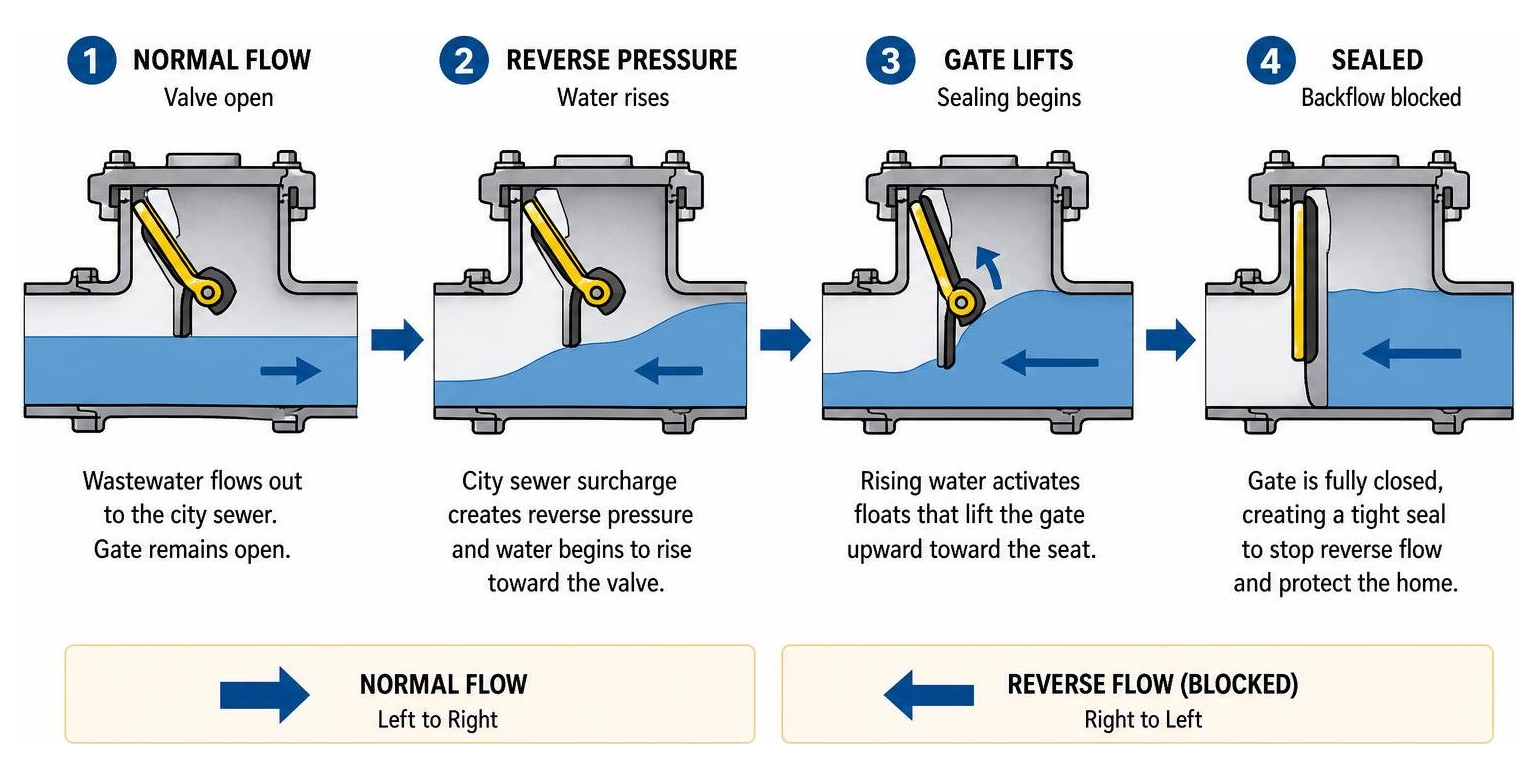
A mainline sewer backwater valve installs directly inline along your primary building sewer pipe downstream of all drainage connections. Unlike branchline check valves that only protect a single fixture, a mainline unit shields the entire structure. Under regular conditions, gravity moves household effluent out through the valve body smoothly. When reverse pressure pushes water back toward the building, closed-cell polyethylene floats react immediately to the rising liquid, lifting the gate to form a hermetic seal against an engineered neoprene O-ring.
Understanding the “Normally Open” Gate Design
Traditional sewer backwater valves rely on “normally closed” flappers that hang in the path of draining water. These older flapper designs cause solids to snag, produce continuous friction, and prevent municipal sewer gases from safely venting up through home plumbing roof stacks.
Mainline revolutionized this technology with the patented normally open gate configuration:
- Unrestricted Flow Dynamics: The gate rests completely suspended or recessed above the normal wastewater stream, allowing unrestricted drainage without catching toilet paper or solid waste.
- Continuous Atmospheric Venting: Because the passageway remains open under dry and normal operating conditions, sewer gases pass freely through the lateral and out the roof stack, preventing toxic methane accumulation.
- Buoyancy-Driven Activation: Dual floats engineered with closed-cell polyethylene lift the gate only when wastewater begins flowing backward, driving the sealing surface upward before backwater enters the home.
- Self-Cleaning Action: Specific internal pitch grades (ranging from 4% across the gate to over 8% in the side channels) sweep away settled grit with every routine fixture discharge.
Built-In Cleanouts and Sewer Rodding Protection
Historically, clearing a clogged sewer lateral equipped with an inline valve was a plumber’s nightmare. Mechanical blades on drain snakes would snag and rip off conventional flappers.
Mainline engineering solves this through built-in cleanout access ports and integrated deflector systems. Using proprietary Smart-CURVE technology and contoured cleat inserts, modern Mainline valves guide drain-cleaning cables smoothly over the gate mechanism. Plumbers can run continuous rodding tools or hydro-jet nozzles downstream into the municipal main without breaking the valve gate or compromising the water-tight seal. Utilizing a dedicated sewer cleanout built into the valve body saves excavation costs and preserves internal components during routine drain maintenance.
Key Valve Models and Engineering Variations
Selecting the right valve depends on pipe depth, material composition (ABS vs. PVC), available internal slope, and drainage fixture requirements.
| Model Name | Pipe Sizes | Body Material | Internal Elevation Drop | Primary Application |
|---|---|---|---|---|
| Fullport Backwater Valve – Mainline (Model 4963) | 3″, 4″ | ABS or PVC | 3/4 inch | Standard residential indoor sub-slab basements and crawl spaces |
| Top Check Backwater Valve | 4″ | PVC Schedule 40 | 1 inch | High-risk surcharge zones requiring manual shutoff & alarm kits |
| Adapt-a-Valve – Mainline | 3″, 4″ | ABS or PVC | 3/4″ (3″) / 1-3/4″ (4″) | Deep underground laterals requiring ground-level cassette servicing |
| 6″ Backwater Valves – Mainline Straight Fit | 3″, 4″, 6″ | ABS or PVC | Less than 1/2 inch | Low-slope retrofit projects and large commercial sewer laterals |
| Mainline ML-FR4 Backwater Valve | 4″ | ABS | 1/2 inch | Compact indoor retrofits where minimal vertical drop is available |
Choosing the Right Mainline Sewer Backwater Valve Model
For standard basement rough-ins where traditional slope exists, the Fullport Backwater Valve – Mainline remains the industry benchmark. Over 400,000 units have been installed since 1997, thanks to its rugged unibody construction and clear polycarbonate inspection cover.
If you are outfitting a home in an area with chronic seasonal flooding, the Top Check Backwater Valve offers an advanced suspended-gate design. It features an integrated manual shutoff lever located on the clear lid, allowing homeowners to physically lock the sewer line shut before leaving for vacation.
For shallow indoor retrofits where excavation depth is severely constrained, the Mainline ML-FR4 Backwater Valve requires only a 1/2-inch vertical step-down over its 12-inch installed length, ensuring you do not compromise downstream drainage grade.
Deep Lateral Access and Extendable Risers
Plumbing safety codes mandate that any sewer valve installed deeper than 24 inches (2 feet) underground must remain accessible without requiring confined-space trench entry. The Adapt-a-Valve – Mainline and Straight-Fit series solve this through vertical DWV riser pipe extensions.
Instead of building expensive poured-concrete access manholes, an installer extends the valve housing to ground level using standard 4-inch, 6-inch, or 8-inch riser pipe. The internal gate mechanism is mounted to a removable sliding cassette connected to an internal PVC reach-rod. Technicians can effortlessly lift the entire working gate assembly directly to the surface for cleaning, O-ring replacement, or seasonal testing without setting foot in an excavation pit.
Installation Requirements, Slope, and Code Compliance
A backwater valve is a precision mechanical device that relies on gravity and liquid dynamics. Flawless installation geometry is non-negotiable.

Critical mechanical installation rules include:
- Downstream Pitch: A minimum downstream slope of 2% (1/4 inch of fall per linear foot) must be maintained across the drainage run, with 4% preferred for optimal self-scouring velocity.
- Internal Elevation Drop: Installers must account for the built-in step-down offset of the valve body (from 1/2 inch to 1-3/4 inches depending on the model) so connected lateral piping does not bow or create standing belly pockets.
- Rigid Axial Alignment: Pipes must enter and exit the valve hubs perfectly square. Tilted or skewed pipes place side-load stress on the gate hinge, preventing smooth closure.
- Sub-Base Compaction: Bed the valve body on compacted crushed gravel or sand to eliminate post-installation settling under heavy concrete floor slabs.
- Coupling Connections: Shielded stainless-steel transition couplings (such as heavy-duty Fernco or Mission bands) must be used when splicing into existing cast-iron, clay, or dissimilar plastic pipe.
Grade Calculations and Retrofit Challenges
Retrofitting a backwater valve into an existing basement floor often reveals limited pipe fall. If the original cast-iron sewer line was laid with minimal pitch, inserting a standard high-drop valve can introduce a flat spot or backfall upstream.
Plumbing contractors address this by opening 4 to 6 feet of concrete slab to gently regrade surrounding pipe sections, or by utilizing low-drop models like the 6″ Backwater Valves – Mainline Straight Fit or ML-FR4. Before cutting any concrete slab, professional plumbers run camera inspection services through the entire building lateral to assess existing line depth, identify pipe materials, and verify continuous slope.
Plumbing Code Standards and Essential Accessories
Mainline valves carry full certification across North American plumbing standards, including CSA B181 (ABS), CSA B182 (PVC), ASME A112.14.1, and IAPMO PS-38. These listings confirm compliance under both the International Plumbing Code (IPC) and Uniform Plumbing Code (UPC). Local districts also outline specific mandate guidelines; see the Municipal sewer backwater valve guidelines for regional municipal sewer connection standards.
Key accessories enhance safety and code performance:
- Removable Test Gates: Slide into the cassette track during rough-in construction to pressure-test DWV piping with water or air before installing the permanent operating gate.
- Magnetic Flood Alarms: Integrate a 9-volt battery sensor and sounding horn that shrieks loudly when rising backwater lifts the gate, alerting occupants to suspend water usage while the main is blocked.
- Threaded Access Boxes: Flush-mount floor vaults (such as the PE-2013 box) that seal the slab cutout against ground moisture, radon gas intrusion, and insects while preserving simple access.
Inspection and Long-Term Maintenance Best Practices
Because backwater valves sit silently beneath basement floors, they are prone to being forgotten until an emergency strikes. Establishing a routine maintenance schedule ensures moving parts remain responsive.
A comprehensive inspection plan combines homeowner visual monitoring with periodic service:
- Quarterly Visual Check: Unthread the cleanout plug or look directly through the clear polycarbonate lid with a flashlight to verify the gate rests flat and no debris is wedged beneath the hinge.
- Debris Flush: Twice annually, unscrew the gasketed cover and flush the valve body with warm water to clear accumulated fats, hair, or fine sediment from the side flow tracks.
- Seal & Float Testing: Manually lift the gate assembly to ensure it pivots effortlessly on its hinge pins without binding. Inspect the perimeter O-ring for cracks, flattening, or brittleness, and verify that the closed-cell floats remain buoyant and intact.
- Annual Professional Service: Schedule routine sewer lateral checkups alongside professional drain cleaning to clear downstream root intrusions or scale that could cause sluggish flow.
Maintaining Your Mainline Sewer Backwater Valve for Maximum Reliability
Follow this operational checklist every autumn before winter storm runoff begins:
- Remove the top cover and wipe clean the underside of the transparent viewport.
- Clean and lubricate the cover O-ring with pure silicone grease (avoid petroleum-based jellies, which degrade rubber).
- Check the gate seal channel for calcification; scrape away any hard water crust with a soft plastic tool.
- Test alarm batteries on units equipped with electronic water sensors.
- Re-torque access lid bolts evenly in a cross-pattern to maintain uniform gasket compression without cracking the plastic casing.
Frequently Asked Questions About Mainline Sewer Backwater Valves
What is the difference between a backwater valve and a backflow preventer?
While their names sound similar, they perform entirely different jobs on separate systems. A backflow preventer protects your pressurized clean drinking water supply from cross-connection contamination (such as chemical fertilizer back-siphoning from an irrigation system). A mainline sewer backwater valve is an unpressurized, gravity-drainage mechanical check valve installed on the large drain lateral to stop raw municipal wastewater from backing into your building.
How often should a sewer backwater valve be inspected and cleaned?
You should inspect the valve at least once every three to four months through the clear inspection lid, as well as immediately following any severe regional storm or municipal sewer maintenance event. A complete manual cleanout and float check should be conducted once per year to remove grease film and ensure moving components articulate freely.
Can you snake a drain line through a backwater valve?
Yes, provided the valve is engineered with cleanout access ports or Smart-CURVE gate technology like Mainline systems. When rodding a sewer, the snake must be introduced through the built-in cleanout port or guided through a valve housing equipped with cable deflectors. Never force a cutting head backward through a standard swinging flap, as mechanical blades will tear the gate from its hinge.
Conclusion
A mainline sewer backwater valve is your property’s primary mechanical defense against hazardous, destructive municipal sewer surcharges. By selecting an engineered “normally open” Mainline valve, you gain unrestricted drainage, continuous atmospheric sewer venting, clear-top maintenance visibility, and dependable whole-building protection.
Whether you need a new valve installed during home construction, an urgent retrofit for a basement remodel, or routine line maintenance, our team at Honest Home Services is ready to help across Salt Lake County, Davis County, and Northern Utah. We provide comprehensive lateral camera diagnostics, professional installations, and 24/7 emergency response. Schedule your expert Salt Lake City sewer mainline repair or backwater valve assessment today to safeguard your home against unexpected backflow disasters.