
What Main Line Plumbing Repair Cost Looks Like Before You Call a Plumber
Main line plumbing repair cost catches most homeowners completely off guard. Here’s a quick snapshot so you know what you’re dealing with right away:
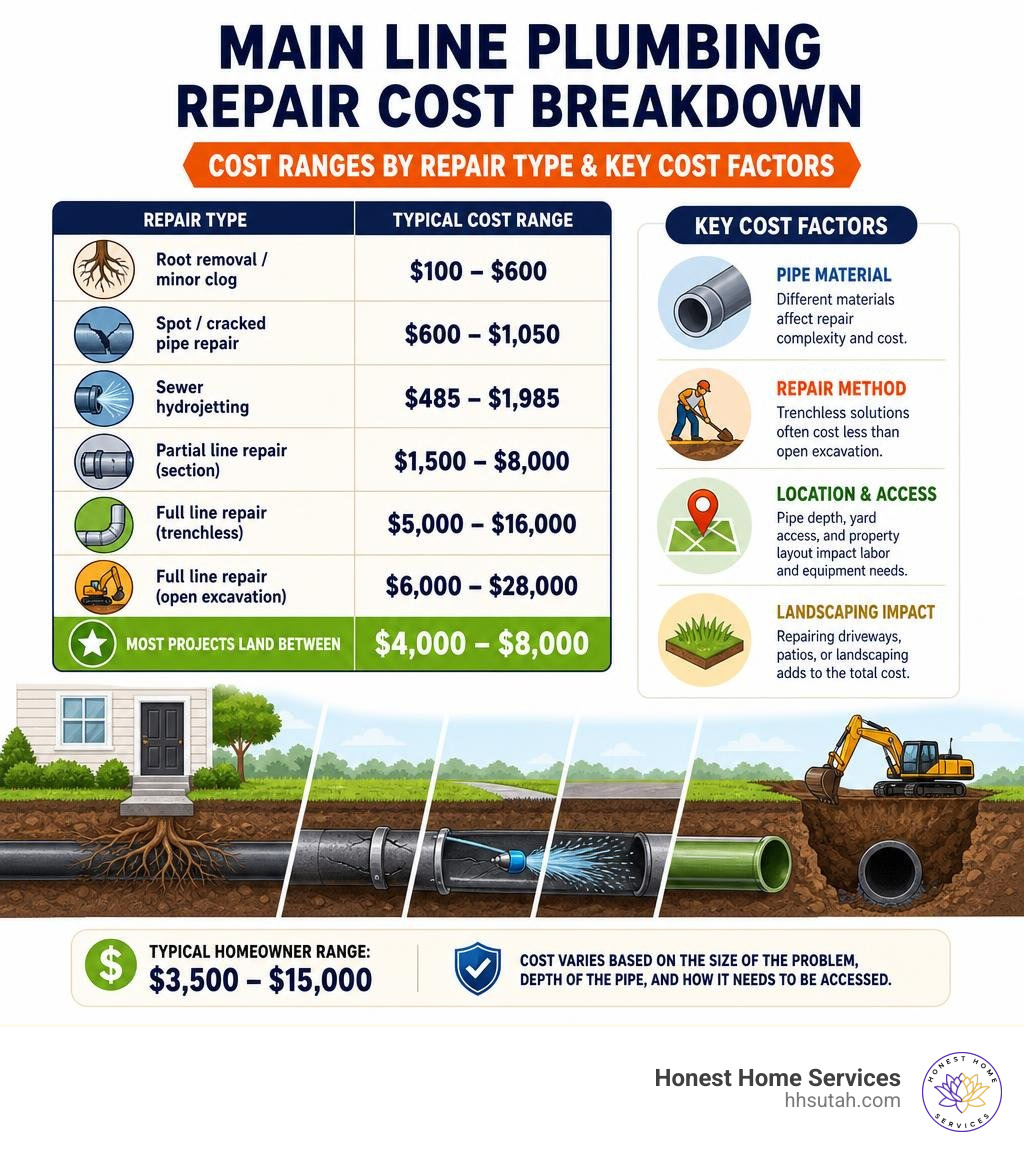
| Repair Type | Typical Cost Range |
|---|---|
| Root removal / minor clog | $100 – $600 |
| Spot / cracked pipe repair | $600 – $1,050 |
| Sewer hydrojetting | $485 – $1,985 |
| Partial line repair (section) | $1,500 – $8,000 |
| Full line repair (trenchless) | $5,000 – $16,000 |
| Full line repair (open excavation) | $6,000 – $28,000 |
| Most projects land between | $4,000 – $8,000 |
Most homeowners pay somewhere in the $3,500 to $15,000 range, depending on the size of the problem, how deep the pipe is buried, and how the plumber needs to access it.
That’s a wide range — and the gap between the low end and high end usually comes down to a handful of factors: pipe material, repair method, location, and whether your yard or driveway has to be dug up.
This guide breaks all of that down clearly, so you can walk into any contractor conversation knowing what’s fair and what’s not.
At Honest Home Services, we’ve been helping Northern Utah homeowners and businesses navigate main line plumbing repair costs for over 20 years — with transparent pricing and no surprise bills. We’ll walk you through everything you need to know before the first shovel hits the ground.
Average Main Line Plumbing Repair Cost in 2026
When facing a main line issue in 2026, the overall project pricing can vary significantly depending on whether you are dealing with a minor localized fix or a major underground excavation project. Nationally, the average sewer line replacement costs $3,319, though typical projects range from $225 for minor repairs up to $10,000 for standard replacements. However, when looking at comprehensive main line plumbing repairs—which often combine advanced diagnostics, permitting, and excavation—most homeowners find their total project costs landing between $4,000 and $8,000.
For highly complex jobs, such as deep-line excavations under paved surfaces or long pipe runs, prices can escalate to between $12,000 and $28,000. On the lower end, simple, accessible repairs might only set you back $1,500 to $3,500.
| Repair Method | Low-End Cost | Average Cost | High-End Cost |
|---|---|---|---|
| Point / Spot Repair | $600 | $1,500 | $3,500 |
| Trenchless Pipe Repair | $5,000 | $8,500 | $16,000 |
| Traditional Open-Cut Excavation | $6,000 | $12,000 | $28,000 |
Here in Northern Utah—including Salt Lake City, Draper, Layton, and Park City—local labor rates and regional factors play a major role. The Mountain West region carries a regional cost multiplier of 1.00 to 1.15 compared to the national average. This means local structural constraints, freezing depths, and regional labor markets can slightly elevate pricing. Understanding these baseline numbers is the first step toward avoiding sticker shock. For a detailed breakdown of these baseline expenses, check out our guide on understanding sewer line repair expenses to see how diagnostics and localized fixes are calculated.
For real-time pricing trends across the country, you can also explore the Main Line Plumbing Repair Cost Guide 2026 – LatestCost to see how regional variables shift the baseline.
Typical Price Ranges for Common Repairs
Not every main line issue requires a complete system overhaul. Often, the problem is a localized blockage or a single cracked joint. Understanding the price ranges for these individual services helps you understand your itemized estimates:
- Root Removal: Tree roots are naturally drawn to the moisture inside your sewer pipes. Clearing out root intrusions using mechanical augers or chemical treatments typically costs between $100 and $600.
- Sewer Hydrojetting: If your main line is choked with grease, scale, or heavy debris, hydrojetting uses high-pressure water streams to blast the pipe clean. This professional service ranges from $485 to $1,985.
- Cracked Pipe Spot Repair: If a camera inspection reveals that only a single 2-to-5-foot section of your pipe is cracked or broken, a plumber can perform a localized point repair. This targeted fix typically costs between $600 and $1,050, assuming the pipe is easily accessible.
If you are dealing with a persistent backup, reading up on the main sewer line clog repair cost can help you determine whether a simple snake or a heavy-duty hydrojetting session is the right path forward.
How Pipe Material Impacts Your Main Line Plumbing Repair Cost
The material of your existing pipe—and the material chosen for the replacement section—directly influences both the material cost per foot and the labor required to work with it. If you have an older home in Salt Lake County or Davis County, you might still have clay, cast iron, or even legacy Orangeburg pipes underground.
- PVC (Polyvinyl Chloride) / ABS: PVC is the modern standard for residential main lines. It is incredibly durable, resistant to root intrusion, and highly cost-effective. PVC pipe material costs around $4.50 per linear foot, with fully installed costs ranging from $50 to $100 per linear foot.
- Cast Iron: Found in many historic homes, cast iron is incredibly strong but prone to internal rusting, scaling, and eventual cracking. Replacing or repairing cast iron is highly labor-intensive, with material and installation costs ranging from $50 to $200 per linear foot.
- Copper: Primarily used for main water service lines rather than sewer lines, copper is highly durable but subject to material price volatility. Copper piping can cost upwards of $85 to $250 per linear foot installed.
- Clay: Common in homes built before the 1980s, clay pipes are highly susceptible to cracking under soil shifts and are easily penetrated by tree roots. Clay pipe repairs or transitions to PVC typically cost $60 to $150 per linear foot.
To understand how these material differences affect your clean water delivery lines versus your waste lines, read our resource on uncovering the cost of water main line repair.
Key Factors That Drive Main Line Repair Expenses
When you receive a quote for main line plumbing repair cost, the physical pipe material is only a fraction of the total bill. The vast majority of the price tag is driven by labor, depth, and the complexity of accessing the pipe.
- Pipe Depth: In Northern Utah, main lines must be buried deep enough to sit safely below the frost line to prevent freezing during our freezing winters. Deeply buried pipes (often 4 to 8 feet down) require heavy machinery and shoring to excavate safely, which significantly increases labor hours.
- Accessibility: A pipe running under a soft, open grass yard is relatively straightforward to dig up. However, if your main line runs beneath a concrete driveway, a paved sidewalk, a pristine patio, or worse, your home’s concrete slab foundation, costs will rise. Breaking through concrete and restoring those surfaces afterward can add thousands to the final bill.
- Local Labor Rates: Licensed plumbers typically charge between $65 and $150 per hour, with highly specialized excavation crews charging up to $200 per hour. Because a standard main line repair requires a multi-person crew working anywhere from 6 to 40 hours, labor quickly becomes the dominant cost driver.
To see how these logistical factors stack up nationally, you can refer to the Main Line Repair Cost Guide for U.S. Homes – Current Cost for an in-depth breakdown of site access challenges.
The Role of Camera Inspections and Diagnostics
Before a single shovel touches your lawn, an accurate diagnosis is critical. In the past, plumbers had to rely on guesswork and exploratory digging to locate a leak or break. Today, we use high-resolution sewer camera inspections.
During a camera inspection, a waterproof, fiber-optic camera is snaked through your main line cleanout. This allows our technicians to see the exact cause of the issue—whether it is a collapsed joint, a massive root ball, or a sag in the line—and pinpoint its exact depth and location from the surface.
A professional sewer camera inspection typically costs between $285 and $785 (with basic diagnostic fees starting around $100 to $500). While this represents an upfront cost, it ultimately saves you thousands of dollars by preventing unnecessary digging and ensuring we only repair the section of pipe that actually needs fixing. To learn how this diagnostic tool saves your yard and your wallet, read about the benefits of a drain pipe camera inspection.
Trenchless vs. Traditional: Choosing the Right Main Line Plumbing Repair Cost Option
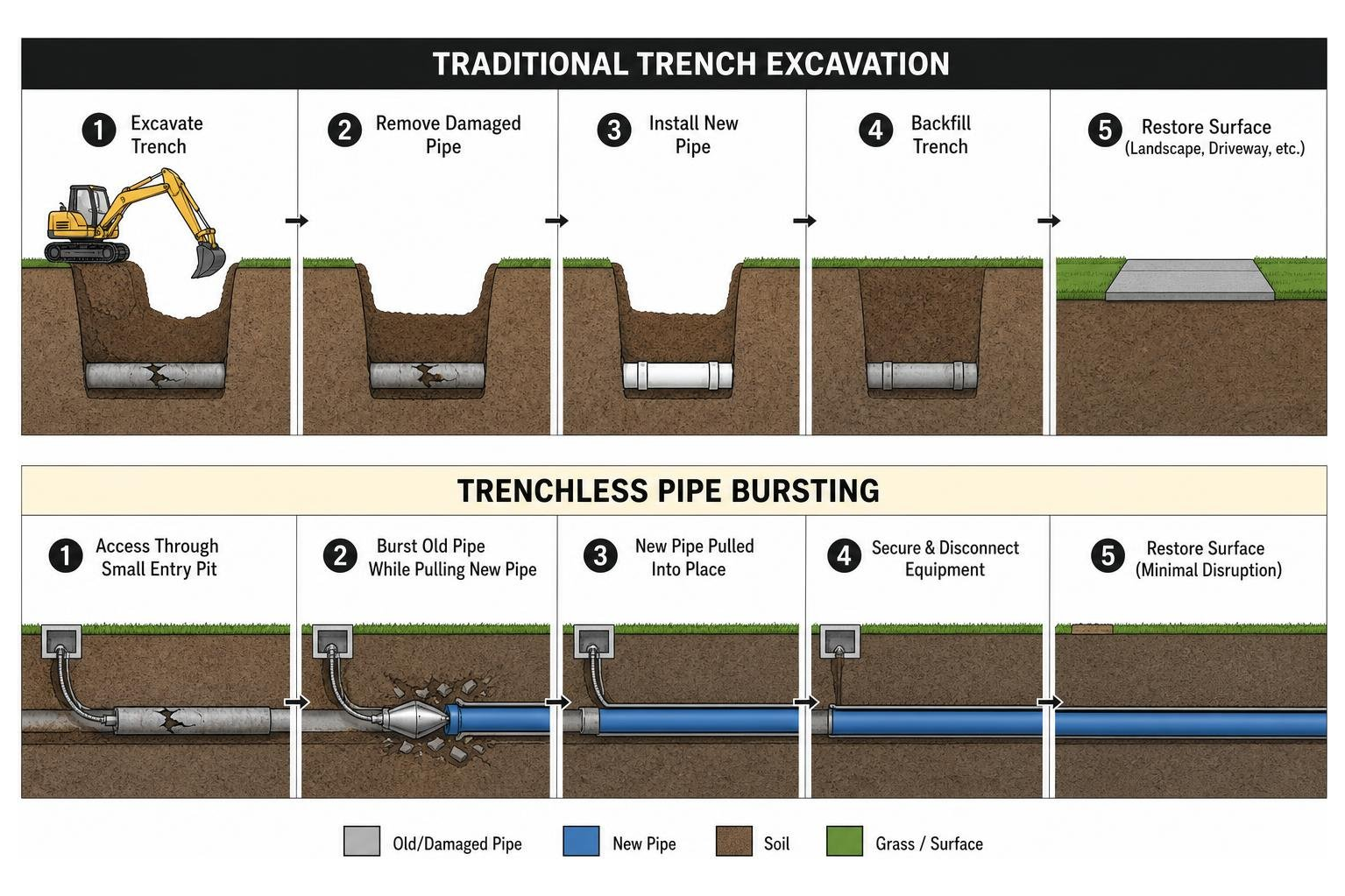
If a significant portion of your main line needs to be replaced, you will generally have to choose between two primary methods: traditional open-cut excavation and modern trenchless technology.
Traditional Open-Cut Excavation
This is the time-tested method of digging a physical trench along the entire path of your sewer pipe.
- Cost: Typically ranges from $3,485 to $13,485 for a standard 50-foot run, but can climb up to $28,000 if the line is deep or runs under hardscaping.
- Pros: Allows the plumber to physically inspect the pipe bedding, correct any “bellies” or sags in the line, and work around complex utility crossings.
- Cons: Highly destructive to your landscaping, driveways, and sidewalks. The cost of restoring your property afterward is rarely included in the initial plumbing quote.
Trenchless Pipe Repair
Trenchless methods allow us to repair or replace your underground pipes with minimal digging. The two most common trenchless practices are pipe bursting (pulling a steel bursting head through the old pipe to shatter it while simultaneously pulling a new, seamless HDPE pipe into place) and pipe lining (inserting a resin-saturated felt sleeve into the old pipe and curing it to create a brand-new “pipe within a pipe”).
- Cost: Typically ranges from $5,485 to $17,485 for a 50-foot run (or $60 to $250 per linear foot).
- Pros: Preserves your yard, driveway, and landscaping. The work is often completed in a single day, saving you massive amounts of time and property restoration stress.
- Cons: Cannot be used if the existing pipe has completely collapsed or has a severe sag (belly) that needs to be physically graded.
To explore how these no-dig solutions work in detail, take a look at our guide on pipe bursting as an alternative to traditional sewer repair.
Hidden and Additional Costs to Budget For
When budgeting for your main line plumbing repair cost, it is essential to establish a 5% to 15% contingency fund to cover expenses that fall outside the basic plumbing estimate. These additional costs often catch homeowners off guard:
- Landscaping and Yard Restoration: Traditional excavation will leave you with a dirt trench through your lawn. Re-seeding grass, replacing sod, replanting ruined gardens, or rebuilding fences can easily cost $500 to $3,000+.
- Concrete and Asphalt Repair: If a plumber has to cut through your driveway or sidewalk, expect to pay $300 to $350 per linear foot to pour new concrete or patch the asphalt.
- Municipal Permits and Inspections: Most cities in Utah require formal permits and safety inspections for main line utility work. These municipal permit fees typically range from $100 to $2,000 depending on your local city codes.
- Utility Locate and Water Shutoff Fees: While locating public utilities (gas, power) is usually free via 811, private utility locating or emergency municipal water shutoffs can sometimes incur small administrative fees.
To see how these line-item fees are benchmarked across the industry in 2026, you can review the 2026 Plumbing Cost Benchmarks | BuildCrux to compare material costs, labor splits, and regional permitting trends.
Repair vs. Full Replacement: Making the Right Choice
When faced with a damaged main line, one of the toughest decisions is deciding whether to patch the existing pipe or invest in a full replacement. While a spot repair is cheaper upfront, it can sometimes be a temporary band-aid on a system that is failing structurally.
We recommend choosing a spot repair if:
- The overall pipe is structurally sound, and the damage is limited to a single, isolated area (such as a single joint cracked by a tree root).
- The pipe material is modern PVC or ABS with decades of useful life remaining.
- The pipe is shallow and easily accessible, meaning future repairs won’t incur astronomical excavation costs.
We recommend choosing a full replacement if:
- Your home has legacy clay, Orangeburg, or heavily corroded cast iron pipes that are structurally failing throughout.
- You are dealing with recurring clogs, backups, or root intrusions every few months.
- The pipe has multiple sags (bellies) or has completely collapsed in several locations.
- The line runs under expensive hardscaping or pristine landscaping—in this case, it is highly cost-effective to replace the entire line once rather than risk having to dig up your yard again in a few years.
To weigh the long-term financial pros and cons of each option, consult our comprehensive main sewer line replacement cost guide.
Frequently Asked Questions about Main Line Plumbing Repair
How much does a sewer line camera inspection cost?
A professional sewer line camera inspection typically costs between $285 and $785, with national averages ranging from $100 to $500 depending on the accessibility of your cleanout. At Honest Home Services, we highly recommend this diagnostic step because it eliminates all guesswork and prevents unnecessary digging. To learn more about how we use high-tech cameras to inspect your pipes, view our breakdown of sewer line camera inspection cost.
What is the average cost to clear a main line clog?
Clearing a standard main sewer line clog using a professional drain snake or root cutter typically costs between $200 and $600 (with a national average of $380). If the clog is severe or composed of heavy grease and scale, hydrojetting is recommended, which ranges from $485 to $1,985. If you suspect your system is backing up, read our expert advice on how to identify a main sewer line clog before it causes water damage in your home.
Does homeowner’s insurance cover main line plumbing repairs?
Standard homeowner’s insurance policies typically do not cover main line plumbing repairs if the damage is caused by wear and tear, gradual deterioration, or tree root intrusion. However, your policy may cover the repairs if the damage was caused by a sudden, accidental covered peril (such as an explosion or a third-party excavation accident).
To protect yourself from unexpected main line failures, we highly recommend adding a service line endorsement to your insurance policy. This optional coverage usually costs only a few dollars a month and can cover up to $10,000 or $15,000 in utility line repair and excavation costs.
Conclusion
Dealing with main line plumbing issues can be stressful, but understanding the underlying costs and repair methods puts the power back in your hands. By investing in early diagnostics—like a video camera inspection—and exploring modern trenchless options, you can protect your property and keep your main line plumbing repair cost as manageable as possible.
At Honest Home Services, we believe in providing our Northern Utah neighbors with transparent, fair, and reliable plumbing solutions. Whether you live in Salt Lake City, Layton, Draper, or Park City, our team of local, certified technicians is here to help with 24/7 emergency support, guaranteed satisfaction, and honest, upfront pricing.
Don’t let sewer line issues disrupt your home and peace of mind. Contact us today to schedule a professional camera diagnostic, or visit our guide on expert sewer services in Salt Lake City to learn more about how we can keep your home’s plumbing running smoothly.