
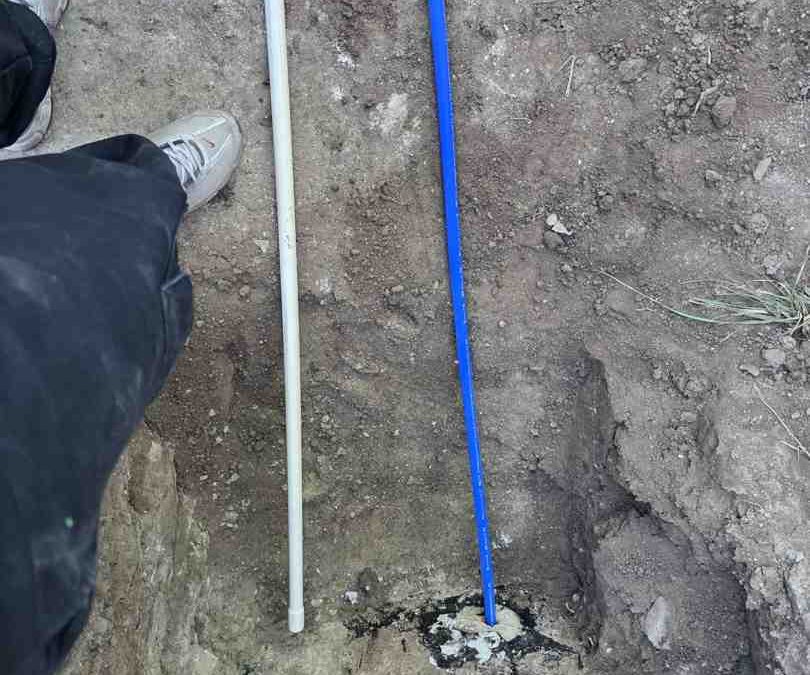
What a Main Line Sewer Scope Actually Is (And Why It Matters)
A main line sewer scope is a video inspection of the underground pipe that carries all wastewater away from your home to the city sewer main or septic tank.
Here’s the quick version:
- A flexible camera is fed into your sewer line through a cleanout access point
- The camera records live video of the inside of your pipes
- A technician identifies problems like cracks, blockages, root intrusion, or pipe damage
- You get a report showing exactly what’s wrong and where
- Typical cost: $150–$500 — a fraction of the $2,500–$20,000 repair bills that go undetected problems can create
Most homeowners never think about their sewer line until something goes wrong. And by then, the damage is expensive.
The pipe running from your foundation to the street is entirely your responsibility — and it’s completely invisible without a camera. Slow drains, gurgling toilets, soggy yard patches, or a foul smell can all point to a problem brewing underground.
The only way to know for sure? A main line sewer scope inspection.
At Honest Home Services, we’ve spent over 20 years diagnosing and repairing sewer and main line issues for homeowners and businesses across Northern Utah — and a main line sewer scope is almost always where that process starts. Let’s walk you through everything you need to know.
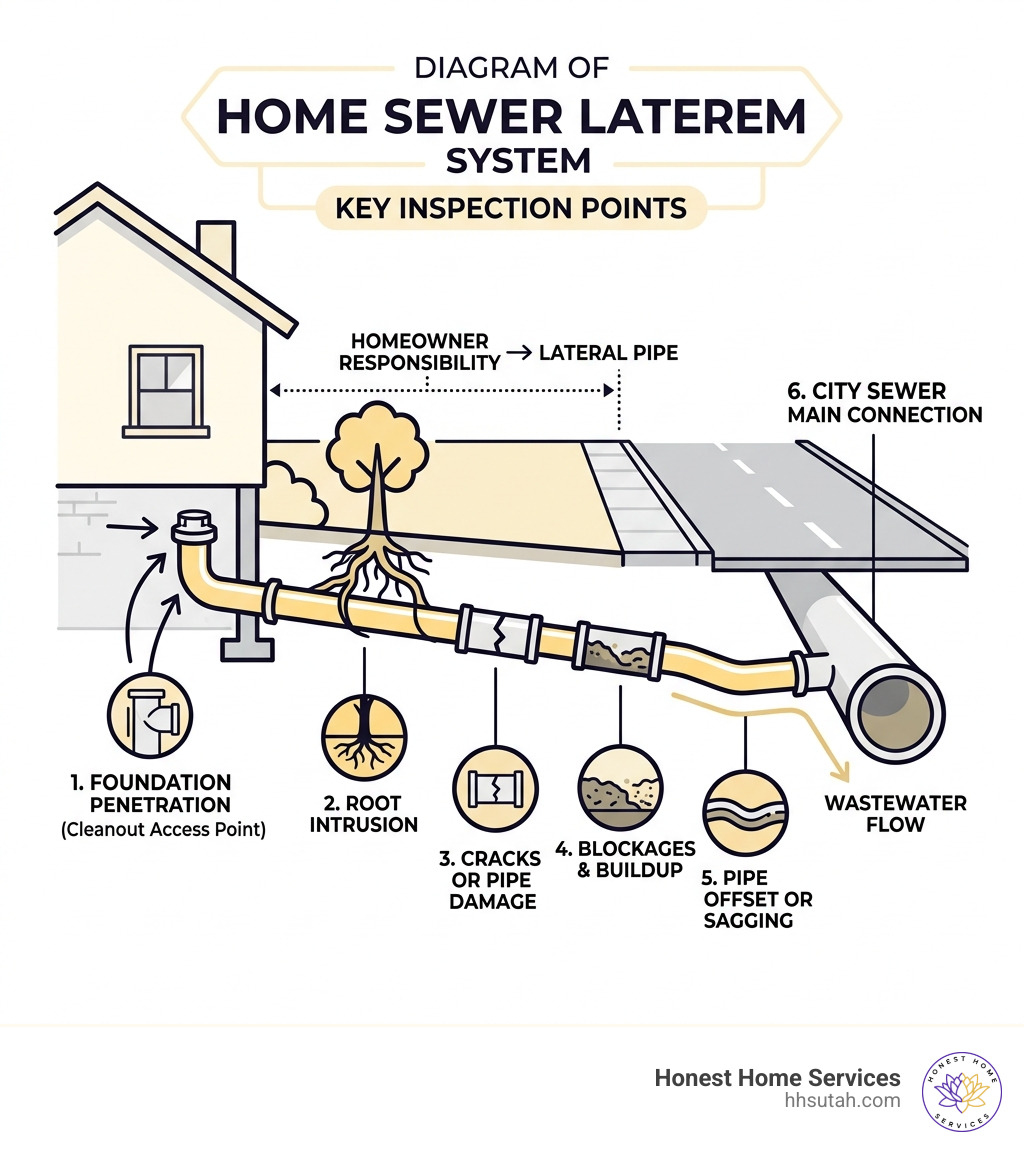
Key terms for main line sewer scope:
What is a Main Line Sewer Scope?
Think of a main line sewer scope as a “colonoscopy” for your home’s plumbing. We use a high-tech, waterproof camera attached to a long, flexible fiber-optic cable. This device, often called a borescope camera, is pushed through your lateral sewer line—the private pipe that connects your home’s internal plumbing to the municipal sewer main under the street.
The primary goal is to assess pipe integrity. Because these pipes are buried several feet underground, there is no other way to see what is happening without digging up your entire yard. A sewer lateral inspection provides a real-time, high-definition look at the “hidden” part of your home. At Honest Home Services, we believe that mainline inspection services are the foundation of responsible home maintenance in Utah.
Key Features of Sewer Camera Technology
Modern sewer cameras aren’t just webcams on a string; they are sophisticated pieces of diagnostic equipment. Here is what makes them so effective:
- High-Resolution Video: We need to see the difference between a minor scratch and a structural crack. High-definition sensors allow us to spot tiny hairline fractures before they become geysers.
- Self-Leveling Heads: As the camera twists through elbows and turns, the image stays upright. This prevents the “Blair Witch Project” effect and makes it much easier to tell if a crack is on the top, bottom, or side of the pipe.
- Locatable Sondes: These are small transmitters inside the camera head. If we find a collapsed section, we use a handheld locator above ground to pinpoint the exact spot (and depth) in your yard. This means we only dig where necessary.
- Meter Markers: The cable tracks exactly how many feet the camera has traveled. If there’s a blockage at 42 feet, we know exactly where that is in relation to your foundation.
- LED Lighting: Pipes are pitch black. Adjustable, high-intensity LEDs illuminate the pipe walls so nothing stays hidden in the shadows.
- DVR Recording: We record the entire session. This provides you with “documented leverage” if you are buying a home or proof for an insurance claim.
When to Schedule a Main Line Sewer Scope Inspection
How do you know if your pipes are crying for help? Sometimes the signs are obvious, like a basement full of sewage (which we definitely want to avoid!), but often the signs are much more subtle. You should consider a main line sewer scope if you notice:
- Lush Grass Patches: Is one strip of your lawn suspiciously greener and faster-growing than the rest? Leaking sewer water acts as a potent fertilizer. It might look nice now, but it’s a sign that sewage is escaping into your soil.
- Slow Drains and Gurgling Toilets: If one sink is slow, it’s a local clog. If every drain in the house is sluggish or your toilets gurgle when the dishwasher runs, the problem is likely in the main line.
- Rodent or Pest Activity: Rats and roaches love sewer lines. A break in the pipe provides them with a “highway” directly into your home’s perimeter.
- Sewage Odors: A healthy sewer system is airtight. If you smell “rotten eggs” (hydrogen sulfide) in your yard or basement, you likely have a crack or a dried-out trap.
- Frequent Backups: If you have to call a plumber to snake your drains every few months, you aren’t fixing the problem—you’re just treating the symptom.
For more details, check out our guide on the 6 telltale signs you need a camera drain inspection.
The Role of a Main Line Sewer Scope in Home Buying
In the Utah real estate market, a standard home inspection usually stops at the foundation. The inspector will flush the toilets and run the sinks, but they won’t look at the 60 feet of pipe buried under the driveway.
A sewer line scope for Utah home inspections is one of the smartest investments a buyer can make. If we find a $10,000 collapse during the due diligence period, you can ask the seller to fix it or credit you the cost before you close. Once you sign those papers, that pipe—and its problems—are yours.
Pre-Purchase Inspection Benefits:
- Negotiating Power: Use the video evidence to lower the sale price.
- Peace of Mind: Know that you won’t have a sewage backup during your first week in the new house.
- Budgeting: If the pipe is old but functional, you can plan for a future upgrade rather than being hit with an emergency.
Risks for Older Homes and Specific Pipe Materials
If your home was built before 1980, your risk level is significantly higher. Different eras used different materials, many of which are now reaching the end of their lifespan. We often discuss these in our look at mainline sewer upgrades.
- Clay Piping: Common in older Salt Lake City neighborhoods. It’s durable but brittle. Over time, the joints shift, allowing tree roots to enter.
- Cast Iron: These pipes are prone to internal rusting (tuberculation). This creates a rough surface that catches hair and grease, leading to constant clogs.
- Orangeburg Pipe: Used from the 1940s to the 70s, this is essentially “tar paper” pipe. It is notorious for flattening over time under the weight of the soil. If you have Orangeburg, it’s not a matter of if it will fail, but when.
- Galvanized Steel: Similar to cast iron, these rust from the inside out, eventually narrowing the pipe until almost nothing can pass through.
Common Issues Revealed by a Camera Inspection
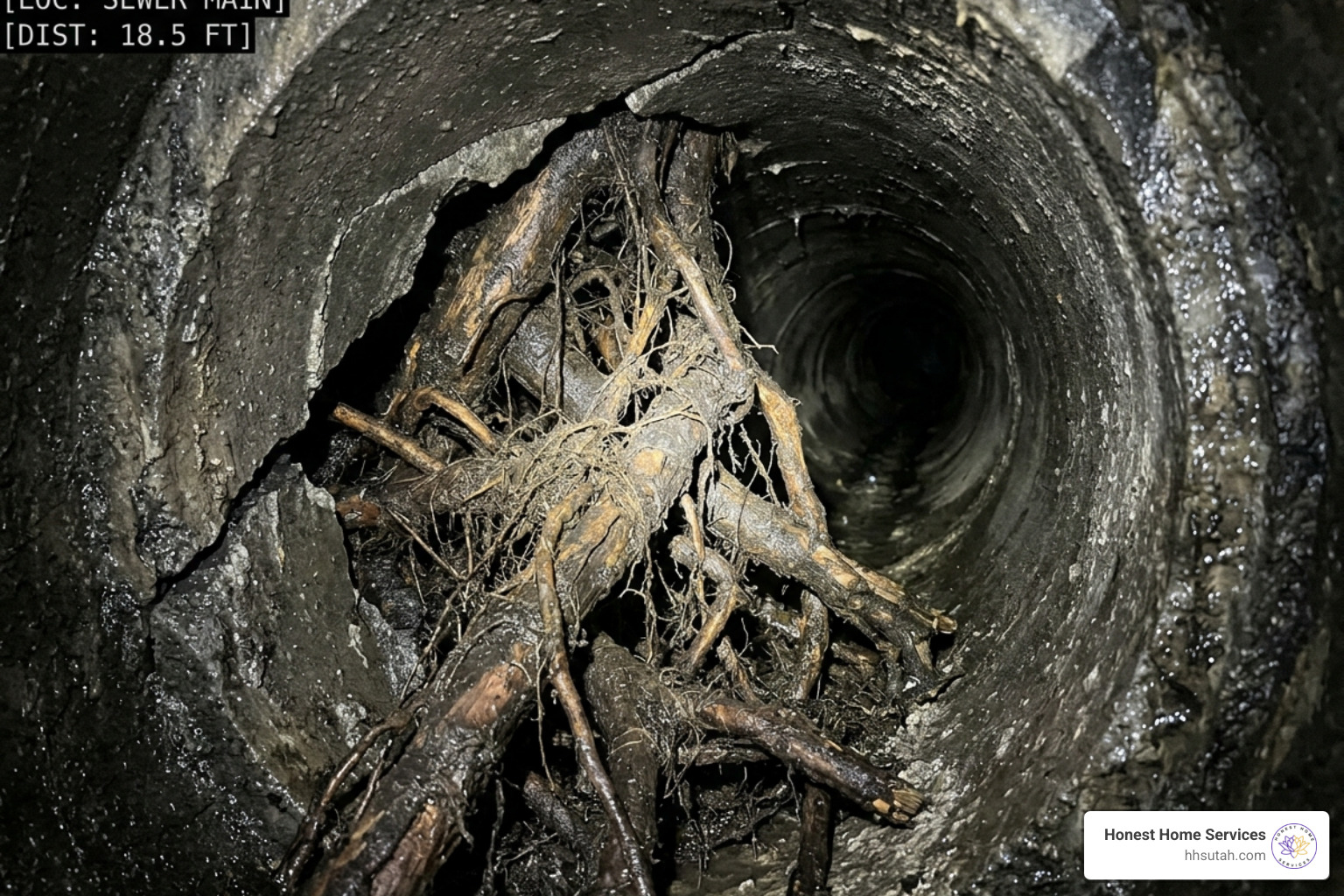
When we push that camera through, we are looking for specific “villains” that disrupt your plumbing. Some of the most common issues we find in Utah homes include:
- Tree Root Intrusion: Roots are drawn to the moisture and nutrients inside sewer pipes. They can enter through tiny cracks or loose joints, eventually growing into a thick “root ball” that completely blocks the flow.
- Pipe Bellies (Sags): Due to soil shifting or poor installation, a section of the pipe may sink. This creates a low spot where water and debris sit, eventually causing a “soft clog.”
- Offset Joints: In older clay or concrete lines, sections of pipe can move independently. If one section drops lower than the next, it creates a “lip” that catches solids.
- Structural Cracks and Collapses: Whether from age, ground freezing cycles, or heavy vehicle traffic overhead, pipes can simply break.
- Scale Buildup: In cast iron pipes, mineral deposits and rust can create a “crust” that narrows the pipe diameter.
Dealing with these issues early is the key to avoiding sewer and sewage backup repairs.
Identifying Pipe Material and Grading Problems
Beyond just looking for breaks, the camera tells us what the pipe is made of (PVC, Terracotta, Cast Iron) and if it was installed with the correct “grade” or slope.
Pipes rely on gravity. If a pipe is too flat, water won’t move fast enough to carry solids away. If it’s too steep, the water outruns the solids, leaving them behind to dry and clog the pipe. A main line sewer scope identifies these grading issues by showing us where “standing water” remains even when no faucets are running.
The Step-by-Step Process of a Professional Inspection
Many homeowners worry that a sewer scope will be a messy, all-day affair. In reality, it’s quite clean and usually takes less than an hour. Here is how we do it at Honest Home Services:
- Locate Access: We look for your sewer cleanout—a capped pipe usually found in the basement, crawlspace, or yard. If no cleanout exists, we may access the line via a roof vent stack or by temporarily removing a toilet. You can learn more about finding your cleanout here.
- Flushing the Line: We often run water briefly to clear out loose debris and ensure the camera can glide smoothly.
- Insertion & Monitoring: We feed the camera in and watch the monitor in real-time. We move slowly, stopping to inspect every joint and connection.
- Mapping & Locating: If we find a problem, we use the sonde transmitter to mark the spot on your lawn with eco-friendly paint.
- Recording: The entire journey is recorded for your records.
Interpreting Your Main Line Sewer Scope Report
Once the inspection is done, we don’t just say “it looks bad” and leave. You receive an annotated report. This is where we unclog the mystery of your plumbing. A good report should include:
- Video Footage: A digital copy of the scope.
- Defect Locations: Exact foot markers where issues were found.
- Depth Measurements: How deep the pipe is at the point of failure (important for repair costs).
- Professional Recommendations: Whether you need a simple hydro-jetting cleaning, a trenchless repair, or a full replacement.
Costs, Repairs, and Next Steps
The biggest question on every homeowner’s mind is: “How much is this going to cost me?” While the inspection itself is affordable, the repairs can vary.
If a problem is found, you generally have three options:
- Maintenance (Cleaning): If the pipe is structurally sound but full of roots or grease, we use hydro-jetting (high-pressure water) to clear it out.
- Trenchless Repair (Pipe Lining or Bursting): This is the “modern marvel” of plumbing. We can often create a new pipe inside your old one without digging up your yard. This is faster and often cheaper when you factor in the cost of replacing landscaping or driveways.
- Conventional Replacement: If the pipe is completely collapsed or severely offset, we may have to dig. We provide a full main sewer line replacement cost guide to help you plan.
Professional Expertise vs. DIY Risks
You might see “sewer cameras” for sale online for a few hundred dollars. While tempting, DIY scoping is often a waste of money for a few reasons:
- Image Quality: Cheap cameras often have poor lighting and low resolution, making it impossible to distinguish between a cobweb and a crack.
- Distance: Consumer cameras usually lack the cable length or rigidity to reach the city main.
- Interpretation: Seeing the pipe is only half the battle. A professional knows the difference between a normal joint and a failing one.
- Liability: If you get a cheap camera stuck in your line, you’ve just created a very expensive blockage that a professional will have to remove.
Trusting a professional mainline plumbing service ensures the job is done safely and accurately.
Frequently Asked Questions about Sewer Scoping
How long does a sewer scope inspection take?
For a standard residential home in Salt Lake County or Davis County, the process typically takes 45 to 90 minutes. This includes setup, the actual camera run, and explaining the findings to you.
Can a sewer camera detect an active leak?
A camera can see cracks, holes, and separated joints—which are the sources of leaks. However, because it only sees the inside of the pipe, it can’t always see water escaping into the soil unless the crack is significant. If we suspect a hidden leak, we may pair the scope with a hydrostatic pressure test.
How often should I have my main line scoped?
- New Homebuyers: Always.
- Older Homes (30+ years): Every 2 to 3 years as preventative maintenance.
- Homes with Large Trees: Every 1 to 2 years to catch root intrusion before it causes a backup.
- New Construction: Believe it or not, we often find construction debris or “bellies” in brand-new lines. It’s worth checking before your builder warranty expires!
Conclusion
Your home’s sewer line is its most vital—and most overlooked—utility. By the time you notice a problem, it’s usually an emergency. A main line sewer scope turns an invisible risk into a manageable plan.
At Honest Home Services, we pride ourselves on providing the most transparent and reliable plumbing diagnostics in Northern Utah. Whether you’re buying a new home in Draper, dealing with slow drains in Layton, or just want peace of mind for your property in Salt Lake City, we are here to help. Don’t wait for a backup to ruin your day (and your basement).
Schedule your Salt Lake City sewer mainline repair or inspection today and let us give you a “picture perfect” look at your pipes!