
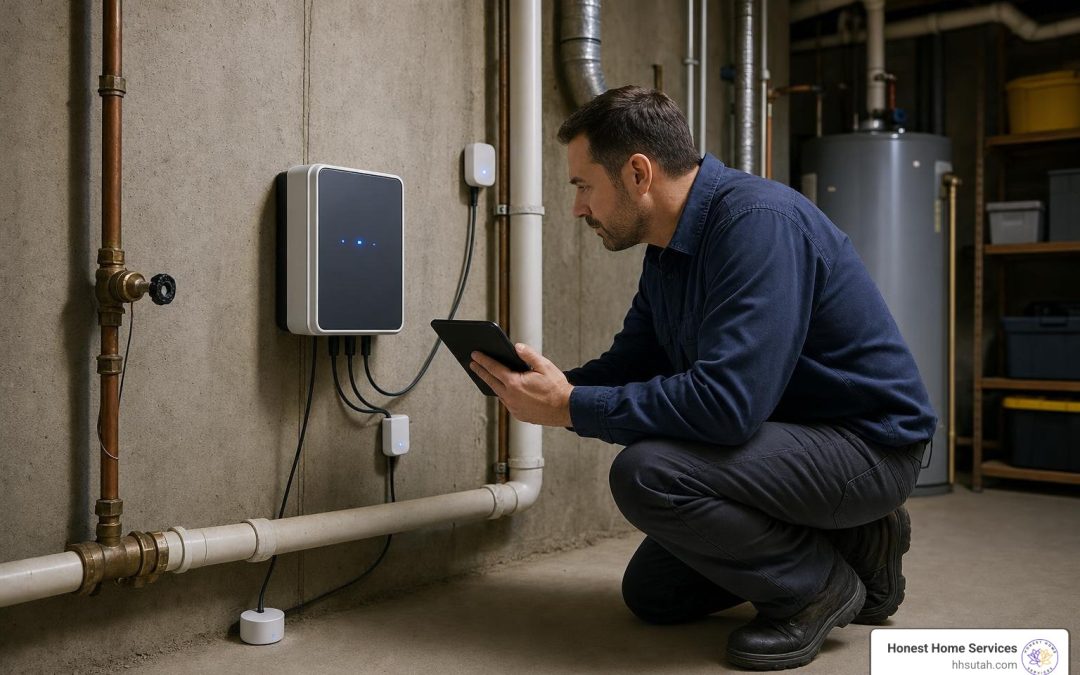
Why Every Commercial Property Owner Needs a Water Leak Detection System
A commercial water leak detection system is one of the smartest investments you can make to protect your business property from costly, hidden water damage.
Here’s what you need to know at a glance:
| Question | Quick Answer |
|---|---|
| What is it? | A network of sensors, flow meters, and automatic shutoff valves that monitors your building’s water 24/7 |
| How does it work? | Detects abnormal water flow or physical water contact, then alerts you and/or shuts off water automatically |
| Who needs it? | Any commercial property — offices, multi-family buildings, hospitals, schools, warehouses |
| Why does it matter? | Water damage is now the #1 cause of property loss in commercial buildings, surpassing fire |
| Key benefit? | Stops leaks before they become disasters — especially after hours when no one is on site |
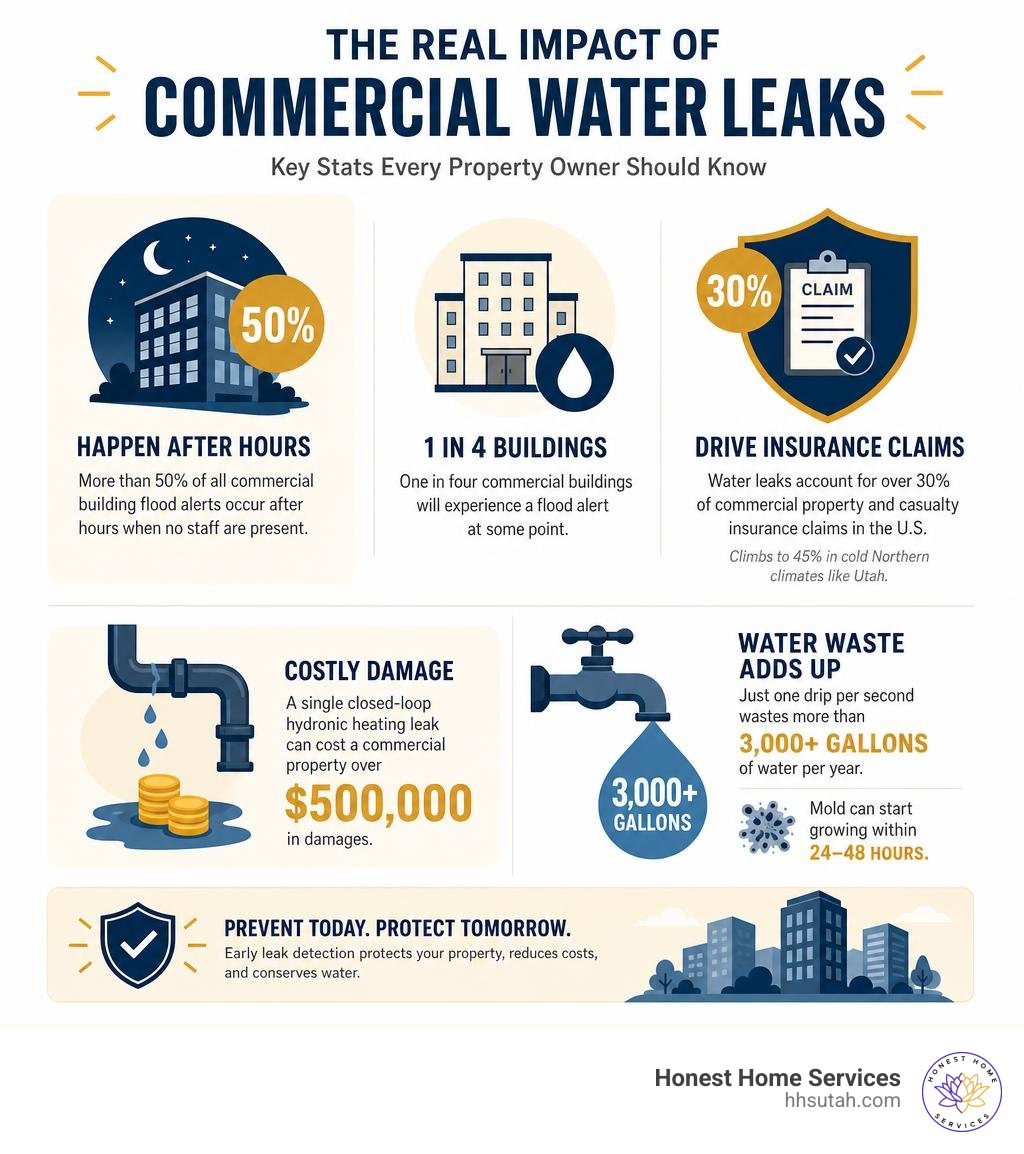
Water damage is not a rare, dramatic event. It is a slow, silent threat that builds behind walls, under slabs, and inside mechanical rooms. Consider this: more than half of all commercial building flood alerts happen after hours, when no staff are present to respond. And one in four commercial buildings will experience a flood alert at some point.
The numbers are sobering. Water leaks account for over 30% of commercial property and casualty insurance claims in the United States — climbing to 45% in cold Northern climates like Utah, where frozen pipes are a real seasonal risk. A single closed-loop hydronic heating leak can cost a commercial property over $500,000 in damages. Even a seemingly minor leak — just one drip per second — wastes more than 3,000 gallons of water per year and can trigger mold growth within 24 to 48 hours.
The good news? These losses are largely preventable with the right detection technology in place.
At Honest Home Services, we have spent over 20 years helping Utah homeowners and commercial businesses protect their properties from exactly these kinds of plumbing failures — including helping clients choose and install the right commercial water leak detection system for their building’s specific needs. Whether you manage a single commercial space or a multi-unit portfolio, we are here to help you get ahead of the problem before it becomes a crisis.
Relevant articles related to commercial water leak detection system:
Understanding the Threat: Common Causes and Costs of Commercial Water Leaks
Commercial plumbing systems are far more complex than residential setups. They experience higher water pressures, heavy daily usage, and rely on intricate mechanical networks that run 24/7. In Northern Utah, our unique geographic and climatic conditions introduce distinct vulnerabilities to commercial buildings.
Several key factors commonly trigger commercial water leaks:
- Frozen Pipes: In cold mountain and valley climates—such as Park City, Layton, and Salt Lake City—winter temperatures regularly plunge below freezing. Uninsulated or exposed pipes in exterior walls, crawlspaces, and unheated mechanical rooms can freeze, expand, and rupture.
- HVAC Condensation and Boiler Failures: Commercial HVAC systems generate massive volumes of condensation. Blocked drain lines or cracked pan reservoirs can cause water to overflow directly into ceilings and wall cavities. Additionally, boiler systems are highly vulnerable; statistically, one in five commercial boilers will leak within its first 24 months of operation.
- Hard Water Scaling: Utah is notorious for its mineral-rich, hard water. Over time, calcium and magnesium deposits accumulate inside pipes, valves, and commercial water heaters. This scaling restricts water flow, increases internal pressure, weakens pipe joints, and accelerates localized corrosion. Regular maintenance is vital to prevent these issues, as detailed in our guide on the Inspection and Service of Commercial Water Heaters.
- Failed Automatic Systems: High-occupancy buildings rely on automated systems like commercial irrigation, water chillers, and public restrooms. A single running toilet can waste up to 6,000 gallons of water per month, driving up utility bills silently.
The True Cost of Water Damage in Commercial Properties
When a pipe bursts in a commercial building, the financial impact extends far beyond the cost of hiring a plumber. According to industry data, the average cost of water damage caused by leaking water heaters is $3,642, while faulty plumbing lines regularly result in structural damages exceeding $17,200.
For larger systems, the numbers scale up drastically. A leak inside a closed-loop hydronic heating system averages over $500,000 in commercial property damages. Additionally, the average commercial HVAC water event costs $127,000.
Beyond the physical repairs, commercial property owners must contend with:
- Business Interruption and Downtime: A major leak can force office closures, ruin expensive IT infrastructure in server rooms, and halt daily operations.
- Mold Growth and Air Quality Issues: Mold begins to colonize damp drywall and carpeting within 24 to 48 hours of water exposure. This can lead to sick building syndrome, tenant disputes, and significant legal liabilities.
- High Tenant Turnover: In multi-family properties and Class A or B office spaces—which carry a 36.9% leak rate—frequent plumbing disruptions destroy tenant trust and lead to broken leases.
Implementing a proactive approach to Commercial Water Leak Detection and Prevention is the only reliable way to protect your bottom line from these compounding expenses.
Why Your Facility Needs a Commercial Water Leak Detection System
Relying on manual visual inspections to catch plumbing failures is no longer viable. Modern facilities require continuous, automated oversight. Installing a dedicated commercial water leak detection system shifts your operational model from reactive crisis management to proactive risk mitigation.
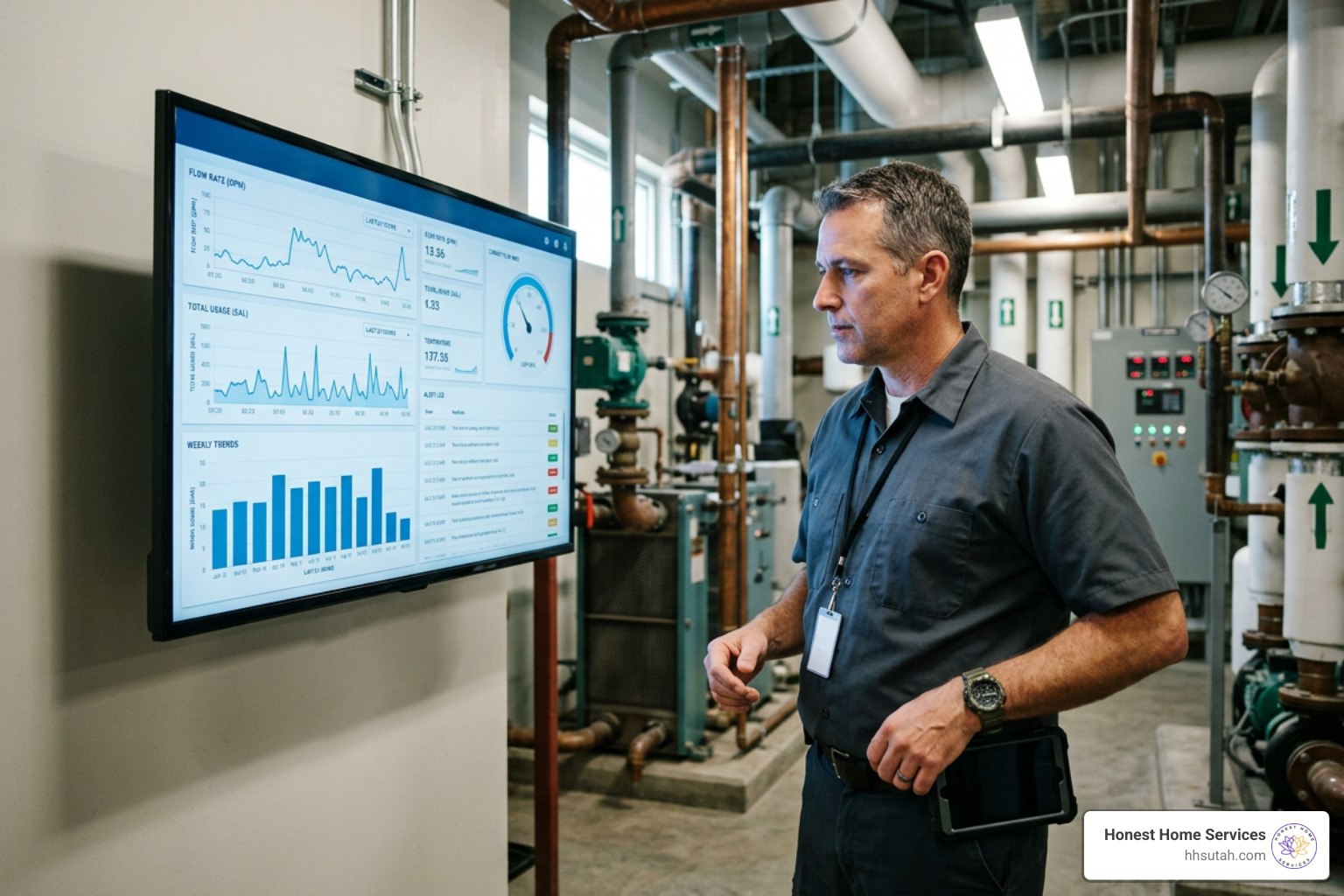
The strategic benefits of these systems include:
- Substantial Insurance Discounts: Because water damage accounts for more than 30% of all commercial property and casualty claims, insurance carriers actively incentivize mitigation technology. Installing a certified system with automatic shutoff capabilities can significantly lower your annual premiums.
- Meeting Corporate ESG and Sustainability Goals: Water conservation is a critical pillar of environmental, social, and governance (ESG) reporting. Because approximately 85% of commercial buildings waste up to 35% of their water due to undetected leaks, smart monitoring directly reduces utility waste and your property’s overall carbon footprint.
- Enhanced Operational Oversight: Facility managers gain complete, remote visibility into water usage patterns across multiple properties or floors, allowing them to spot anomalies before they turn into building-wide emergencies.
What is a Commercial Water Leak Detection System?
At its core, a commercial water leak detection system is an integrated network of hardware and software designed to identify unwanted water presence or abnormal flow patterns in real time.
Unlike basic residential alarms, commercial systems are engineered to handle large pipe diameters (ranging from 0.75 inches up to 12 inches) and complex architectural layouts. They continuously monitor your infrastructure and, upon detecting an issue, send instant cellular or wireless alerts to facility managers while simultaneously triggering motorized shutoff valves to isolate the leak.
To learn more about the basic mechanics of these devices, you can read our resource on Leak Detectors Demystified: Your Guide to Finding Hidden Pipe Problems.
Point-of-Leak Sensors vs. Flow-Based Monitoring
To design the most effective protection plan for your building, it is important to understand the two primary technologies used in commercial leak detection: Point-of-Leak (Spot/Zone) Sensors and Flow-Based Monitoring.
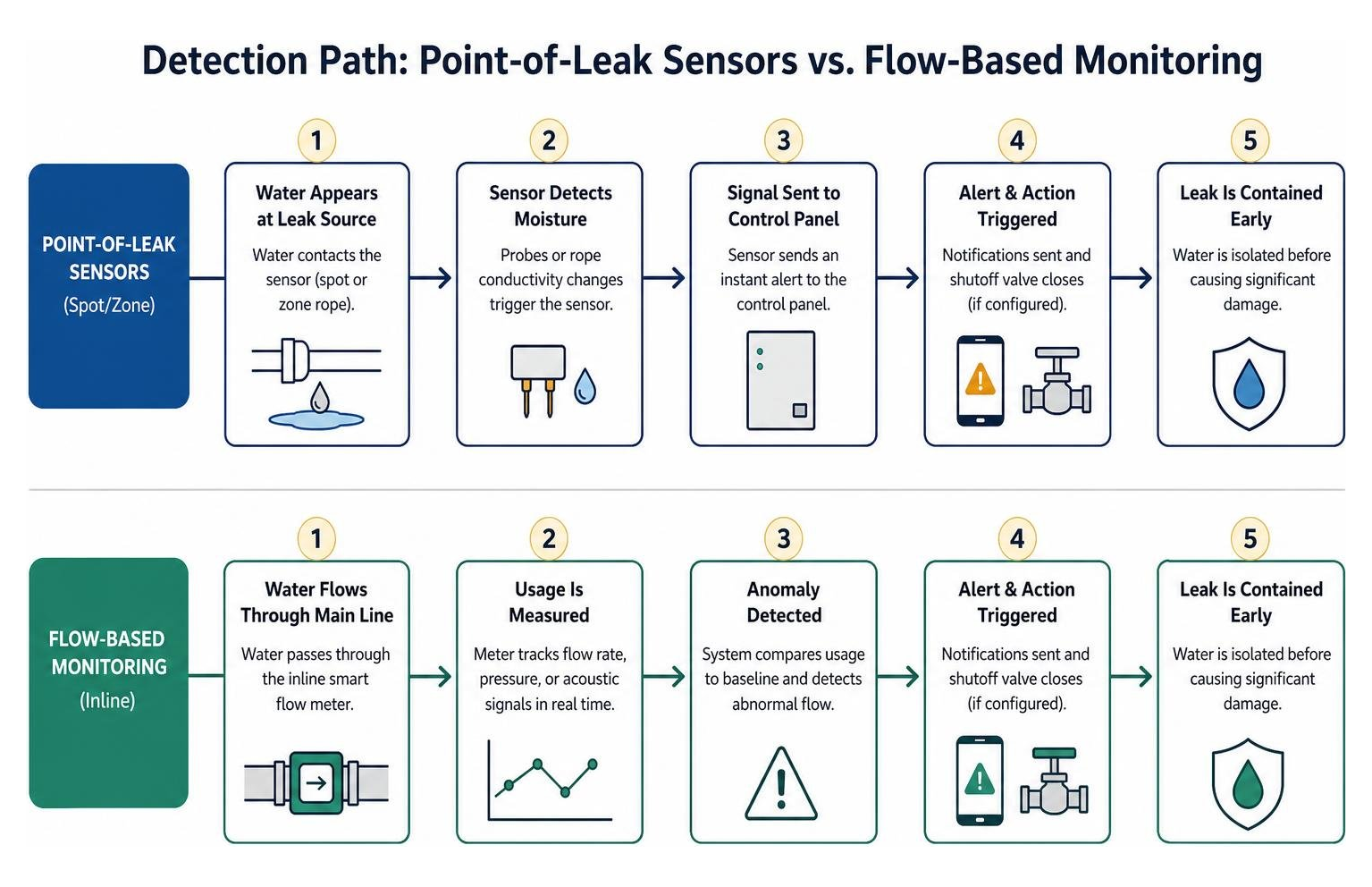
- Point-of-Leak Sensors: These are localized devices placed in high-risk areas where water is likely to accumulate first (e.g., mechanical rooms, elevator pits, under water heaters). They include spot detectors with gold-plated probes or flexible, linear zone water ropes that can be linked together to cover up to 100 square feet under raised floors or inside drop ceilings.
- Flow-Based Monitoring: These systems utilize smart inline meters installed directly on the main water line. By measuring water velocity, pressure, or acoustic sound waves, they establish a baseline of normal building usage. If water flows continuously for an abnormal period or exceeds a specific threshold, the system flags it as a leak.
| Feature | Point-of-Leak Sensors | Flow-Based Monitoring |
|---|---|---|
| Primary Mechanism | Physical contact with water | Monitoring water velocity, pressure, or acoustic waves |
| Best For | Server rooms, elevator pits, localized mechanical areas | Whole-building main lines, hidden pipe runs, tracking overall consumption |
| Installation | Non-invasive (peel-and-stick, spot placement) | Inline (requires plumbing integration) or non-invasive clamp-on |
| Coverage | Highly localized (spot or zone-specific) | Comprehensive (monitors all downstream plumbing) |
| Alert Trigger | Immediate contact with 1/16″ of water | Deviations from normal usage baselines or continuous flow |
For maximum security, we recommend a hybrid approach: using flow-based meters to monitor the building’s main lines, paired with targeted point-of-leak sensors in high-risk utility zones.
Selecting the Right Technology for Your Building
Every commercial property has unique structural demands. A high-rise apartment complex in downtown Salt Lake City requires a different engineering approach than a spread-out warehouse in West Valley or a historic commercial space in Park City.
When evaluating systems, consider the following variables:
- Building Size and Layout: Large multi-story properties need zone-level isolation. If a leak occurs on the 4th floor, the system should shut off water to that specific riser rather than cutting off supply to the entire building.
- Infrastructure Age: Older buildings with legacy galvanized or copper pipes are highly susceptible to pinhole leaks behind walls. In these environments, flow-based systems capable of running daily micro-leak pressure tests are incredibly valuable.
- Wireless Protocol and Signal Penetration: Standard Wi-Fi often struggles to penetrate thick concrete walls, steel beams, and subterranean mechanical shafts. Look for systems that utilize LoRaWAN (Long Range Wide Area Network) operating at 915 MHz. LoRaWAN easily penetrates deep structural concrete and offers a wireless communication range of up to 2 kilometers, ensuring your sensors remain online.
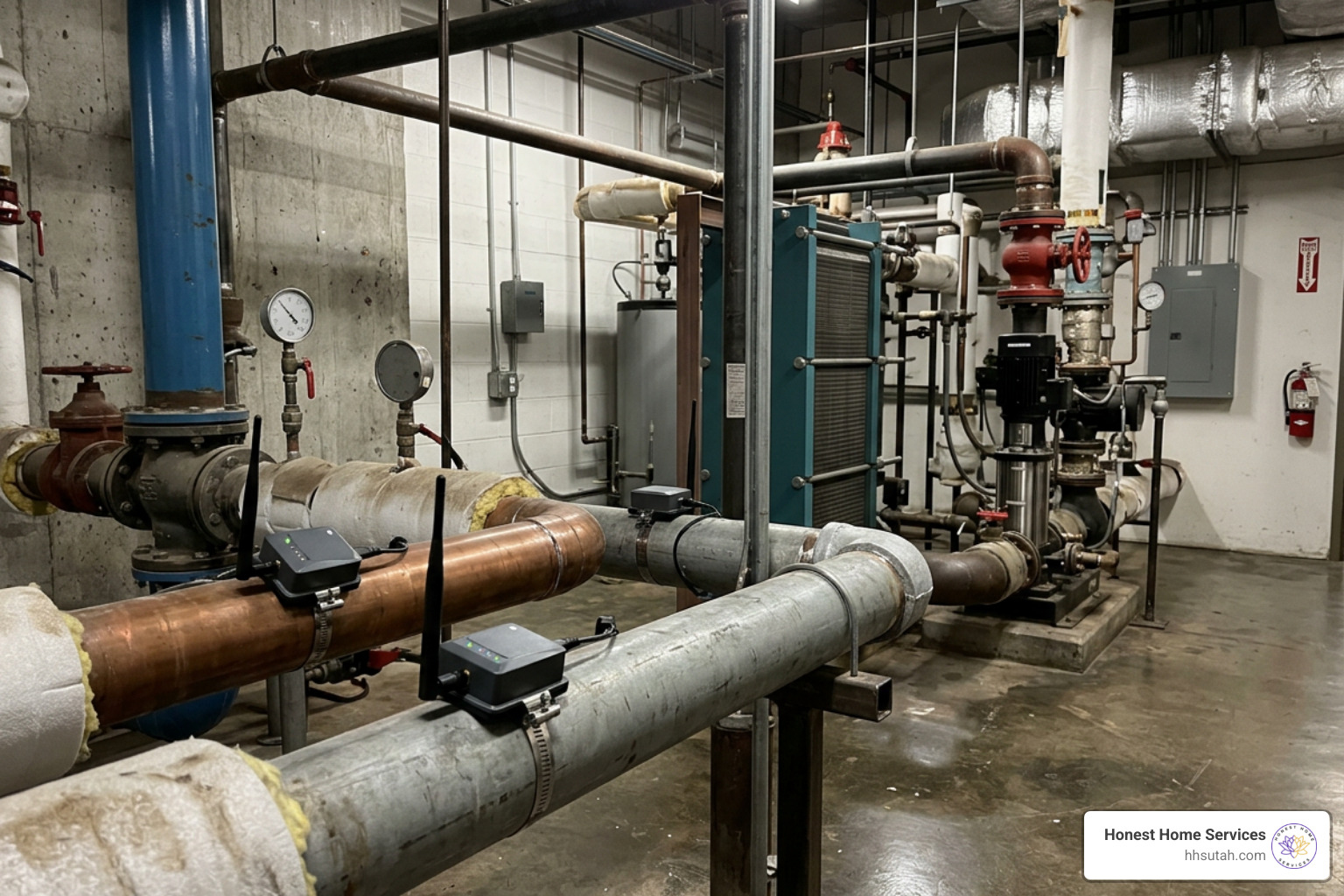
Key Features of a Commercial Water Leak Detection System
When selecting hardware, ensure the system includes these essential commercial-grade features:
- Automatic Shut-Off Valves: Detection is only half the battle. A system must have the physical capability to stop the flow of water automatically when a major leak is identified. For life safety compliance, fire mains and sprinkler systems must always be excluded from automatic shutoff valves.
- Cellular Connectivity: Systems that rely solely on local Wi-Fi will fail during a power outage or network disruption. Cellular-connected hubs bypass local IT security protocols and ensure continuous monitoring 24/7/365.
- 3-in-1 Environmental Sensing: High-quality spot sensors, such as the Eddy H2O | Wireless water detection sensor | Eddy Solutions , track water presence, ambient temperature, and relative humidity. This helps catch freezing pipe risks before they rupture and identifies high humidity levels that foster mold growth.
- Specialized Physical Form Factors: For unique building areas, look for specialized solutions. This includes vandal-resistant restroom sensors with “wash-down modes” for janitorial cleaning, or low-profile ceiling trays designed to catch overhead pipe drips before they ruin acoustic tiles. You can explore these options further through Water Alert® Commercial Water Leak Detection Systems .
Integrating Smart Water Detectors with Building Management Systems (BMS)
For modern commercial properties, standalone systems create unnecessary software silos. True operational efficiency is achieved by integrating your water leak detection hardware directly with your existing Building Management System (BMS).
Using open APIs or dry-contact relays, your leak detectors can feed real-time data directly to your central facility dashboard. When a leak is detected, the BMS can automatically coordinate responses: shutting down corresponding HVAC water chillers, alerting on-site security, and logging the precise time and location of the event.
For properties where cutting pipes is not an option, non-invasive clamp-on sensors offer an elegant solution. You can read more about these technologies in our guide on Non-Invasive Ways to Detect Water Flow in Your Pipes.
Frequently Asked Questions about Commercial Leak Detection
Managing a commercial facility comes with a unique set of responsibilities. Here are some of the most common questions we hear from building owners and property managers in Northern Utah.
How do commercial leak detection systems reduce insurance premiums?
Insurance underwriters evaluate properties based on risk. Because water damage is the leading cause of non-weather-related commercial property losses, installing an active mitigation system significantly reduces their financial exposure.
When you install a system with automatic shutoff capabilities, you can provide your carrier with documented mitigation reports. These reports act as verifiable proof of your building’s rapid response time. Many major insurance carriers offer premium discounts, lower deductibles, or policy rebates for properties that implement these certified systems.
Can these systems be retrofitted into older commercial buildings?
Yes, absolutely. Modern smart water systems are highly adaptable. Thanks to wireless communication protocols like LoRaWAN and long-lasting battery lives (often exceeding 6 to 7 years), sensors can be installed in hard-to-reach areas without tearing down walls or running miles of physical wiring.
Non-invasive, clamp-on flow sensors can easily strap onto existing water meters to track water usage without requiring pipe cuts. If you are planning a system upgrade for an older property, our Leak Detection Company Complete Guide covers what to look for when choosing a professional installation team.
How do leak detection systems support corporate sustainability and ESG goals?
Water waste is a growing concern, especially in drought-prone western states like Utah. Undetected leaks—such as running toilets, malfunctioning cooling towers, and weeping pipe joints—account for a massive percentage of commercial water waste.
By utilizing smart water platforms like the ODEUS – Smart Water Leak Detection Sensor or Commercial Water Leak Detection – Alert Labs , facilities can monitor consumption minute-by-minute. This granular data allows companies to verify their water conservation efforts, reduce utility bills, and back up their environmental claims with concrete, auditable metrics for annual ESG reporting.
Conclusion
Investing in a commercial water leak detection system is no longer a luxury—it is a foundational necessity for modern property management. From protecting sensitive server rooms to securing lower insurance premiums and preventing catastrophic business downtime, a proactive water management strategy safeguards your physical assets and your bottom line.
At Honest Home Services, we are dedicated to providing the reliable, expert plumbing support that Northern Utah businesses trust. Our team of local, certified technicians is ready to help you design, install, and maintain a commercial leak detection system tailored to your building’s unique layout and operational needs.
Whether you are located in Salt Lake City, Davis County, Layton, Park City, or Lehi, we are here to ensure your property remains dry, compliant, and efficient.
Don’t wait for a costly drip to turn into an expensive flood. Schedule a commercial leak detection consultation in Salt Lake City with our expert team today, or call us to learn more about our comprehensive commercial plumbing services.