

Understanding Your Main Sewer Repair Cost in 2026
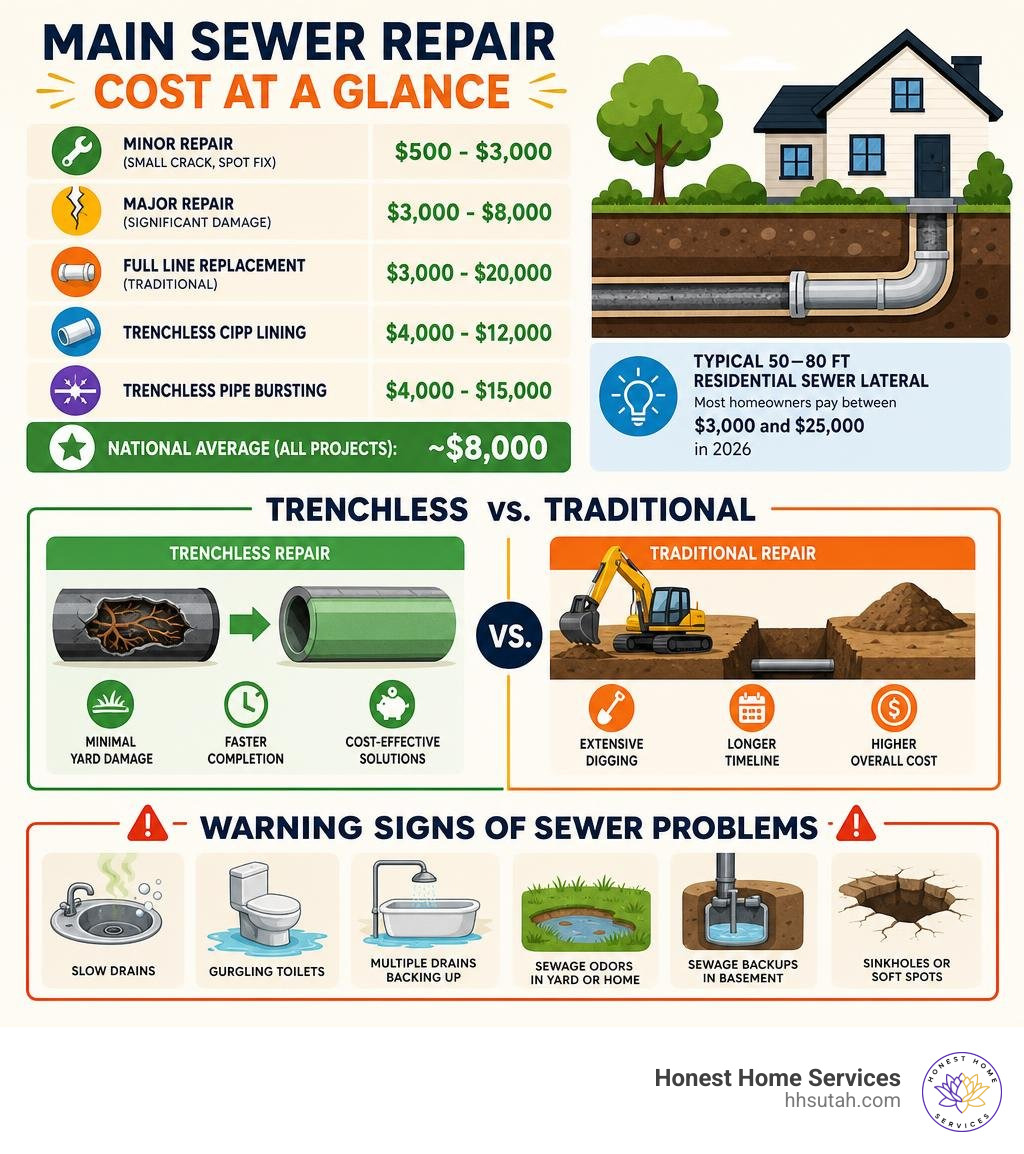
Main sewer repair cost ranges widely depending on the severity of the damage and the method used. Here is a quick overview so you can budget before reading further:
| Repair Type | Typical Cost Range |
|---|---|
| Minor repair (small crack, spot fix) | $500 – $3,000 |
| Major repair (significant damage) | $3,000 – $8,000 |
| Full line replacement (traditional) | $3,000 – $20,000 |
| Trenchless CIPP lining | $4,000 – $12,000 |
| Trenchless pipe bursting | $4,000 – $15,000 |
| National average (all projects) | ~$8,000 |
The national average sits around $8,000 for a typical 50 to 80 foot residential sewer lateral in 2026. Most homeowners pay somewhere between $3,000 and $25,000, depending on pipe length, depth, repair method, and what is sitting above the pipe.
The hard part is that sewer problems rarely announce themselves early. By the time raw sewage is backing up into your basement or a sinkhole appears in your yard, the damage is already significant — and so is the bill.
At Honest Home Services, we have spent over 20 years helping Utah homeowners navigate exactly this situation, giving them straight answers on main sewer repair cost so there are no surprises when the invoice arrives. In this guide, we will walk you through every factor that affects your final price.
Main sewer repair cost terms made easy:
When you are facing a sewer line issue in Northern Utah, the first question is always: How much is this going to cost me? It is a completely fair question. Nobody wakes up in the morning hoping to spend their hard-earned savings on an underground pipe.
To understand your potential bill, we have to look at both the national averages and our local Utah market. Nationally, minor repairs like fixing a small crack or a single separated joint run between $500 and $3,000. Major repairs, which involve replacing larger sections of damaged pipe, typically cost between $3,000 and $8,000. If the entire line is beyond saving, a full replacement will run anywhere from $3,000 to $25,000, as outlined in this Sewer Line Replacement Cost 2026 Guide.
How does Utah compare? According to 2026 cost data, Utah homeowners actually enjoy slightly lower average costs than the national baseline for basic repairs. The Utah state average for a sewer line repair is $3,325, with low-end repairs starting around $950 and high-end, complex repairs topping out near $7,125.
However, where you live in the Beehive State makes a big difference. If you are in Salt Lake City, the average repair cost jumps to $3,675 due to denser neighborhoods, older infrastructure, and deeper pipe layouts. Down in Provo, the average sits slightly lower at $3,430.
Understanding these differences is key to budgeting. If you want to dive deeper into how these estimates are calculated, check out our guide on understanding sewer line repair expenses.
Factors That Drive the Main Sewer Repair Cost
No two sewer lines are identical, which is why plumbers cannot give you a flat, one-size-fits-all price over the phone without looking at the property. Several geological and structural factors will push your estimate up or down:
- Pipe Depth: This is a massive cost driver in Utah. In warmer climates, sewer lines might only be 2 to 3 feet deep. However, in Northern Utah, lines must be buried deeper—often 4 to 8 feet down—to stay safely below the frost line. If you live in an older home in Salt Lake City or up in Park City, your lines could be buried 10 feet deep or more. Deeper pipes require heavy excavation equipment, trench shoring to satisfy OSHA safety laws, and significantly more labor hours, which can easily double the digging costs.
- Soil Type: The dirt in your yard plays a huge role. Sandy or loose soils are easy to shovel but prone to cave-ins, requiring wider trenches. On the other hand, heavy clay soils—common throughout the Salt Lake Valley—are dense, heavy, and incredibly difficult to dig through. Clay soil also swells and shrinks with moisture changes, putting immense physical stress on buried pipes.
- Pipe Material: What is your sewer line made of? If your home was built before 1970, you likely have vitrified clay or cast iron pipes. Clay is highly brittle and easily crushed by shifting soil, while cast iron is prone to internal rust and scaling (tuberculation). If you have Orangeburg pipes (made of tar paper and wood pulp, common in mid-century homes), they are almost guaranteed to be collapsed by now. Modern replacements utilize high-density polyethylene (HDPE) or Schedule 40 PVC, which are smooth, highly durable, and resist root intrusion for 50 to 100 years.
- Tree Roots: Trees love sewer lines. The warm, nutrient-rich water vapor escaping from tiny pipe joints acts like a beacon for thirsty roots. Once they find a microscopic crack, they wiggle inside and expand, eventually shattering the pipe. Removing root blockages via hydro jetting costs $300 to $900 before the actual pipe repair can even begin.
For a complete breakdown of how these elements come together to form a final estimate, read our comprehensive sewer line replacement cost guide.
Cost Differences: Under Slab vs. In the Yard
Where the break occurs dictates how painful the repair process will be for your property and your wallet.
If the damaged section of the pipe is out in your yard, the repair is relatively straightforward. We can either excavate a trench or use trenchless technology to fix it. While traditional yard excavation will tear up your grass, the physical digging is fast.
However, if the pipe has failed directly under your home’s concrete slab foundation, you are looking at a much more complex project. To access a pipe under a slab traditionally, plumbers must use jackhammers to break through your indoor flooring and concrete foundation. This “slab trenching” adds a massive premium of $300 to $350 per linear foot just for the demolition and excavation.
Once the pipe is fixed, you then have to pay to repour the concrete foundation, repair the subfloor, and replace your indoor tile, hardwood, or carpet. This structural and cosmetic restoration can easily add $5,000 to $12,000 to the plumbing bill.
Because of this, we almost always recommend rerouting the sewer line around the outside of the foundation or using trenchless structural pipe lining to avoid touching the concrete slab altogether.
Traditional Excavation vs. Trenchless Sewer Repair
If you need a sewer line replacement or major repair, you generally have two paths: traditional open-trench excavation or modern trenchless technology.
Traditional excavation is the classic “dig up the yard” method. We bring in a backhoe, dig a continuous trench from your home to the street, pull out the old pipe, lay down a new one, and bury it.
Trenchless sewer repair, on the other hand, is like minimally invasive surgery for your yard. Instead of digging up your entire property, we only need one or two small access pits. From there, we use specialized machinery to either reline the existing pipe or burst a new one directly through the old path.
To help you compare the two methods, here is a direct look at how they stack up financially and logistically:
| Feature | Traditional Excavation | Trenchless (CIPP / Pipe Bursting) |
|---|---|---|
| Direct Plumbing Cost | $3,000 – $20,000 | $4,000 – $15,000 |
| Cost Per Linear Foot | $50 – $250 | $60 – $300 |
| Average Project Duration | 3 – 7 Days | 1 – 2 Days |
| Yard/Landscaping Damage | Severe (requires full trench) | Minimal (1-2 small access pits) |
| Restoration Costs | High ($2,000 – $12,000+) | Extremely Low ($0 – $1,000) |
| Expected Lifespan | 50 – 100 Years (PVC) | 50+ Years (HDPE/Epoxy) |
| Warranty Offered | Typically 1 – 2 Years | Typically 20 – 50 Years |
Choosing between these two options requires weighing the upfront plumbing bid against the total project cost, including the aftermath of the dig. You can read more about making this choice in our guide on trenchless or traditional options.
How Trenchless Methods Lower the Total Main Sewer Repair Cost
At first glance, the per-foot price of trenchless plumbing can seem slightly higher than traditional digging. However, focusing solely on the plumbing bid is a major trap that catches many homeowners off guard. The real savings of trenchless technology come from avoiding the “hidden” restoration costs.
When we dig a traditional trench across your property, we have to cut through whatever is sitting on top of that pipe. If your sewer lateral runs under a manicured lawn, a mature flower bed, a concrete driveway, a custom patio, or a sidewalk, all of those features will be completely destroyed.
Traditional excavation yard restoration costs typically range from $2,000 to $8,000 for landscaping, sod, and trees. If we have to cut through a concrete driveway or patio, repaving can easily add $3,000 to $12,000 to your total bill.
With trenchless methods, those restoration costs drop to practically zero.
There are two primary trenchless methods we use:
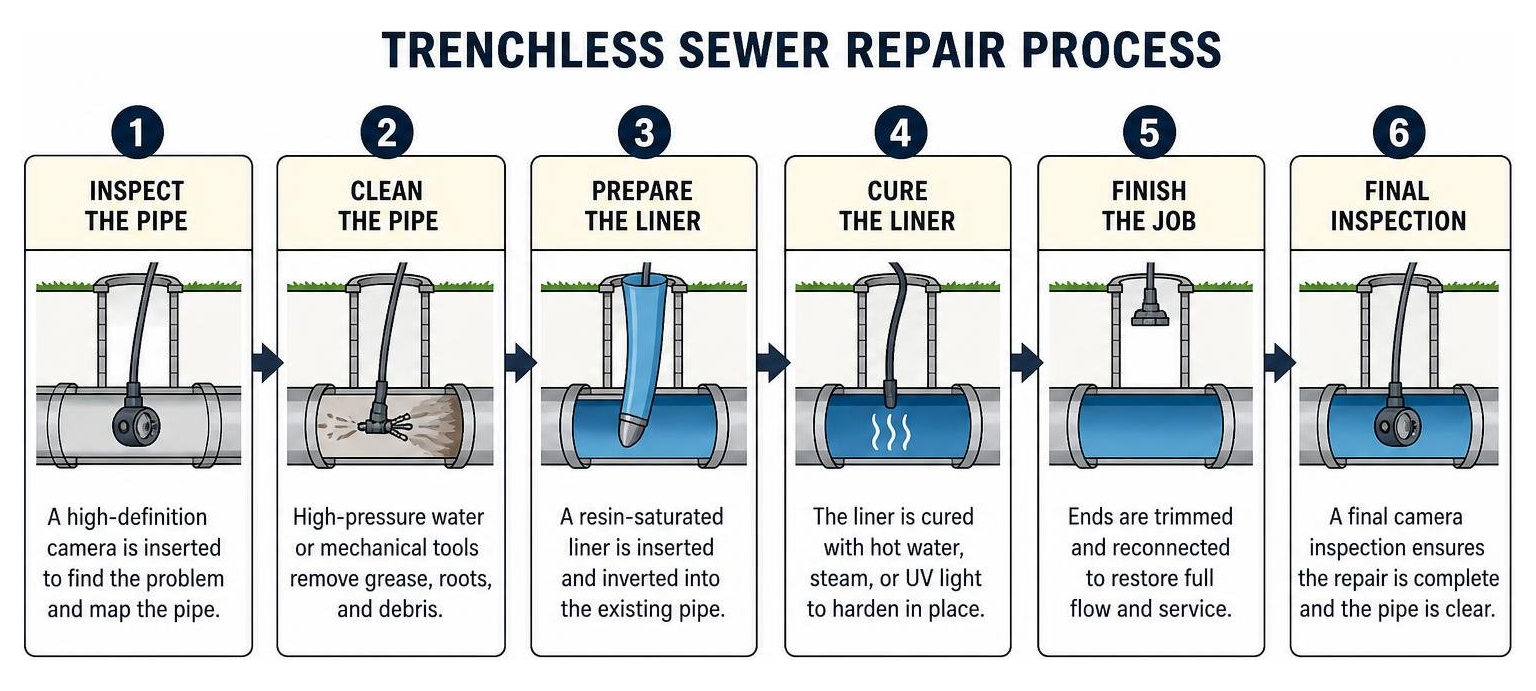
- Cured-in-Place Pipe (CIPP) Lining: We insert an epoxy-saturated felt tube into your old pipe, inflate it, and let it cure using heat or UV light. This creates a brand-new, seamless, jointless pipe inside your old one, reducing the diameter by only about a quarter of an inch.
- Pipe Bursting: We pull a high-strength, cone-shaped bursting head through your old pipe. This head physically breaks the old clay or cast iron pipe apart while simultaneously pulling a brand-new, seamless HDPE pipe into its place.
By choosing trenchless, you preserve your expensive landscaping, driveways, and patios, which almost always results in a lower total project cost. For a broader look at national trenchless pricing, check out this guide on How Much Sewer Line Repair Costs.
Warning Signs You Need Sewer Line Repair
Sewer lines rarely collapse overnight. Usually, they scream for help long before they completely fail. Catching these warning signs early can mean the difference between a simple spot repair and an expensive, emergency whole-house backup.

Keep an eye (and nose) out for these common red flags:
- Multiple Slow Drains: If a single sink is draining slowly, it is probably just a local hair clog. But if your kitchen sink, bathtub, and laundry line are all draining slowly at the same time, the blockage is deep in your main sewer lateral.
- Gurgling Toilets: When you flush your toilet, does it sound like a boiling cauldron? Or does water bubble up in your shower drain when the washing machine drains? This happens because air is trapped in the line by a blockage, forcing sewer gases to bubble up through your fixtures.
- Persistent Sewer Odors: A healthy plumbing system should keep sewer gases completely contained. If you smell rotten eggs or sulfur inside your home, in your basement, or near your yard drains, you likely have a cracked sewer line.
- Unusually Lush, Green Patches of Grass: If one strip of your lawn is suddenly growing twice as fast and looks incredibly vibrant compared to the rest of your yard, do not celebrate just yet. Raw sewage is an excellent fertilizer. A cracked pipe under your yard is likely leaking nutrient-rich wastewater straight into the roots of your grass.
- Soggy Spots or Sinkholes: If the leak is severe, the constant flow of water will saturate the surrounding soil, causing it to compress and sink. This leads to muddy, wet patches in your yard even when it hasn’t rained, or localized sinkholes.
- Pest Infestations: Rats, mice, and sewer roaches use cracked sewer lines as underground highways. If you have a sudden pest problem in your basement that exterminators cannot seem to solve, a broken sewer pipe might be providing them with an easy entryway.
If you notice any of these signs, the very first step should always be a professional video camera inspection. This allows us to run a high-definition camera down the line to see exactly what is going on. You can learn about what this costs in our camera inspection cost guide.
Spot Repair vs. Full Sewer Line Replacement
If our camera inspection reveals a break in your sewer line, you face a critical decision: Do you perform a localized spot repair, or do you replace the entire line?
A spot repair (or point repair) makes perfect sense if the rest of your sewer line is in great structural shape. For example, if a single tree root has cracked a joint on an otherwise healthy 15-year-old PVC line, we can dig a small hole, cut out the damaged 4-foot section, and clamp in a new piece of pipe. Spot repairs typically cost between $1,500 and $4,500.
However, a spot repair is a temporary band-aid if your pipe material is near the end of its natural lifespan.
Here is what you can expect for the lifespan of different sewer pipe materials:
- Orangeburg: 30 – 50 Years (highly prone to collapse; should always be fully replaced)
- Vitrified Clay: 50 – 60 Years (brittle, highly susceptible to root intrusion at every joint)
- Cast Iron: 50 – 75 Years (prone to internal rust, scaling, and bottom-channel rotting)
- Modern PVC / HDPE: 50 – 100+ Years (highly durable, smooth, and completely root-resistant)
If you have an older clay or cast iron line that is already showing multiple cracks, bellies (sagging sections), or widespread root intrusion, paying for a spot repair is often throwing good money after bad. If the pipe has failed in one spot due to old age, it will likely fail in another spot within 12 to 18 months. In these cases, a full replacement is the smarter, more cost-effective long-term financial choice.
Frequently Asked Questions About Sewer Repair
Does homeowners insurance cover main sewer line repair?
This is one of the most common questions we get, and the short answer is: Usually, no.
A standard HO-3 homeowners insurance policy specifically excludes coverage for underground utility lines that fail due to wear and tear, age, corrosion, or tree root intrusion. Because these issues develop slowly over decades, insurance companies view them as standard home maintenance responsibilities.
However, there are two important exceptions to keep in mind:
- Sewer Backup Endorsement: This is an optional add-on to your standard policy (usually costing $50 to $250 per year). It does not pay to repair the broken pipe outside, but it will pay to clean up the toxic mess and replace the ruined drywall, flooring, and furniture if sewage backs up into your basement.
- Service Line Coverage: This is a relatively new, highly valuable insurance rider (typically costing just $30 to $90 per year). If you add this to your policy before you have a problem, it will actually cover the excavation, repair, and replacement of your buried sewer, water, and gas lines up to a certain limit (usually $10,000 or $15,000). We highly recommend all Northern Utah homeowners call their insurance agents to add this coverage today.
What permits and inspections are required for sewer work?
Because sewer lines carry hazardous bio-waste, all sewer line repairs and replacements require official municipal plumbing permits and inspections. You cannot legally dig up or repair a sewer line without them.
In Northern Utah, a standard residential sewer permit costs between $100 and $500. If the repair work extends past your property line and requires digging into the public sidewalk or street to connect to the city main, you will also need a right-of-way permit and a traffic control plan, which can push permit fees up to $2,000.
Once the work is completed, but before the trench is backfilled with dirt, a local city or county plumbing inspector must come out to the property. They will physically inspect the new pipe, verify the slope (grade) is correct so waste flows properly, and sometimes require a hydrostatic pressure test to ensure there are zero leaks.
At Honest Home Services, we handle the entire permitting and inspection process for our customers, ensuring all work is 100% compliant with local Utah building codes.
How can homeowners save money on sewer line repairs?
While a sewer repair is never cheap, there are several smart ways to keep your costs as low as possible:
- Catch Problems Early: Do not ignore slow drains or gurgling toilets. Clearing a simple root blockage with hydro jetting costs a few hundred dollars. Ignoring it until the pipe collapses entirely will cost you thousands.
- Get a Video Camera Inspection First: Never let a plumber quote you for a full replacement without showing you the live video footage of the inside of your pipe. A camera inspection ensures you are paying for the exact repair you actually need, rather than a worst-case scenario guess.
- Choose Trenchless Options: Even if the upfront plumbing bid for trenchless lining is slightly higher than traditional digging, calculate the total cost including yard, driveway, and landscaping restoration. Trenchless is almost always the cheaper option overall.
- Schedule During Shoulder Seasons: If your sewer line is flowing but needs repair soon, try to schedule the work during the spring or fall. Plumbing companies are often slammed with heating emergencies in the winter and AC calls in the summer, meaning you can sometimes secure better rates during their slower months.
Conclusion
Facing a main sewer line issue can feel overwhelming, but you do not have to navigate it alone. Understanding the factors that drive your main sewer repair cost—from pipe depth and soil chemistry to traditional excavation versus modern trenchless technology—empowers you to make the smartest financial decision for your home.
At Honest Home Services, we pride ourselves on delivering transparent, fair pricing and reliable plumbing solutions to our neighbors throughout Northern Utah. Whether you are in Salt Lake City, Davis County, or Draper, our local, expert technicians are ready to help with state-of-the-art diagnostic cameras and minimally invasive trenchless repair options.
Do not wait for a small clog to turn into a major basement flood. Contact us today to schedule a Salt Lake City sewer mainline repair and get an honest, accurate assessment of your system’s health.