

What Does Water Heater Thermostat Replacement Cost in 2026?
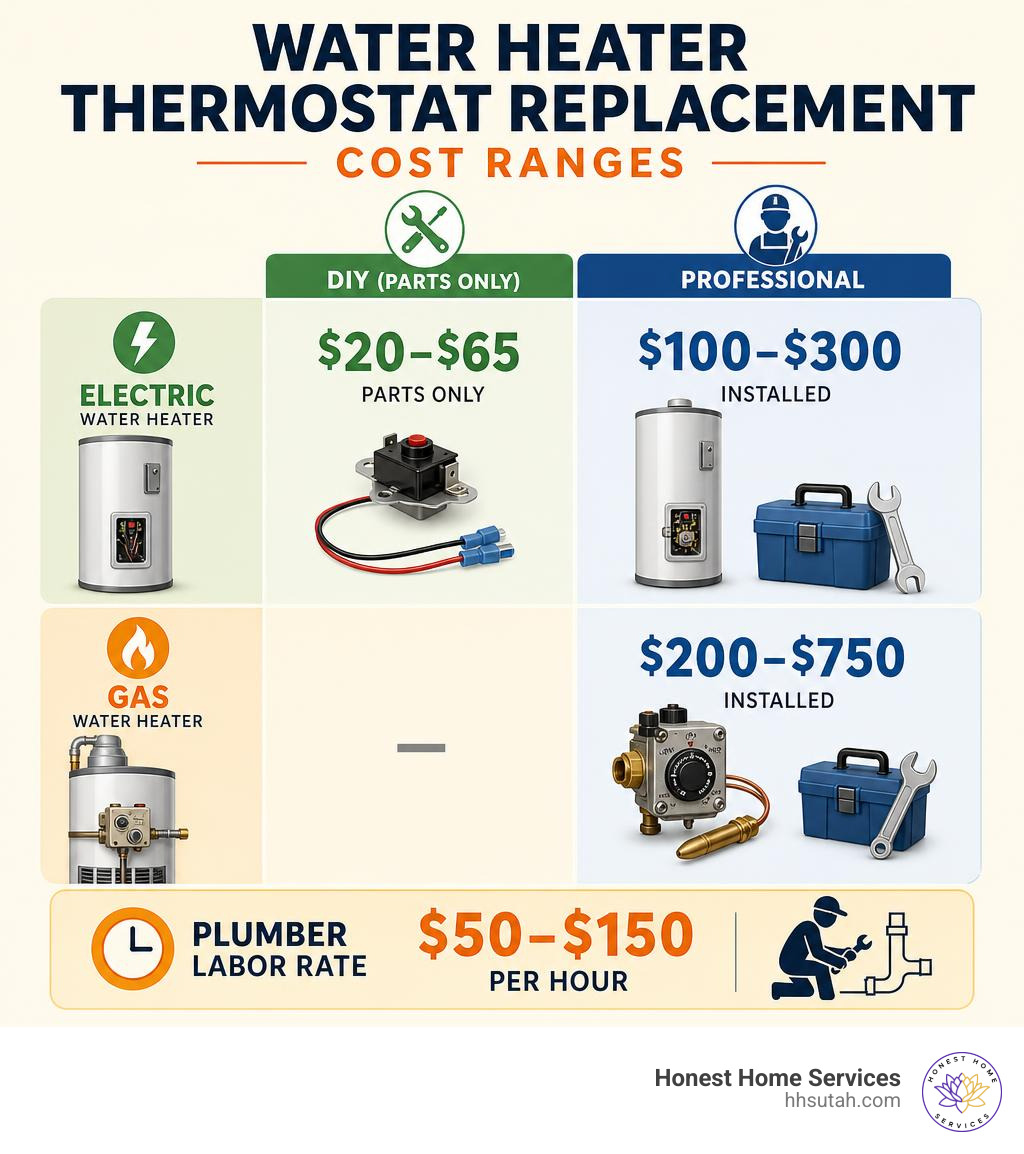
The water heater thermostat replacement cost typically falls between $100 and $350 for most homeowners in 2026 — but what you’ll actually pay depends on your heater type, whether you DIY or hire a pro, and where you live.
Here’s a quick breakdown:
| Scenario | Typical Cost Range |
|---|---|
| DIY electric thermostat (parts only) | $20 – $65 |
| Professional electric thermostat replacement | $100 – $300 |
| Gas thermostat / control valve replacement (pro) | $200 – $750 |
| Plumber labor rate | $50 – $150 per hour |
Cold showers and rising utility bills are usually the first signs something’s wrong. A failing thermostat can get stuck “on” — running your heater non-stop — or stop responding entirely, leaving you with lukewarm water at best. Either way, the fix is time-sensitive.
At Honest Home Services, our team has over 20 years of experience handling water heater thermostat replacement across Northern Utah, giving us a clear picture of what fair, transparent pricing looks like for this exact repair. We’ll walk you through everything you need to make a confident decision.
Glossary for water heater thermostat replacement cost:
Average Water Heater Thermostat Replacement Cost in 2026
When budgeting for a water heater repair, it helps to understand how the final bill is structured. In 2026, the overall average homeowner spends about $600 on a typical water heater repair, with total costs ranging from $90 to $1,775+ depending on the specific component that has failed. However, a thermostat replacement is a relatively minor and affordable fix, generally falling in the $100 to $350 range.
The price you pay is primarily driven by whether your water heater runs on electricity or gas. Gas units require a more complex part called a gas control valve, which houses the thermostat. Electric units, on the other hand, use simple, low-voltage thermostats that are much cheaper to purchase and quicker to install.
| Cost Component | Electric Water Heater | Gas Water Heater |
|---|---|---|
| Thermostat Part Cost | $20 – $65 | $140 – $400 (Gas Control Valve) |
| Professional Labor (1–2 hrs) | $100 – $250 | $150 – $350 |
| Diagnostic / Service Fee | $75 – $200 | $75 – $200 |
| Total Professional Cost | $100 – $300 | $250 – $750 |
Most professional plumbing companies charge a diagnostic fee between $75 and $200 to visit your home, test the system, and confirm the exact cause of the failure. If you decide to move forward with the repair, many plumbers (including us at Honest Home Services!) will apply that diagnostic fee toward the total cost of the job.
To get a broader sense of how thermostat repairs fit into your overall system budget, you can check out this Thermostat Replacement Cost: DIY vs Pro Guide or use an online Water Heater Cost Calculator (2026) to estimate potential expenses based on your specific tank type and size.
Electric Water Heater Thermostat Replacement Cost
Electric water heaters are a bit unique because most standard models (especially those 40 gallons or larger) actually use two thermostats: an upper thermostat and a lower thermostat.
These two thermostats work in a relay system to control their respective upper and lower heating elements. They do not run at the same time. First, the upper thermostat senses cold water and turns on the upper heating element. Once the top portion of the tank is hot, the upper thermostat switches power down to the lower thermostat, which activates the lower heating element to heat the rest of the tank.
If you are experiencing lukewarm water, it often means only one of these thermostats or elements has failed. For example, if you get a few minutes of hot water that quickly turns cold, your lower thermostat or element is likely broken.
For a DIYer, purchasing a single replacement electric thermostat part is very affordable, typically costing between $20 and $65. If you hire a professional plumber, the job usually takes 1 to 1.5 hours, bringing the total professional cost to $100 to $300 per thermostat. If both thermostats are old, we often recommend replacing both at the same time to save on future labor charges. To see how these costs compare to other standard electric tank repairs, read our guide on How Much Will Your Broken Water Heater Cost To Fix.
Gas Water Heater Thermostat Replacement Cost
Replacing a thermostat on a gas water heater is a completely different story. Gas units do not have an independent, clip-on thermostat like electric models. Instead, the thermostat is fully integrated into the gas control valve assembly (the large box on the front of your water heater where you adjust the temperature dial).
Because the thermostat is built directly into this valve, you cannot replace the thermostat by itself. You must replace the entire gas control valve assembly. This part is significantly more expensive, with OEM replacement valves typically costing between $140 and $400 depending on the brand (such as Rheem, A.O. Smith, or Bradford White).
In addition to the higher part cost, gas repairs carry strict safety requirements. The technician must safely shut off the main gas line, disconnect the pilot tube, burner tube, and thermocouple, drain the tank partially to unscrew the old valve, thread in the new valve, and test the entire system for gas leaks.
Because of the specialized skills required and the potential safety risks of working with natural gas, this is not a recommended DIY project. Professional labor for a gas control valve replacement typically takes 1.5 to 2 hours and costs between $250 and $750 in total. You can learn more about these specialized gas repairs by reading our detailed breakdown of Understanding Gas Water Heater Service Costs.
Key Factors Influencing Your Repair Bill
When you call a plumber in Northern Utah, you might notice that quotes for a water heater thermostat replacement cost can vary. This is because several real-world factors influence the final invoice.
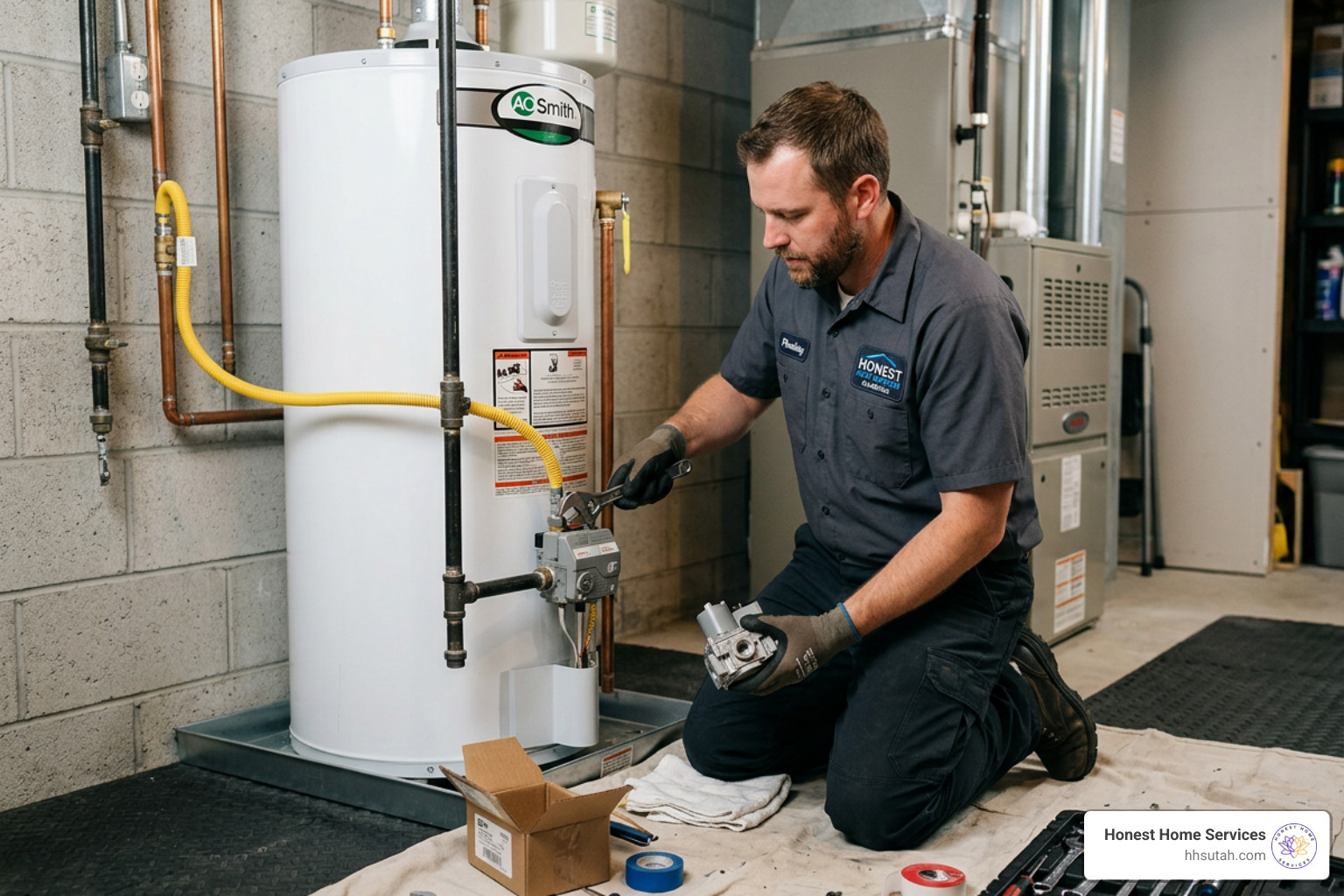
- Unit Accessibility: Is your water heater easily accessible in a spacious basement or utility closet, or is it squeezed into a tight crawlspace, attic, or a cramped closet in Park City? If our technicians have to spend extra time squeezing into tight spots or removing obstacles to access your water heater, the extra labor time will increase the final bill.
- Geographic Location and Labor Rates: Labor rates are heavily influenced by local living costs and regional overhead. According to the Average Water Heater Cost by State in 2026, states with higher living costs see significantly higher repair bills. Here in Utah, plumber labor rates generally range from $50 to $150 per hour.
- Local Code Requirements: If your water heater was installed several years ago, local plumbing codes in cities like Salt Lake City, Layton, or West Jordan may have changed. If a professional plumber opens up your system to replace a major part like a gas control valve, they may be legally required to bring certain aspects of your system up to current code (such as installing an expansion tank or upgrading a flue vent pipe). These safety upgrades can add to your overall bill. You can read more about local pricing dynamics in this guide on Utah Water Heater Repair Cost Factors.
- Emergency vs. Scheduled Service: If your water heater quits on a Sunday morning or during a freezing winter night, you might need emergency service. Emergency or after-hours service calls typically carry a premium surcharge of $150 to $300 to cover the overtime rates for dispatching a technician outside of normal business hours.
How to Diagnose a Faulty Water Heater Thermostat
Before you spend money on a replacement, you want to be reasonably sure that the thermostat is actually the culprit. Many water heater symptoms can overlap with other issues, like a burned-out heating element or a broken dip tube.

Here are the most common signs that your water heater thermostat is failing:
- No Hot Water at All: If your water is completely ice-cold, the upper thermostat on an electric unit may have failed, or the gas control valve on a gas unit may be broken. On electric models, first check your main electrical panel to ensure the circuit breaker hasn’t tripped. If the breaker is on, press the red high-limit reset button located on the upper thermostat. If it trips again immediately, you likely have a shorted element or a faulty thermostat.
- Lukewarm Water: If your water gets warm but never truly hot, one of your electric thermostats is likely failing to signal its corresponding heating element to turn on.
- Running Out of Hot Water Quickly: If you get a few minutes of hot water and then it suddenly goes cold, your lower thermostat has likely failed. The upper thermostat heats the top of the tank (giving you a brief burst of hot water), but because the lower thermostat is broken, the bottom of the tank remains cold.
- Inconsistent Temperatures (“Ghost Cycling”): If your water temperature fluctuates wildly from day to day—scalding hot one morning and lukewarm the next—the internal calibration of your thermostat is failing.
- Unusually High Energy Bills: If your thermostat gets stuck in the “on” position, it will continuously send power to the heating elements or keep the gas burner running non-stop. This continuous cycle wastes massive amounts of energy and will cause a sudden, painful spike in your monthly utility bills.
If you are experiencing any of these issues, you can read our comprehensive guide on Common Water Heater Problems to help narrow down the exact cause.
DIY vs. Professional Thermostat Replacement
If you are a handy homeowner in Davis County or Salt Lake County, you might be tempted to tackle a thermostat replacement yourself to save on labor costs. While this is entirely possible for electric water heaters, it is highly discouraged—and often dangerous—for gas models.
For an electric water heater, DIY replacement is a reasonable weekend project if you have basic electrical knowledge. To help you decide if you’re ready to take this on, you can read our guide on how to Fix Broken Water Heater Issues Like A Pro.
If you choose to DIY an electric thermostat replacement, here are the tools you will need:
- Non-contact voltage tester (absolutely essential for safety!)
- Screwdrivers (flathead and Phillips)
- Needle-nose pliers
- A multimeter (to test for continuity and voltage)
- Replacement thermostat (ensure it matches your unit’s voltage and model)
Step-by-Step DIY Electric Thermostat Replacement:
- Turn Off the Power: Locate your home’s main electrical panel and turn off the dedicated double-pole breaker for your water heater (usually a 30-amp, 240-volt breaker).
- Verify the Power is Off: Remove the metal access covers on the side of your water heater and fold back the insulation. Use your non-contact voltage tester on the wire terminals to double-check and triple-check that there is absolutely zero electrical current running to the unit. Do not skip this step!
- Document the Wiring: Take a clear digital photo of the existing wiring on your smartphone. This will serve as your reference map when connecting the new thermostat.
- Disconnect and Remove: Carefully disconnect the wires from the terminal screws. Slide the old thermostat out of its metal retaining clip on the side of the tank.
- Install the New Thermostat: Slide the new thermostat into the retaining clip, ensuring it fits snugly against the tank wall (it must make direct contact with the tank to read the temperature accurately).
- Reconnect Wires: Using your photo as a guide, connect the wires to the correct terminals and tighten the screws.
- Set the Temperature: Use a flathead screwdriver to set the temperature dial to 120°F (49°C). This is the recommended setting to prevent accidental scalding and maximize energy efficiency.
- Replace Covers and Restore Power: Replace the plastic protective cover, tuck the insulation back in, screw the metal access doors back on, and turn the circuit breaker back on. Wait about an hour and test your hot water!
Why Gas Thermostat Replacement is a Job for Professionals: We cannot stress this enough: do not attempt to replace a gas control valve yourself. Working with gas lines carries extreme safety hazards, including gas leaks, fire risks, explosion hazards, and carbon monoxide poisoning if the flue venting is not reassembled correctly. Furthermore, many local municipalities in Northern Utah require a licensed plumber to pull a permit for any gas line modifications to ensure the work is inspected and compliant with local safety codes.
Repair vs. Replace: When to Buy a New Water Heater
If your water heater thermostat has failed, you face a classic homeowner dilemma: should you pay for the repair, or is it time to bite the bullet and replace the entire unit?
To make the best financial choice, consider the following three factors:
- The Age of Your Water Heater: Standard tank-style water heaters have an average lifespan of 8 to 12 years in Northern Utah due to our regional water chemistry. If your water heater is under 8 years old, replacing a faulty thermostat is highly cost-effective and will easily extend the life of your unit. However, if your water heater is over 10 or 12 years old, the tank is likely nearing the end of its reliable lifespan. Spending $200 to $300 on a repair today might only buy you a few months before another major component fails or the tank itself begins to leak.
- Signs of Tank Corrosion: Thermostats, heating elements, and valves can all be replaced. A leaking or corroding tank, however, cannot be repaired. Inspect the bottom of your water heater and the surrounding floor. If you see active water leaks, rusty water coming out of your faucets, or heavy rust accumulation around the bottom seams of the tank, the inner steel lining has corroded. In this scenario, a full replacement is your only option.
- The 50% Rule: A good rule of thumb is to look at the total cost of the repair. If the repair quote exceeds 50% of the cost of a brand-new water heater installation, your money is much better spent on an upgrade. A new, energy-efficient model will lower your utility bills and give you years of worry-free hot water.
If you are leaning toward an upgrade, you can read about the long-term benefits and financial savings in our guide on the Advantages Of Water Heater Replacement.
Frequently Asked Questions about Water Heater Thermostats
How long does a water heater thermostat typically last?
A water heater thermostat typically lasts between 6 and 10 years. While they are designed to be durable, their lifespan is heavily influenced by local water quality.
Here in Northern Utah (including Salt Lake City, Sandy, and Layton), our water has a high mineral content. Over time, calcium and magnesium precipitate out of the water and settle at the bottom of the tank as hard sediment. This sediment acts as an insulating barrier, forcing your heating elements and burners to work much harder to heat the water. This extra heat buildup inside the tank subjects the thermostats to extreme thermal stress, often causing them to fail prematurely. You can learn more about how hard water and sediment affect your system in our article on Why Your Water Heater Is Giving You The Cold Shoulder.
Can a faulty thermostat cause my energy bills to spike?
Absolutely. When a water heater thermostat fails, it often gets stuck in the “closed” (or “on”) position. When this happens, the thermostat loses its ability to detect that the water has reached its target temperature. As a result, it continuously feeds electricity to the heating elements or keeps the gas burner firing non-stop.
This constant operation turns your water heater into an incredibly expensive energy drain. Not only will your monthly utility bills skyrocket, but it also poses a serious safety risk of scalding hot water and can quickly burn out your heating elements. If you suspect your system is running constantly, read our guide on Fixing The Flow When Your Hot Water Heater Needs Repair.
Are there rebates or warranties to help cover the cost?
Yes, there are several ways to reduce your out-of-pocket expenses:
- Manufacturer Parts Warranty: If your water heater is less than 6 to 10 years old (depending on the model), the thermostat part itself may still be covered under the manufacturer’s warranty. Be sure to find your water heater’s model and serial number (located on the rating plate on the side of the tank) and check the manufacturer’s website to see if the part is covered. That warranties typically cover the replacement part but do not cover the cost of professional labor.
- Utility Rebates: Many local natural gas and electric utility companies in Utah offer rebates for upgrading to high-efficiency water heating equipment. If you decide to replace an old, inefficient unit rather than repairing a broken thermostat, check with your utility provider for current rebate programs.
- Federal Tax Credits: Under current federal energy programs, homeowners who upgrade to highly efficient heat pump water heaters can claim tax credits of up to $2,000, significantly offsetting the upfront cost of a new system.
Conclusion
A broken water heater thermostat can quickly disrupt your household’s daily routine, turning comfortable morning showers into icy wake-up calls. Fortunately, a water heater thermostat replacement cost is one of the most affordable and straightforward plumbing repairs you can face in 2026.
Whether you need a quick, budget-friendly electric thermostat swap or a highly professional gas control valve replacement, the team at Honest Home Services is here to help. We proudly serve homeowners throughout Northern Utah, including Salt Lake City, Layton, Bountiful, West Jordan, and Draper.
We stand behind our work with fair, upfront pricing, local expert technicians, and a 100% customer satisfaction guarantee. Don’t suffer through another lukewarm shower—Schedule Salt Lake City Water Heater Repair with Honest Home Services today and let us restore your home’s hot water safely and affordably!