

Troubleshooting Common Propane Tankless Water Heater Issues
Propane tankless water heater repair is something most Northern Utah homeowners will face at some point — and knowing where to start can save you time, money, and a lot of cold showers.
Here are the most common propane tankless water heater problems and their fixes:
| Problem | Likely Cause | Quick Fix |
|---|---|---|
| No hot water | Empty propane tank, closed gas valve, or low flow | Check propane level, open valves, verify flow exceeds 0.4 GPM |
| Ignition failure | Gas supply issue or dirty igniter | Check propane, inspect flame rod for carbon buildup |
| Cold water bursts | Cold water sandwich or plumbing crossover | Run water briefly before showering, check check valves |
| Not enough hot water | Mineral buildup or system overload | Flush heat exchanger, reduce simultaneous hot water use |
| Error codes on display | Sensor, venting, or scale issue | Refer to manual, check vents, reset unit |
| Strange noises | Lime deposits, water hammer, or debris | Flush system, install water hammer arrestor |
| Leaking unit | Loose fittings or faulty T&P valve | Inspect connections, call a pro for internal leaks |
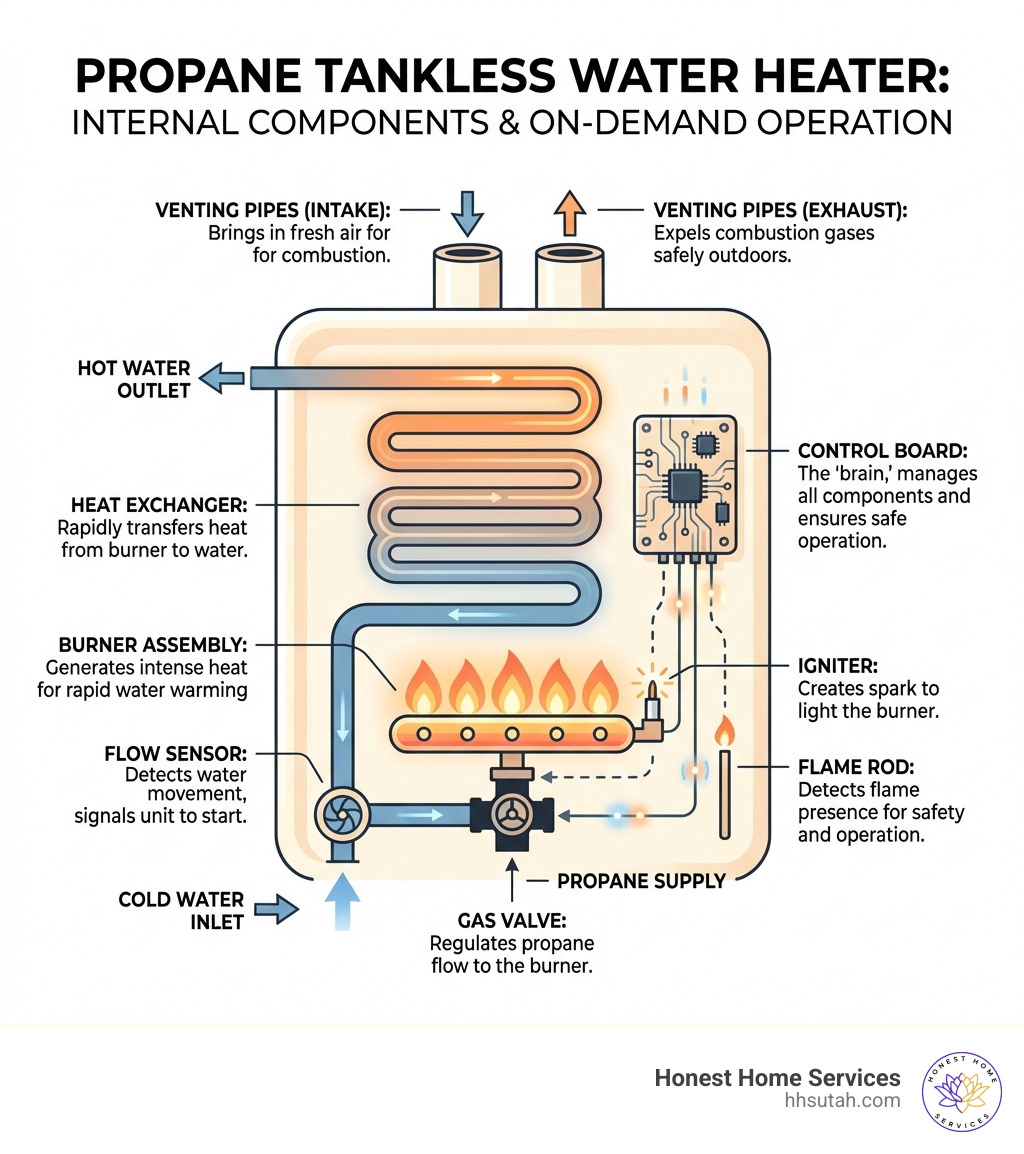
Propane tankless water heaters heat water on demand — only firing up when you open a hot tap. That makes them highly efficient, but it also means several components have to work together perfectly every time. When one part fails, the whole system can stop delivering hot water.
Unlike traditional tank heaters, these units rely on precise gas pressure (between 8.0 and 13.0 inches of water column), minimum flow rates, electronic igniters, and venting systems — all of which can develop issues over time.
The good news? Many problems are fixable without a service call if you know what to look for.
At Honest Home Services, we’ve spent over 20 years repairing propane tankless water heaters for homeowners and small businesses across Northern Utah, making us a trusted name in propane tankless water heater repair. Whether it’s a simple flush or a complex ignition fault, we’ll walk you through what you can handle yourself — and when it’s time to call in a pro.
Propane tankless water heater repair basics:
When your unit stops providing that endless stream of hot water, the first thing we check isn’t the complex electronics—it’s the basics. Tankless units are incredibly sensitive to their environment. For instance, most propane models require a minimum activation flow rate of 0.4 gallons per minute (GPM). If you’re just cracking the tap to wash a single spoon, the heater might not even “wake up.”
Furthermore, propane units are picky about gas pressure. They typically need a minimum inlet pressure of 8.0 inches of water column (In. w.c.) and a maximum of 13.0 In. w.c. to operate safely. If the pressure drops because your propane tank is getting low or the regulator is icing over in a Salt Lake City winter, the unit will shut down to prevent damage. Understanding these common water heater problems is the first step in a successful DIY fix. For those who want to dive deep into the mechanics, referencing a technical troubleshooting and repair manual can provide the specific electrical resistance values needed for advanced testing.
Identifying Why There Is No Hot Water
If you’re standing in a cold shower, start with the “Three Gs”: Gas, GPM, and Grounding (Power).
- Gas: Is your propane tank actually empty? It sounds simple, but we see it all the time in Davis County. Check that all gas valves—both at the tank and the unit—are fully open.
- Power: Ensure the unit is plugged in and the circuit breaker hasn’t tripped. A power surge during a Utah thunderstorm can easily blow a fuse on the control board.
- Flow: If the water is flowing but the heater isn’t clicking on, check your faucet aerators. If they are clogged with grit, the flow rate might drop below that 0.4 GPM threshold.
If you’ve checked these and still have an icy stream, you might need emergency water heater repair services to diagnose a faulty flow sensor or control board.
Solving the Cold Water Sandwich
The “cold water sandwich” is a classic tankless quirk. It happens when you take back-to-back showers. The first person finishes, leaving hot water in the pipes. The second person hops in, feels that warm water, but then gets a 10-second blast of cold water that was sitting in the unit before the burner reignited.
While some of this is inherent to the technology, extreme fluctuations can point to a plumbing crossover. This happens when a single-handle faucet (like in a kitchen or shower) has a worn internal seal, allowing cold water to bleed into the hot water line. You can test this by shutting off the cold water supply to the heater and opening a hot tap; if water keeps flowing, you’ve got a crossover issue. Fixing the flow of your hot water often involves replacing these faulty valves or installing a small buffer tank.
Step-by-Step Propane Tankless Water Heater Repair for Ignition and Flame Failures
Ignition and flame failures are the most frequent reasons for a propane tankless water heater repair call. When the unit tries to light but fails, it’s usually because the “spark” isn’t happening or the “sensor” doesn’t see the flame.
Safety is paramount here. The ignition cable in these units can carry over 10,000 volts. Always disconnect the power before opening the cabinet. If you ever smell gas (that distinct rotten egg odor), do not attempt a repair. Follow proper gas leak detection and safety protocols: leave the house immediately and call your gas supplier or the fire department.
Cleaning the Flame Rod and Igniter
Over time, the flame rod (which tells the computer that a fire is actually burning) can develop a thin layer of carbon or “soot.” When this happens, it can’t send the tiny electrical signal required to keep the gas valve open.
To fix this:
- Turn off the power and gas.
- Remove the burner cover.
- Locate the flame rod and igniter (usually held in by one or two screws).
- Gently clean the metal rod with a piece of fine-grit sandpaper or a Scotch-Brite pad until the metal is shiny.
- Reinstall, ensuring the gap between the igniter and the burner matches the manufacturer’s specs (usually about 1/8th of an inch).
This simple bit of propane tankless water heater repair for ignition issues can save you a $200 service call.
Clearing Air Supply and Exhaust Blockages
Propane tankless heaters are high-performance machines that need to breathe. If the air intake or exhaust vent is blocked, the unit will throw an error code (often a 10 or 90) and shut down for safety. In Northern Utah, we frequently find bird nests, wasp hives, or even accumulated snow blocking these pipes.
Check your external vent terminations. Most non-condensing units require Category III stainless steel venting to handle acidic exhaust. If you see white powdery residue or “pitting” on the vents, they may be corroding and leaking exhaust back into the intake. Also, don’t forget to clean the intake filter inside the unit cabinet. A dusty filter is one of the most common water heater problems solved by a simple 5-minute cleaning.
Managing Mineral Buildup and Routine Maintenance
If you live in a place like Farmington or Bountiful, you know our water is “hard.” In some parts of the country, mineral concentrations can reach 358 mg/L. These minerals (calcium and magnesium) love to settle inside the narrow copper heat exchanger of your tankless unit.
Scale acts like an insulator. It forces the burner to work harder to heat the water, which eventually leads to the copper overheating and cracking. Regular maintenance is the only way to reach that coveted 20-year lifespan. While you don’t have to worry about a gas water heater anode like you would in a tank model, you absolutely must flush the system.
How to Flush Your System for Propane Tankless Water Heater Repair
Flushing should be done every 6 to 12 months. If you have “service valves” (the red and blue handles under your unit), this is a DIY job.
- Setup: Turn off the power and gas. Close the main cold and hot water valves.
- Connect: Attach hoses to the service ports. Connect the cold hose to a small submersible pump sitting in a 5-gallon bucket.
- Solution: Fill the bucket with 3-4 gallons of undiluted white vinegar or a dedicated descaling solution.
- Circulate: Open the service port valves and turn on the pump. Let it circulate through the heater for at least 45 to 60 minutes.
- Flush: Drain the vinegar, then run fresh water through the unit for 5 minutes to remove any remaining debris.
This process is vital for understanding hot water heater repair and replacement; a unit that is never flushed will likely fail in half the time it should. You can find a step-by-step guide to extending water heater life to help keep your system running smoothly.
Essential Maintenance for Longevity
Beyond flushing, annual service should include:
- Cleaning the water inlet filter (the screen that catches pebbles and rust).
- Inspecting the fan motor for dust buildup.
- Checking the gas manifold pressure.
- Verifying the BTU optimization. Most residential units max out at 199,900 BTU/hr, and if they aren’t pulling enough propane, they won’t reach the set temperature.
Decoding Error Codes and Strange Noises
Your tankless heater is smart—it has a “Check Engine” light in the form of digital error codes.
| Code (Common) | Meaning | What to Check |
|---|---|---|
| 11 / E003 | Ignition Failure | Propane level, gas valve, igniter rod |
| 12 / E012 | Flame Failure | Flame rod (clean it!), gas pressure |
| 10 / 90 / E030 | Venting Issue | Blocked exhaust, dirty intake filter |
| LC / 00 / E016 | Scale Buildup | Time to flush with vinegar! |
| 29 | Condensate Block | Check the drain line for clogs (condensing units only) |
If you hear screeching sounds, it usually indicates a restriction in water flow, often from scale. Popping or knocking is caused by lime deposits—water gets trapped under a layer of scale, turns to steam, and “pops” as it escapes. These issues are often reflected in professional hot water repair costs if left unaddressed.
Addressing System Overload and Leaks
If your heater shuts off every time the dishwasher and the shower run at the same time, you’re likely experiencing system overload. Tankless units have a maximum BTU capacity. If you try to pull more hot water than the unit can heat, it will either deliver lukewarm water or shut down entirely.
As for leaks, don’t panic immediately. Some “leaks” are actually just condensation forming on the cold pipes inside the unit. However, if water is dripping from the bottom of the heat exchanger, that’s a sign of internal corrosion. A leaking T&P (Temperature and Pressure) valve usually means the pressure in your home is too high, or the valve itself has failed. Handling emergency water heater repairs quickly can prevent thousands of dollars in water damage to your Salt Lake City home.
When to Call a Professional for Propane Tankless Water Heater Repair
While we love empowering homeowners to handle basic maintenance, some propane tankless water heater repair tasks require a specialist. These units contain complex circuitry that can be easily fried if you probe the wrong terminal with a multimeter.
You should call Honest Home Services if:
- You need to adjust manifold pressure (this requires a manometer and technical training).
- You suspect the gas line is undersized. Many older homes in Kaysville or Layton have 1/2-inch lines that can’t provide the volume a 199,000 BTU heater needs.
- The heat exchanger is leaking internally.
- You have recurring error codes that won’t clear after a reset and cleaning.
Knowing who to call for water heater repairs is just as important as knowing how to do them yourself. For expert Salt Lake City water heater repair, our team is ready to help 24/7.
Frequently Asked Questions about Propane Tankless Units
Why does my propane tankless water heater keep shutting off?
The most common culprits are clogged intake filters or venting issues. The unit has sensors that monitor “air proving.” If the fan can’t push exhaust out or pull fresh air in, the unit shuts down to prevent carbon monoxide buildup. Also, check your flow; if it drops below the 0.25 GPM extinction rate, the flame will go out.
How do I know if my propane regulator is bad?
Look at the flame through the sight glass. It should be a crisp, steady blue. If you see yellow flames, heavy soot buildup, or hear popping sounds, your regulator might be failing or delivering the wrong pressure. A professional pressure test is the only way to be sure.
Can I repair a leaking heat exchanger?
In 99% of cases, no. The heat exchanger is a tightly wound series of copper fins and tubes. Once it develops a pinhole leak due to internal corrosion or scale damage, the entire component must be replaced. Depending on the age of the unit, this is often when we discuss replacement vs. repair, as the heat exchanger is the most expensive part of the system.
Conclusion
Maintaining and repairing your propane tankless water heater doesn’t have to be a nightmare. By keeping the unit clean, flushing it annually to fight Northern Utah’s hard water, and keeping an eye on your propane levels, you can enjoy decades of efficient, on-demand hot water.
At Honest Home Services, we pride ourselves on being the local experts for Salt Lake, Davis, and surrounding counties. We offer fair pricing, guaranteed customer satisfaction, and the peace of mind that comes with 24/7 support. Don’t let a small issue turn into a total system failure—schedule your propane tankless water heater repair today and let us get your hot water flowing again!