
What Does Gas Heater Service Really Cost? (Quick Answer)
Gas heater service cost is something every Utah homeowner should understand before the heating season hits — and the range is wider than most people expect.
Here’s a fast breakdown:
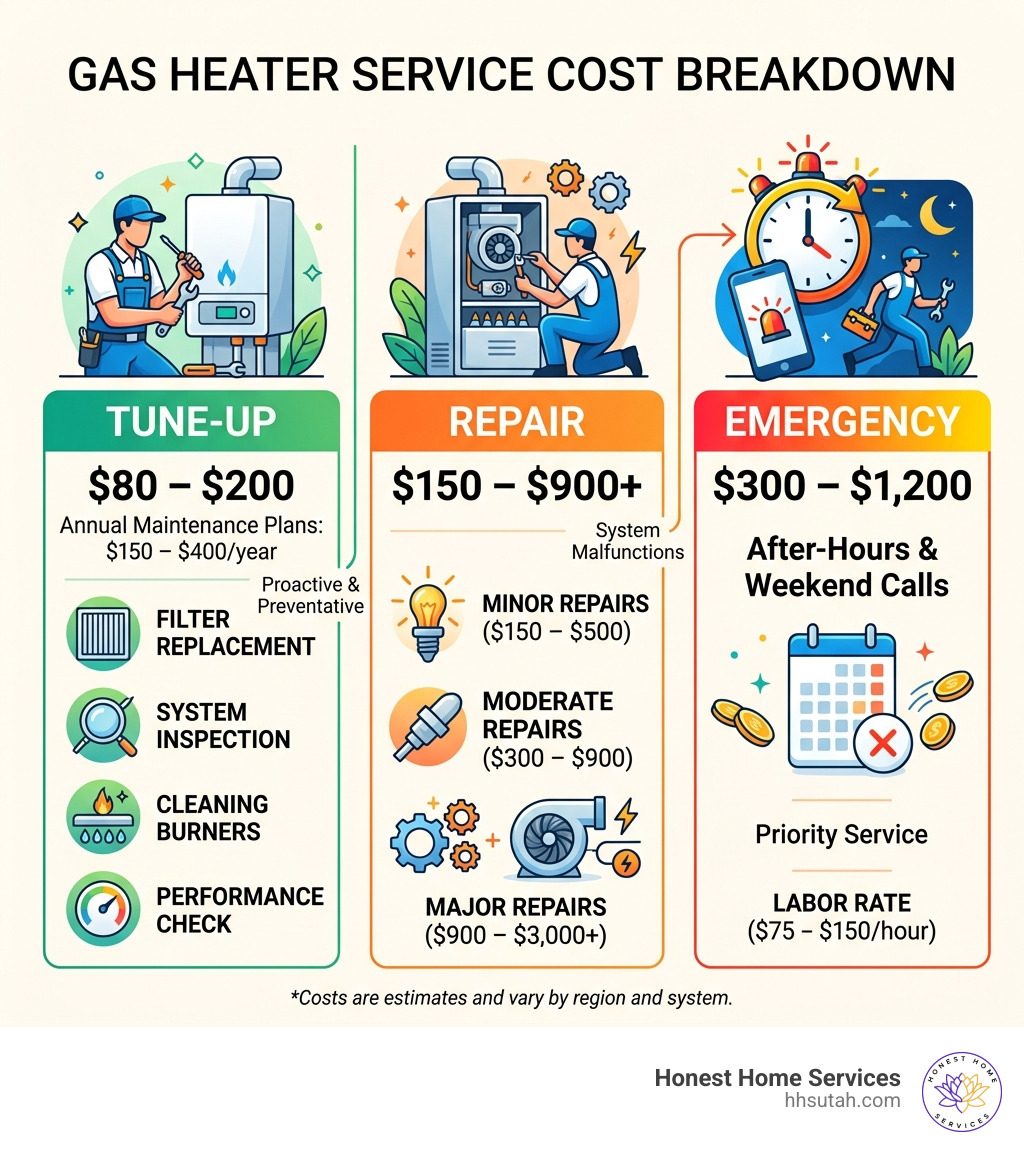
| Service Type | Typical Cost Range |
|---|---|
| Basic tune-up (one-time) | $80 – $200 |
| Annual maintenance plan | $150 – $400/year |
| Minor repair (ignitor, sensor) | $150 – $500 |
| Moderate repair (blower motor) | $300 – $900 |
| Major repair (heat exchanger) | $900 – $3,000+ |
| Emergency/after-hours service | $300 – $1,200 |
| Labor rate | $75 – $150/hour |
Most homeowners pay somewhere between $150 and $800 for a typical gas furnace repair. A routine tune-up usually falls between $80 and $200.
But costs can swing significantly depending on what’s wrong, how old your system is, and when you call. A repair booked in the middle of a cold snap will almost always cost more than one scheduled on a mild fall afternoon.
Gas heater problems also have a way of showing up at the worst possible time — when you need heat most, your system is working hardest. That’s exactly when you want to know what to expect before a technician arrives.
At Honest Home Services, we’ve spent over 20 years helping Utah homeowners navigate gas heater service costs with transparent, upfront pricing — no surprises, no runaround. We understand that managing a gas heater service cost is easier when you know what you’re paying for and why.
Easy Gas heater service cost word list:
Breaking Down the Gas Heater Service Cost

When we talk about Gas heater service cost, it is important to distinguish between three different types of visits: routine maintenance, diagnostic calls, and actual repairs. If your furnace is currently blowing cold air, you aren’t looking for a “tune-up”; you’re looking for a diagnostic service followed by a repair.
A diagnostic fee typically ranges from $75 to $150. Many companies, including us at Honest Home Services, may waive this fee if you choose to move forward with the repair. Labor rates in Northern Utah generally fall between $75 and $150 per hour, depending on the complexity of the job and the technician’s expertise.
For those looking to stay ahead of the curve, maintenance plans are the way to go. These plans often cost between $150 and $400 per year and usually cover two visits: one for your heating system in the fall and one for your AC in the spring. These plans are designed to catch small issues before they become expensive middle-of-the-night emergencies.
If your issues extend beyond the furnace to your home’s water heating system, you might also want to look into more info about hot water repair costs to keep your entire home’s gas infrastructure in top shape.
Standard Maintenance and Tune-Up Pricing
Think of a furnace tune-up like an oil change for your car. You could skip it, but eventually, the engine is going to complain. A standard one-time tune-up in cities like Layton or Kaysville typically costs between $80 and $200.
What exactly are we doing during that time? A thorough technician will:
- Clean the burners and the heat exchanger.
- Inspect the gas valve and connections for leaks.
- Test safety controls and the limit switch.
- Check thermostat calibration.
- Inspect and replace the air filter.
- Measure airflow and combustion gases.
Regularly changing your filter (every 1 to 3 months) is the single best thing you can do as a homeowner to keep your costs down. A clogged filter makes the blower motor work twice as hard, leading to premature failure. Don’t get left in the cold with these service tips to ensure your gas appliances are ready for April 2026 and beyond.
Factors Influencing Your Gas Heater Service Cost
Why does your neighbor pay $150 while you’re looking at a $500 bill? Several factors influence the final price:
- System Age: Older units (15+ years) might require parts that are no longer in stock, leading to higher “legacy” part costs.
- Accessibility: If your furnace is tucked away in a tiny crawlspace or a hard-to-reach attic in Park City, labor costs will increase due to the extra time and effort required.
- Seasonal Demand: If you call during the first week of sub-zero temperatures in January, expect to pay a premium. Peak season repairs can be 10% to 25% higher due to high demand.
- Emergency Surcharges: If your heater dies at 2 AM on a Sunday, emergency service fees can range from $150 to $300 just for the technician to show up.
Common Gas Furnace Repair Costs by Component
When a specific part fails, the Gas heater service cost is determined by the price of the part plus the labor time required to swap it out.
| Component | Repair/Replacement Cost | Typical Lifespan |
|---|---|---|
| Ignitor | $150 – $450 | 5 – 8 Years |
| Flame Sensor | $80 – $250 | 3 – 7 Years |
| Blower Motor | $300 – $900 | 10 – 15 Years |
| Gas Valve | $200 – $800 | 10 – 15 Years |
| Thermocouple | $150 – $300 | 5 – 10 Years |
| Circuit Board | $200 – $600 | 10 – 15 Years |
The ignitor is often the “problem child” of the furnace. It’s the part that gets hot enough to light the gas, and because it undergoes extreme temperature changes, it eventually cracks. This is a common minor repair that we handle frequently across Davis and Salt Lake Counties.
For a deeper dive into these numbers, consult the Furnace Repair Cost in 2026: Complete Price Guide. It’s also helpful to realize that many of these components function similarly to those in your other gas appliances; understanding gas water heater service costs can give you a broader perspective on home maintenance budgeting.
Major Repairs: The Heat Exchanger and Beyond

The heat exchanger is the most critical component of your gas furnace. It’s the metal chamber where the gas burns; its job is to keep the poisonous combustion gases (like carbon monoxide) separate from the air being blown into your living rooms.
If a heat exchanger cracks, it is a major safety hazard. In almost every case, a cracked heat exchanger means the furnace must be shut down immediately to prevent carbon monoxide poisoning. Repairing or replacing a heat exchanger is expensive, ranging from $1,000 to $3,000+.
When you’re facing a bill this high, we often recommend looking at the unit’s AFUE (Annual Fuel Utilization Efficiency) rating. If you have an old 80% efficient unit and the repair is $2,000, it’s almost always smarter to put that money toward a new 95% or 98% efficient model.
Electrical and Control Board Expenses
Modern furnaces are essentially computers that burn gas. They rely on complex circuit boards and relay switches to tell the system when to turn on, when to vent, and when to shut down for safety.
A control board replacement typically costs between $200 and $600. If your thermostat is the culprit, a basic replacement might be $150, while a high-end smart thermostat installation can reach $500. While these components are less about “plumbing” and more about “electronics,” they are vital to your heater’s operation. If you’re curious about the mechanics behind these systems, you can learn how to become a gas heater repair expert.
When to Repair vs. Replace Your Gas Heater
This is the golden question for every homeowner in Salt Lake City: “Should I keep fixing this old thing, or is it time for a new one?”
We generally recommend the 50% Rule: If the repair cost exceeds 50% of the price of a new furnace, and the unit is more than 10–15 years old, replacement is usually the better investment.
Consider replacement if:
- Age: Your gas furnace is over 15–20 years old.
- Efficiency: Your energy bills are skyrocketing despite regular maintenance.
- Frequency: You’ve had more than two significant repairs in the last two years.
- Safety: The heat exchanger is cracked.
A new furnace installation typically ranges from $2,500 to $7,500. While that’s a big upfront cost, the energy savings from a high-efficiency unit can often pay for itself over several winters.
If you are struggling to diagnose your system’s current state, checking the top 7 gas water heater problems and solutions can help you identify if your home’s gas issues are isolated to the furnace or part of a larger utility problem.
Frequently Asked Questions about Gas Heater Service Cost
How often should I pay for a gas heater service cost?
We recommend professional service once a year, ideally in the late summer or early fall. Many manufacturer warranties actually require annual maintenance to remain valid. Regular checks ensure the system is operating at peak performance and, most importantly, that it is venting safely. For those who also manage gas water heaters, keeping an eye on the gas water heater anode guide is another vital part of annual home safety.
What are the signs my gas heater needs immediate professional service?
Don’t wait for the system to stop working entirely. Call a pro if you notice:
- Yellow Flame: A healthy gas flame should be blue. A yellow or flickering flame suggests incomplete combustion and potential carbon monoxide.
- Strange Noises: Banging, whistling, or grinding sounds often indicate a failing blower motor or inducer fan.
- Sulfur Odors: If you smell “rotten eggs,” that’s the mercaptan added to natural gas. Leave the house immediately and call your gas provider and a technician.
- Short Cycling: If the furnace turns on and off every few minutes, it’s likely overheating or has a faulty sensor.
For more on what these symptoms might cost you, see this guide on gas heater maintenance costs and expectations.
Can I perform any gas heater maintenance myself to save money?
Yes! You can significantly lower your long-term Gas heater service cost by doing the following:
- Change the filter: This is the #1 way to prevent repairs.
- Clear the vents: Ensure the intake and exhaust pipes outside your home are clear of snow, bird nests, or debris.
- Keep the area clean: Don’t store flammable materials (like paint or gasoline) near your furnace.
- Check the thermostat: Sometimes a “broken” heater is just a thermostat that needs new batteries.
However, never attempt to open the gas valve, tinker with the heat exchanger, or mess with the internal wiring yourself. The risks of gas leaks, fires, or carbon monoxide poisoning are far too high to DIY.
Conclusion
Managing your Gas heater service cost doesn’t have to be a stressful experience. By investing in annual maintenance and addressing minor repairs quickly, you can extend the life of your furnace and keep your family safe and warm.
At Honest Home Services, we pride ourselves on providing the most reliable and affordable heating services in Northern Utah. Whether you are in Salt Lake City, Draper, or up in Park City, our expert technicians are ready to provide upfront pricing and guaranteed satisfaction. We live and work in these communities, and we treat your home with the same care as our own.
Don’t wait for the first blizzard to find out your furnace isn’t up to the task. Schedule your Salt Lake City gas heater service today and enjoy the peace of mind that comes with a system you can trust.