
The Furnace Circuit Board: The Brain Behind Your Home’s Heat
A furnace circuit board — also called a control board — is the central command center of your heating system. It receives signals from your thermostat, then coordinates every step of the heating process in the correct order.
Here’s what it controls at a glance:
| Function | What the Board Does |
|---|---|
| Ignition | Activates the ignitor to light the burner |
| Flame monitoring | Reads the flame sensor to confirm safe ignition |
| Blower motor | Times the fan to circulate warm air |
| Gas valve | Opens and closes to control fuel flow |
| Safety shutoff | Cuts power if something goes wrong |
| Error reporting | Flashes LED codes to signal faults |
When the board fails, nothing works right — your furnace may not start, may short cycle, or may blow cold air. It’s one of the top five reasons furnaces break down, and it becomes more common once a furnace passes the 10-year mark.
At Honest Home Services, we’ve spent over 20 years diagnosing and replacing furnace circuit boards for homeowners and businesses across Northern Utah — and we know how fast a failed board can leave you in the cold. In this guide, we’ll walk you through everything you need to know to understand, diagnose, and fix the problem.
Furnace circuit board terms made easy:
What is a Furnace Control Board and How Does it Work?
If you think of your furnace like a human body, the furnace circuit board is undoubtedly the brain. Formally known as an Integrated Furnace Control (IFC), this component is a sophisticated piece of hardware that uses microprocessor logic to manage every mechanical action your heating system performs.
Most modern boards operate on 24V AC power for their logic circuits while switching higher voltages (usually 120V) to power heavy-duty components like the blower motor. The board’s primary job is to ensure that the 10 common furnace problems and how to fix them don’t turn into safety hazards. It listens for a “call for heat” from the thermostat and then orchestrates a precise sequence of events.
The Role of the Furnace Circuit Board in Your Heating System
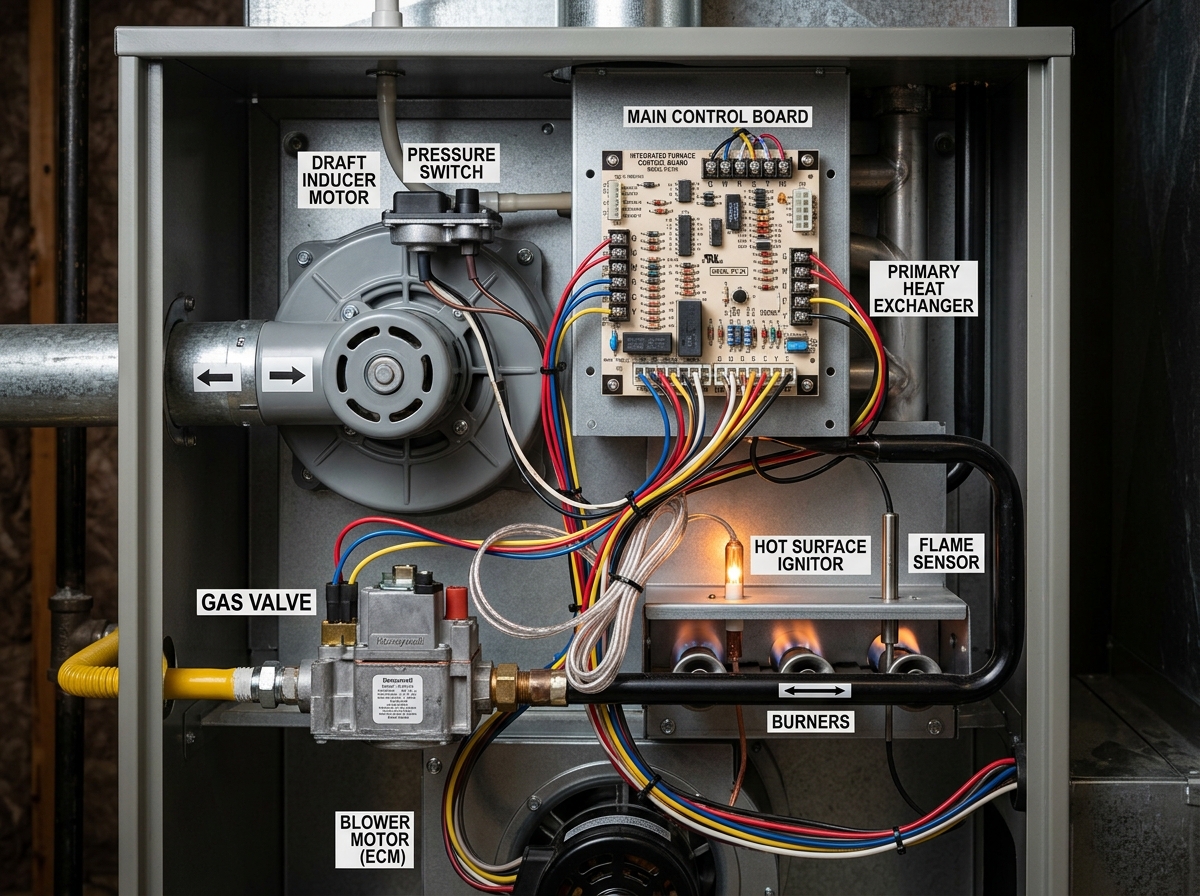
The sequence of operations is a strict “if-this-then-that” logic. First, the board sends power to the inducer motor to clear out any leftover gases. Once a pressure switch confirms airflow, the board activates the ignitor. After a few seconds, it opens the gas valve.
But the board doesn’t just “fire and forget.” It constantly monitors the flame sensor. If the sensor doesn’t detect heat within a few seconds, the board shuts the gas valve immediately to prevent a dangerous buildup of fuel. Finally, once the heat exchanger is sufficiently warm, the board triggers the blower motor to push air through your vents. If any of these steps fail, our furnace repair services are often needed to determine if the “brain” has lost its way.
Types of Ignition Controls
Not all boards are created equal. Depending on the age and model of your unit, the furnace circuit board might manage different types of ignition:
- Hot Surface Ignition (HSI): The most common modern type, where the board sends high voltage to a silicon carbide or nitride ignitor that glows white-hot.
- Direct Spark Ignition (DSI): Similar to a spark plug in a car, the board creates a high-voltage arc to light the gas.
- Intermittent Pilot (IP): The board lights a pilot light only when heat is needed, saving gas compared to old-fashioned standing pilots.
For example, the Carrier Bryant HK42FZ009 / Furnace Control Circuit Board 1012-940-F is a specialized board designed to handle specific ignition sequences and safety timings for those particular brands.
Common Signs and Causes of Failure
How do you know if your board is on the fritz? Often, the symptoms mimic other part failures. You might notice your blower motor running constantly, even when the air coming out is cold. Or perhaps you have no heat at all because the board isn’t sending the signal to the ignitor.
Intermittent operation — where the furnace works one hour and dies the next — is a classic hallmark of a failing circuit board. We always recommend checking for 5 signs your furnace needs immediate attention before the Utah winter hits its peak.
Why Do Furnace Circuit Boards Fail?
Even though they have no moving parts, these boards are under constant stress. Here are the top reasons we see boards fail in Salt Lake City and the surrounding areas:
- Power Surges: Even small “mini-surges” can fry the delicate transistors or blow the small on-board fuse.
- Thermal Expansion: The constant heating and cooling of the furnace causes the board to expand and contract, which can eventually lead to cracked solder joints.
- Dirt and Dust Buildup: Dust acts as an insulator. If a thick layer of Utah dust settles on the board, it can cause components to overheat and burn out.
- Water Exposure: Leaking humidifiers or AC condensate drains can drip directly onto the board, causing instant shorts.
- Vibration: If the blower motor is out of balance, the resulting vibration can loosen wiring connections over time.
Understanding how to avoid a winter emergency starts with protecting this sensitive “brain” from these environmental factors.
Statistics on Board Longevity
Based on industry data and our experience in Davis and Salt Lake Counties, furnaces more than 10 years old are significantly more likely to require a furnace circuit board replacement. During a typical heating season, a furnace may cycle 4 to 5 times per hour. That means the board is switching high-voltage relays thousands of times a year. It’s no wonder that circuit board failure remains one of the top five reasons for total furnace breakdown. To maximize your system’s life, you should look for ways to extend your furnace’s lifespan through regular maintenance.
How to Diagnose and Troubleshoot Your Furnace Circuit Board
Before you assume the board is dead, a little detective work is required. A visual inspection is the easiest place to start. Look for “burn marks” or charred spots on the green fiberglass. If you smell a “fried electronics” scent (like burnt plastic), that’s a smoking gun.
Interpreting Diagnostic Flash Codes
Most modern boards, like the Goodman PCBKF202S Furnace Control Circuit Board, feature a small LED light. This light isn’t just for show; it’s a diagnostic tool.
- Steady Light: Usually means the board has power and is working fine.
- Rapid Flashing: Often indicates a “lockout” mode after too many failed ignition attempts.
- Specific Number of Flashes: (e.g., 3 flashes) corresponds to a specific error code, like a stuck pressure switch or a limit switch trip.
Always refer to the chart on the inside of your furnace blower door to translate these blinks. For more detailed help, our Salt Lake City furnace repair guide provides additional troubleshooting steps.
DIY vs. Professional Diagnosis
We love a good DIY project as much as anyone, but the furnace circuit board is where things get risky. You are dealing with 120V electricity, which can be fatal if mishandled. Furthermore, boards are highly sensitive to static discharge. If you touch the board without being properly grounded, you could “zap” a microprocessor and kill a perfectly good board instantly.
Misdiagnosis is also common. Homeowners often replace a board only to find out the real problem was a $20 sensor or a loose wire. This is why a professional furnace tune-up is so valuable — we can test the board’s outputs with a multimeter to ensure it’s actually the culprit before you spend money on a replacement.
Replacing Your Board: OEM vs. Universal and Cost Factors
If the board is truly dead, you have two main paths: OEM (Original Equipment Manufacturer) or Universal.
| Feature | OEM Board | Universal Board |
|---|---|---|
| Compatibility | Guaranteed to fit and work | May require harness adapters |
| Installation | Plug-and-play | May require setting DIP switches |
| Cost | Usually higher | Generally more affordable |
| Availability | Can be harder to find for old units | Usually in stock |
Universal kits, like those from ICM Controls or White-Rodgers, are popular because they can replace hundreds of different models. For example, the Trane Furnace Control Circuit Board # KIT15815 is an OEM-specific part, but many technicians carry universal alternatives that provide similar 5-star reliability.
Selecting the Right Replacement Furnace Circuit Board
Choosing the right board involves more than just looking at the brand. You must match the part number exactly. Even within the same brand, like Goodman, different models use different pin configurations and blower speed settings. If you’re unsure, check the Goodman OEM Catalog or consult a professional to see how to know if it’s time for furnace replacement entirely.
Average Replacement Costs
The cost to replace a furnace circuit board typically ranges from $300 to $800, depending on the complexity of the board and the labor involved. While the part itself might range from $100 to $400, the expertise required to wire it correctly and verify the safety sequences is where the value of a professional lies. A properly installed board often comes with a warranty, helping you save money this winter by avoiding repeat failures.
Professional Installation and Prevention
When we install a new board, we don’t just “plug it in.” We have to configure it. This includes setting “DIP switches” that control how long the blower runs after the burners shut off. Incorrect settings can lead to “short cycling” or cold drafts.
How to Prevent Future Failures
You don’t want to replace your board every few years. To protect your investment, we recommend:
- Install a Surge Protector: A dedicated HVAC surge protector can save your board from Utah’s occasional power fluctuations.
- Change Your Air Filter: A dirty filter makes the blower motor work harder, which pulls more amps through the circuit board’s relays, causing them to wear out faster. Follow our 5 furnace maintenance tips for more advice.
- Annual Maintenance: During a tune-up, we clean the board and check for loose connections. See how regular furnace tune-ups save you money by catching small issues before they fry the “brain.”
Frequently Asked Questions about Furnace Control Boards
Can I bypass a furnace circuit board?
Absolutely not. Bypassing a board means you are removing the safety logic that prevents gas explosions and fires. If a board is bypassed, the furnace may continue to dump gas even if it doesn’t light, or it may overheat the heat exchanger until it cracks. It is a major code violation and extremely dangerous.
How do I reset my furnace control board?
In many cases, you can reset a “soft lockout” by simply turning the power switch on the side of the furnace off for 30 seconds and then back on. You can also do this at the circuit breaker. However, if the board immediately goes back into lockout, there is an underlying hardware problem that needs attention.
Will a bad board damage other components?
Yes. A faulty board can send improper voltage to the blower motor, causing it to overheat, or it can leave the ignitor on for too long, causing it to burn out prematurely. Ensuring your board is healthy is essential for winter comfort.
Conclusion
The furnace circuit board is a complex but vital part of your home’s comfort. Whether you are dealing with a mysterious blinking light or a furnace that simply won’t kick on, understanding how this “brain” works is the first step toward a warm home.
If you suspect your board is failing, don’t stay in the cold. Honest Home Services provides reliable, affordable, and expert furnace repair and replacement across Northern Utah. From Salt Lake City to Layton and Bountiful, our technicians are ready to help with 24/7 emergency support and a satisfaction guarantee. Give us a call today, and let’s get your furnace’s “brain” back in gear!