
Start With a Safe, Lasting AC Leak Fix
A proper ac leak fix starts by finding the leak, not adding more refrigerant. Look for weak or warm airflow, ice on the refrigerant line or indoor coil, hissing or bubbling sounds, longer cooling cycles, and a sudden rise in energy use. You can safely inspect visible copper joints and service valves with soapy water for bubbles, but refrigerant recovery, repairs, vacuuming, and recharging should be done by an EPA-certified HVAC technician.
A home AC system is sealed. If it is low on refrigerant, it has lost refrigerant somewhere. Topping it off without repairing the source can lead to another breakdown and may put added strain on the compressor.
At Honest Home Services, we bring more than 20 years of plumbing, heating, and air conditioning experience to Northern Utah homes and businesses. Our licensed and insured team can diagnose the cause of an AC leak fix, explain the practical repair options, and help restore dependable cooling.
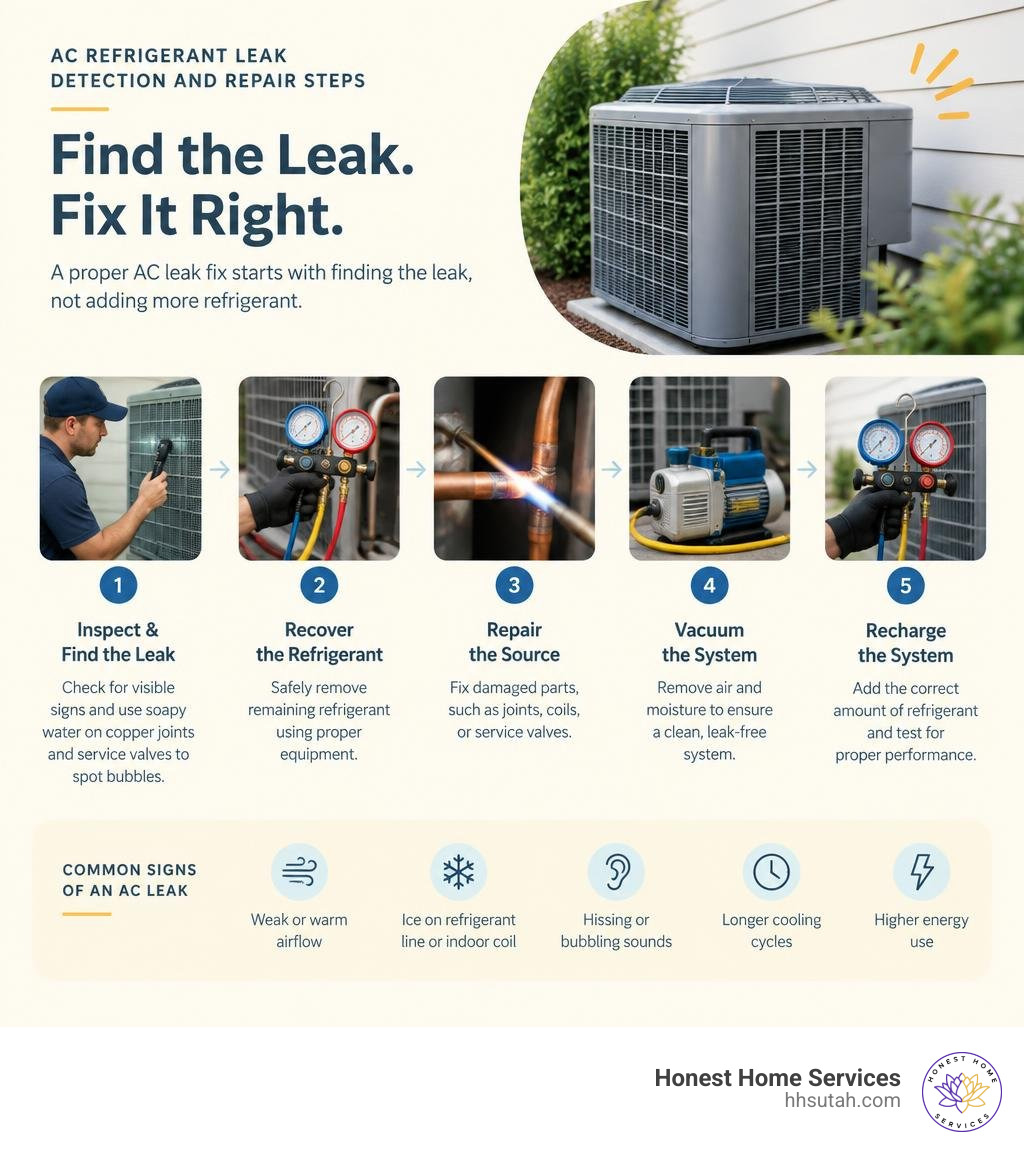
Quick look at ac leak fix:
Detecting Refrigerant Loss: Symptoms and Testing Techniques
When an air conditioning system starts losing its charge, the signs can range from subtle changes in indoor comfort to obvious mechanical distress. Catching these indicators early helps prevent long-term damage to the compressor and keeps indoor humidity and temperatures manageable. Investing in a regular air conditioning tune-up allows technicians to catch pressure drops and minor seam fatigue before they leave you without cooling on the hottest afternoon of the summer.
Warning Signs of an Active Refrigerant Leak
Because an air conditioner operates on a closed, pressurized loop, any reduction in chemical charge leads to distinct operational symptoms:
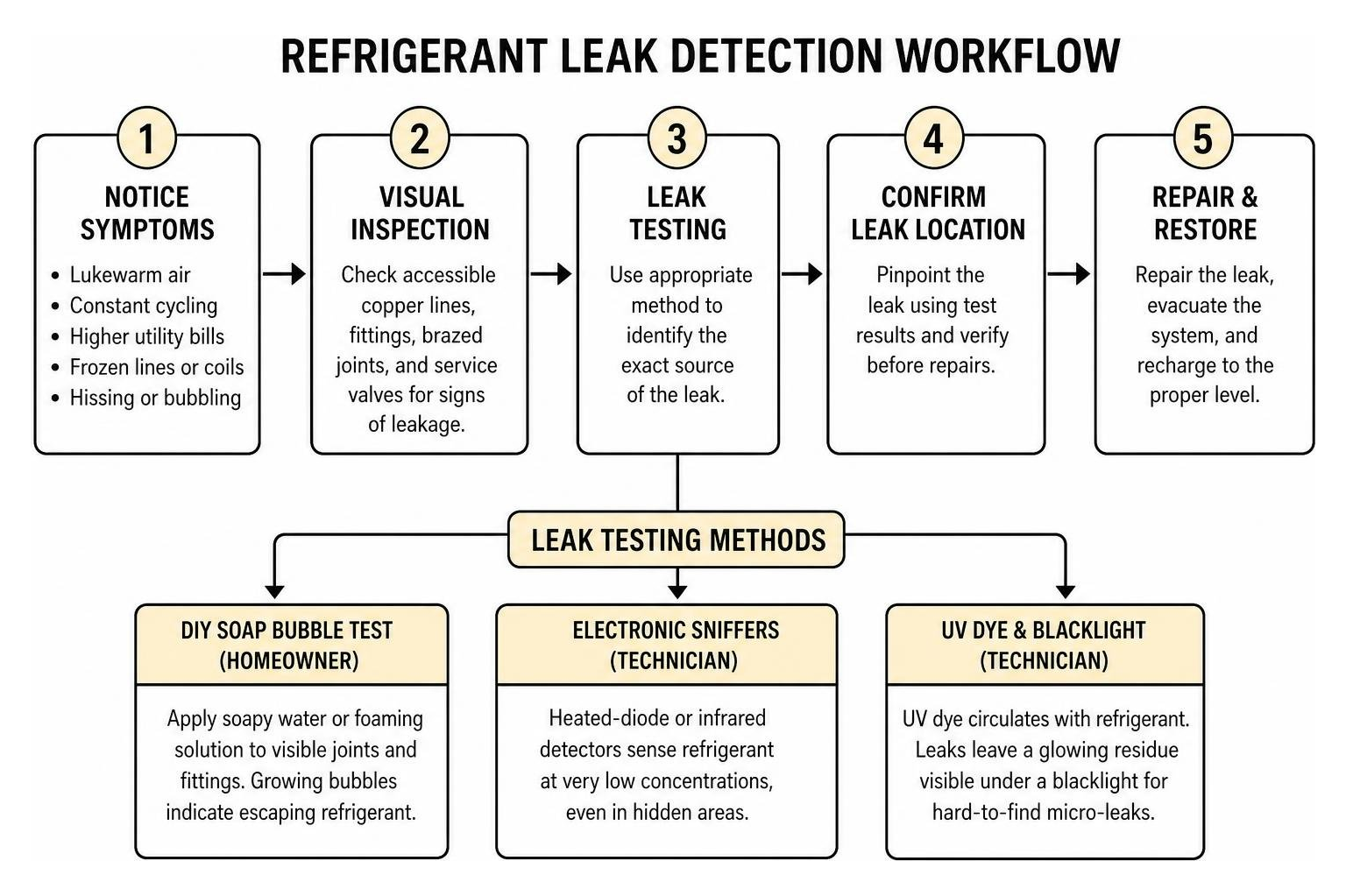
- Lukewarm Supply Registers: Even when the outdoor condenser runs, the air blowing out of your vents feels room-temperature or weak.
- Constant System Cycling: The system runs continuously without satisfying the thermostat setting, driving up wear and tear on electrical components.
- Spiked Utility Bills: Because cooling efficiency drops as the pressure drops, the system consumes far more electricity trying to meet indoor demand.
- Frozen Copper Lines and Evaporator Coils: A drop in pressure causes the remaining refrigerant to boil at a much lower temperature, which freezes ambient moisture along the indoor coil and the insulated suction line.
- Audible Hissing or Bubbling: High-pressure leaks often produce a noticeable hissing noise near the outdoor service valves, while internal coil pinholes can create a faint bubbling sound.
DIY Bubble Testing vs. Electronic Sniffers
Finding the exact source of a leak requires methodical testing. While homeowners can safely perform simple surface checks, specialized equipment provides precise diagnostics for hidden copper pathways.
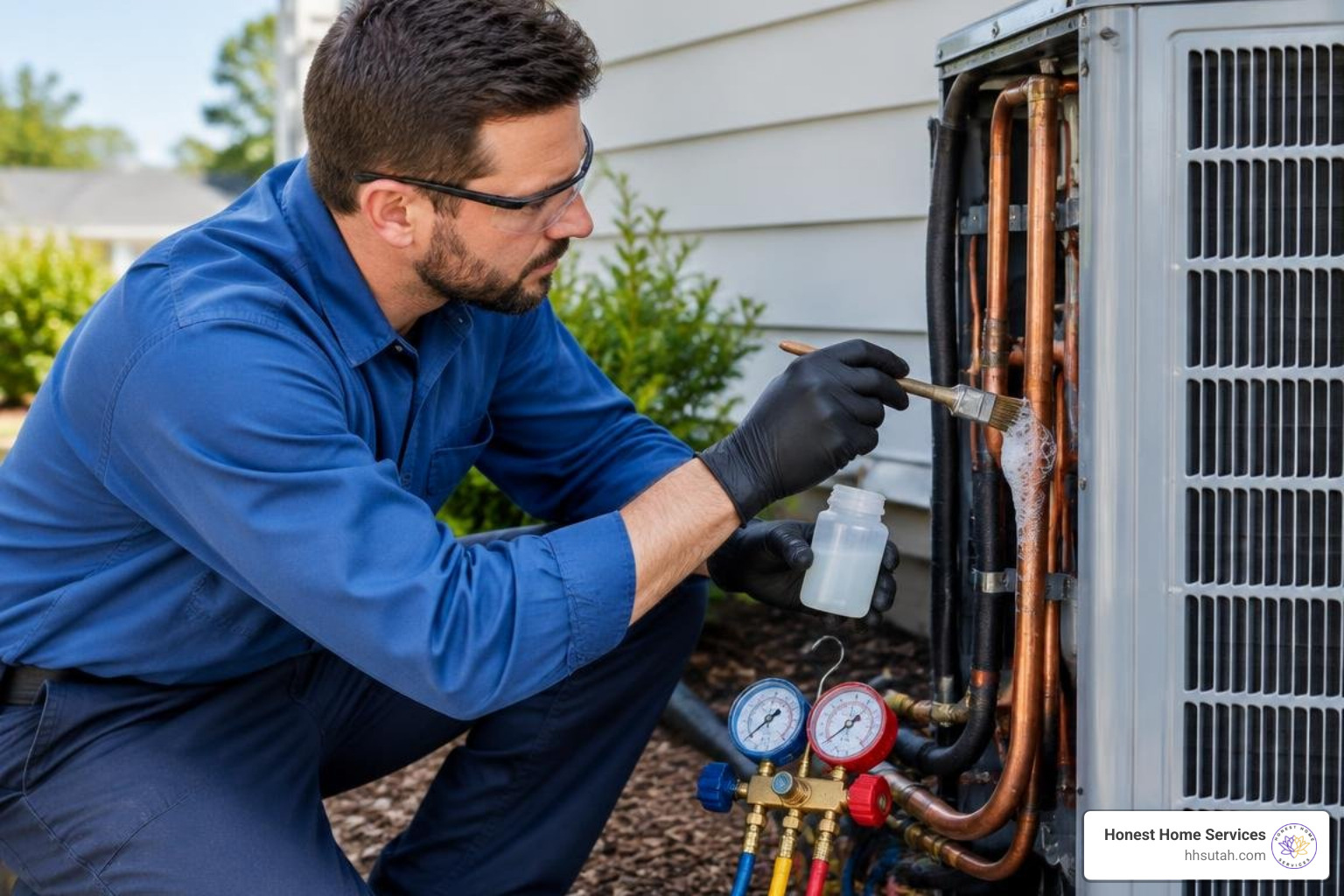
The most accessible diagnostic for homeowners is the soap bubble test. Using a spray bottle with a mild dish soap solution or a commercial foaming fluid, you coat visible copper fittings, brazed elbows, and service Schrader valves. If a joint has a pinhole leak, the escaping gas produces growing clusters of bubbles.
For leaks concealed inside the air handler casing or deep within finned aluminum coils, technicians utilize electronic heated-diode or infrared “sniffer” detectors. These handheld instruments detect halogenated gases at concentrations down to a fraction of an ounce per year. In challenging situations where micro-leaks escape sniffers, ultraviolet (UV) fluorescent dyes are introduced into the lines. Once circulated under pressure, any escaping fluid leaves a glowing residue visible under a UV blacklight. For a deeper technical breakdown of these detection methods, you can review detailed technical refrigerant leak repair guidelines.
Professional AC Leak Fix Options, Procedures, and Costs
Restoring a leaking cooling unit involves far more than simply patching a pipe and turning the system back on. Refrigerant lines require absolute chemical purity, precise pressure balance, and careful handling of sensitive structural metals. Selecting among budget-friendly AC repair solutions depends on the location of the breach, the age of the equipment, and the overall integrity of the coils.
| Repair Method | Best For | Typical Durability | Relative Investment |
|---|---|---|---|
| Chemical Sealant Injection | Micro-fissures (< 0.5 oz/year) & inaccessible pinholes | Moderate (1 to 3+ years) | Low |
| Brazing & Line Patching | Accessible copper joints, rub-outs, and service valves | High / Permanent | Moderate |
| Evaporator / Condenser Replacement | Extensive coil corrosion (formicary corrosion) | Maximum (Manufacturer life) | High |
Choosing an AC Leak Fix: Sealant Injection vs. Brazing and Coil Replacement
HVAC technicians utilize three primary approaches to fix leaking systems:
- Direct Sealant Injection: For microscopic pinhole leaks in inaccessible coil channels, injecting a specialized chemical sealant provides an efficient remedy without requiring structural teardowns.
- Oxygen-Acetylene Brazing: When a leak occurs on exposed copper line sets or accessible manifold joints, technicians cut out the compromised section or apply a high-temperature silver brazing alloy. This process melts filler metal into the joint, creating a permanent, pressure-tight metallurgical bond.
- Component Replacement: When an evaporator or condenser coil suffers from widespread formicary corrosion—often appearing as hundreds of microscopic pits across the metal—brazing is impractical. Replacing the entire coil assembly is the only reliable way to ensure long-term cooling performance.
Deep Vacuum Evacuation and Weight-Based Recharging
Opening an HVAC circuit exposes its interior to atmospheric moisture and oxygen, which react with synthetic compressor oils to generate harmful acids. A professional repair sequence must follow strict restoration steps:
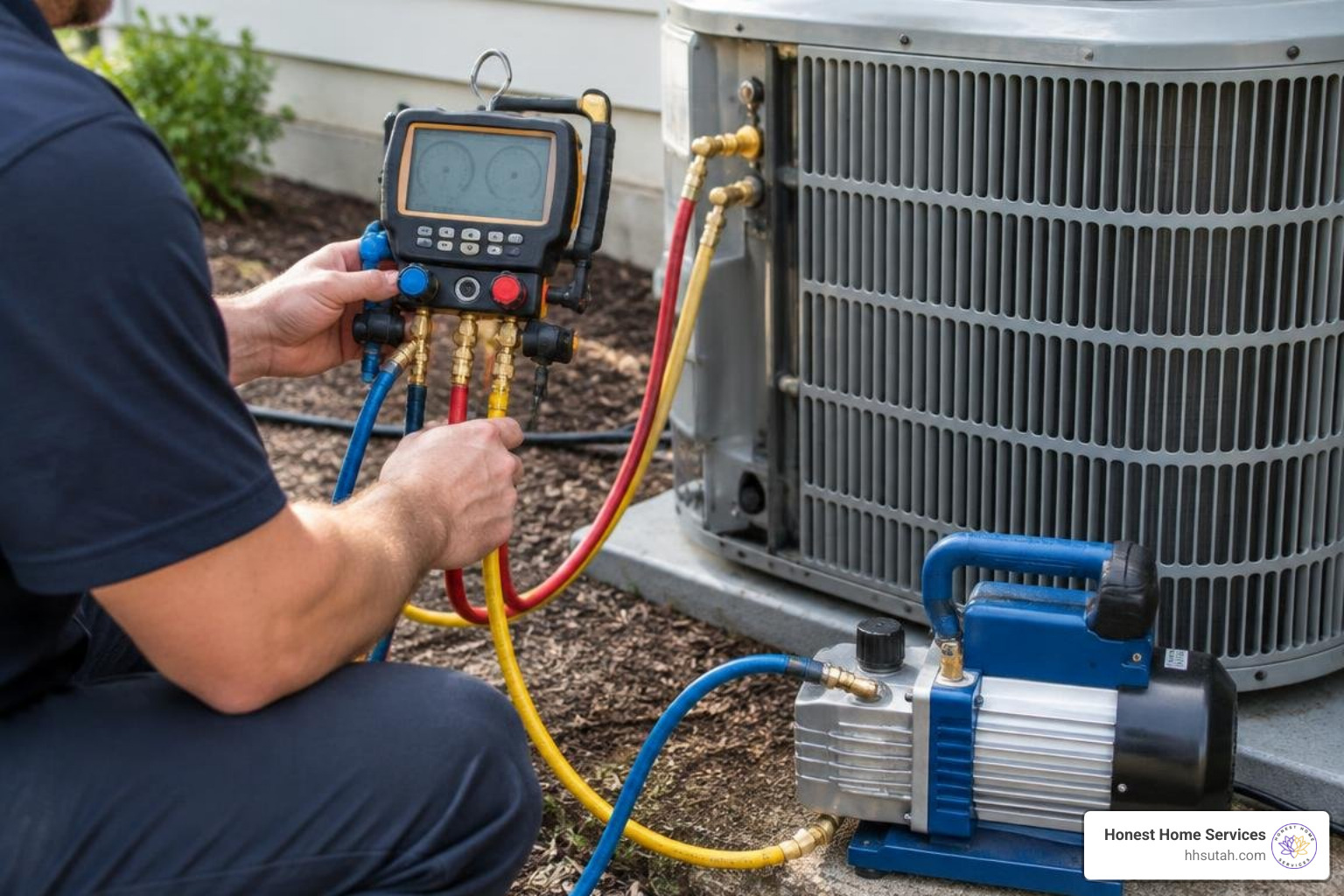
- Refrigerant Recovery: Technicians connect a dedicated recovery machine and DOT-approved recovery cylinder to safely remove all remaining gas from the system.
- Physical Repair: The technician brazes the faulty joint, replaces the damaged valve core, or installs the replacement coil.
- Pressure Testing: The closed loop is pressurized with dry nitrogen to confirm the structural integrity of the repair before any gas is reintroduced.
- Triple Evacuation Protocol: A high-capacity two-stage vacuum pump and digital micron gauge are attached. The system is drawn down below 500 microns to boil off ambient moisture and remove non-condensable gases.
- Weight-Based Recharging: Pure refrigerant is weighed into the suction side using a calibrated digital scale according to the manufacturer’s exact specification plate.

Repair vs. Replace Analysis for Aging Units
If your cooling equipment is approaching or past the 10-year mark, a major refrigerant leak warrants a careful financial evaluation. Older units frequently use phased-out R-22 refrigerant, which is no longer produced and carries high replacement costs. Newer units using R-410A or modern lower-GWP alternatives operate at higher internal pressures, meaning an aging coil that has developed one leak is likely to develop others soon.
For a deeper dive into evaluating equipment lifespans and efficiency trade-offs, consult our comprehensive AC service and repair guide.
Safety Protocols and EPA Regulations for Refrigerant Handling
Refrigerants are governed by federal environmental and workplace safety regulations. Handling these pressurized compounds requires rigorous training, specialized containment tools, and continuous adherence to environmental statutes. Incorporating routine air conditioning maintenance and repairs keeps your equipment within legal operational parameters while protecting local ecosystems.
EPA Section 608 Mandates and Venting Fines
Under Section 608 of the Clean Air Act, it is strictly illegal for any individual to knowingly vent or release ozone-depleting substances and fluorinated greenhouse gases into the atmosphere during service, repair, or disposal.
- Certification Requirements: Anyone purchasing refrigerant, connecting manifold gauges to residential systems, or recovering gas must hold valid EPA Section 608 certification.
- Venting Penalties: The federal government enforces strict civil penalties for unauthorized venting, with statutory fines reaching up to $44,539 per day per violation.
- Closed-Loop Accountability: Technicians must document all recovered amounts and verify that systems are completely tight before introducing a fresh charge.
Chemical Sealants and System Additive Capabilities
Modern chemical sealants have evolved significantly from older automotive formulas that tended to clog internal components. Contemporary professional sealants, such as non-polymer, oil-soluble formulas, meet ASHRAE 97 chemical stability standards.
- Non-Polymer Activation: Rather than reacting with air or moisture to form thick plastics that could clog thermal expansion valves (TXVs), these formulas react exclusively at the site of temperature and pressure drops where refrigerant escapes, creating a chemical weld over pinholes.
- Anti-Friction Lubricants: Advanced formulas incorporate synthetic friction-reducing agents that circulate continuously with compressor oil, dampening operating noise and reducing thermal stress on mechanical bearings.
- Application Dosing: Sealants are packaged in precise single-use canisters (such as 0.5 oz for systems up to 2 tons and 1.46 oz for systems up to 6 tons) to match total system volume. For exact technical data, review the Cool Seal non-polymer sealant specifications.
Comparing Residential and Automotive Air Conditioning Repairs
While both vehicle and residential climate systems rely on the basic vapor-compression refrigeration cycle, their structural designs and operating environments differ significantly. Homeowners needing assistance with residential systems can explore our full range of professional air conditioning services across Salt Lake City and surrounding Utah communities.
Key Differences in an Automotive AC Leak Fix vs. Home Systems
Automotive systems face continuous road vibration, dramatic temperature fluctuations under the hood, and seasonal inactivity. These conditions dictate unique component designs:
- Flexible Connections vs. Rigid Copper: Cars rely on flexible rubber hoses and hydrogenated nitrile butadiene rubber (HNBR) O-rings, which degrade over time due to heat and mechanical movement. Residential split systems use rigid, brazed copper line sets that experience minimal physical disturbance.
- Compressor Lubricants: Automotive systems utilize polyalkylene glycol (PAG) oils suited for open-drive, belt-powered compressors, whereas home systems use polyolester (POE) or alkylbenzene oils inside hermetically sealed compressor shells.
- Service Access: Leaking vehicle components like Schrader valves and condenser lines are relatively accessible, making O-ring replacements straightforward. However, an automotive evaporator leak requires complete dashboard removal, resulting in extensive labor costs. Residential units, by comparison, keep the evaporator coil within a dedicated indoor cabinet for direct service access.
Frequently Asked Questions About Refrigerant Leaks
Can I just top off the refrigerant without fixing the leak?
No. An air conditioning system does not consume refrigerant like a car consumes fuel. It operates as a sealed closed loop. Simply adding refrigerant without repairing the underlying leak allows gas to continue escaping into the environment, violates EPA guidelines, and causes persistent pressure imbalances that can lead to compressor failure.
Are chemical leak sealants a permanent fix?
High-quality, non-polymer sealants provide a reliable, long-term seal for microscopic pinholes (leaks losing less than a few ounces per year) and inaccessible hair-line fissures along coil bends. However, sealants cannot mend cracked line sets, fractured brazed joints, or large punctures. Those larger failures require mechanical brazing or complete component replacement.
How much does it cost to fix an AC refrigerant leak in 2026?
The total investment depends on the diagnostic method, the physical location of the leak, and whether structural components must be ordered from the manufacturer:
- Diagnostic Leak Search: Involves electronic sniffer checks, soap bubble verification, or UV dye injection to isolate the exact breach.
- Direct Sealant Treatment: Suited for micro-fissures in coils, including technician labor and system stabilization.
- Line Brazing and Nitrogen Purging: Requires full recovery, cutting, silver-alloy torch brazing, triple evacuation, and a weight-based recharge.
- Evaporator or Condenser Coil Replacement: Necessary for severe corrosion, involving complete component extraction, new coil installation, sheet-metal work, filter drier replacement, and full factory-spec charging.
Conclusion
A leaking air conditioning system compromises your home’s comfort, increases monthly utility expenses, and places unnecessary mechanical strain on critical components like the compressor. By identifying warning signs early—such as lukewarm vents, frozen suction lines, or hissing sounds—and partnering with certified professionals, you ensure that repairs are completed safely, correctly, and in full compliance with EPA standards.
Whether your system requires precision brazing on a copper line, a safe non-polymer sealant injection, or an evaporator coil replacement, our team at Honest Home Services is here to help. We proudly provide dependable, professional AC repair throughout Salt Lake City, Davis County, and communities across Northern Utah. Contact us today to schedule your system diagnosis and restore dependable cooling to your home.