

Why AC Repair Energy Efficiency Matters for Your Home and Wallet
AC repair for energy efficient homes isn’t just a nice-to-have — it’s one of the fastest ways to cut your monthly utility bills and keep your home comfortable all summer long.
Here’s a quick summary of what you need to know:
- Dirty or faulty AC components — like clogged filters, low refrigerant, or grimy coils — force your system to work harder and use more electricity.
- Nearly half of all home energy use goes toward heating and cooling, so even small repairs can lead to real savings.
- Sealing and insulating ducts alone can improve your system’s efficiency by up to 20%.
- Replacing old equipment with ENERGY STAR certified units can cut your annual energy bill by close to $140.
- Improper installation or deferred repairs can reduce system efficiency by as much as 30%.
The bottom line: a well-maintained, properly repaired AC system costs less to run, lasts longer, and puts less strain on the environment.
This guide walks you through every step — from spotting the warning signs your AC needs attention, to understanding SEER2 ratings, IRA tax credits, and when it makes more sense to replace than repair.
At Honest Home Services, we’ve spent over 20 years helping Northern Utah homeowners get the most out of their HVAC systems through expert AC repair and energy efficient upgrades — all at honest, upfront pricing. Whether you’re dealing with a system that’s struggling to keep up or just want to lower your bills, we’re here to help you make the smartest decision for your home.
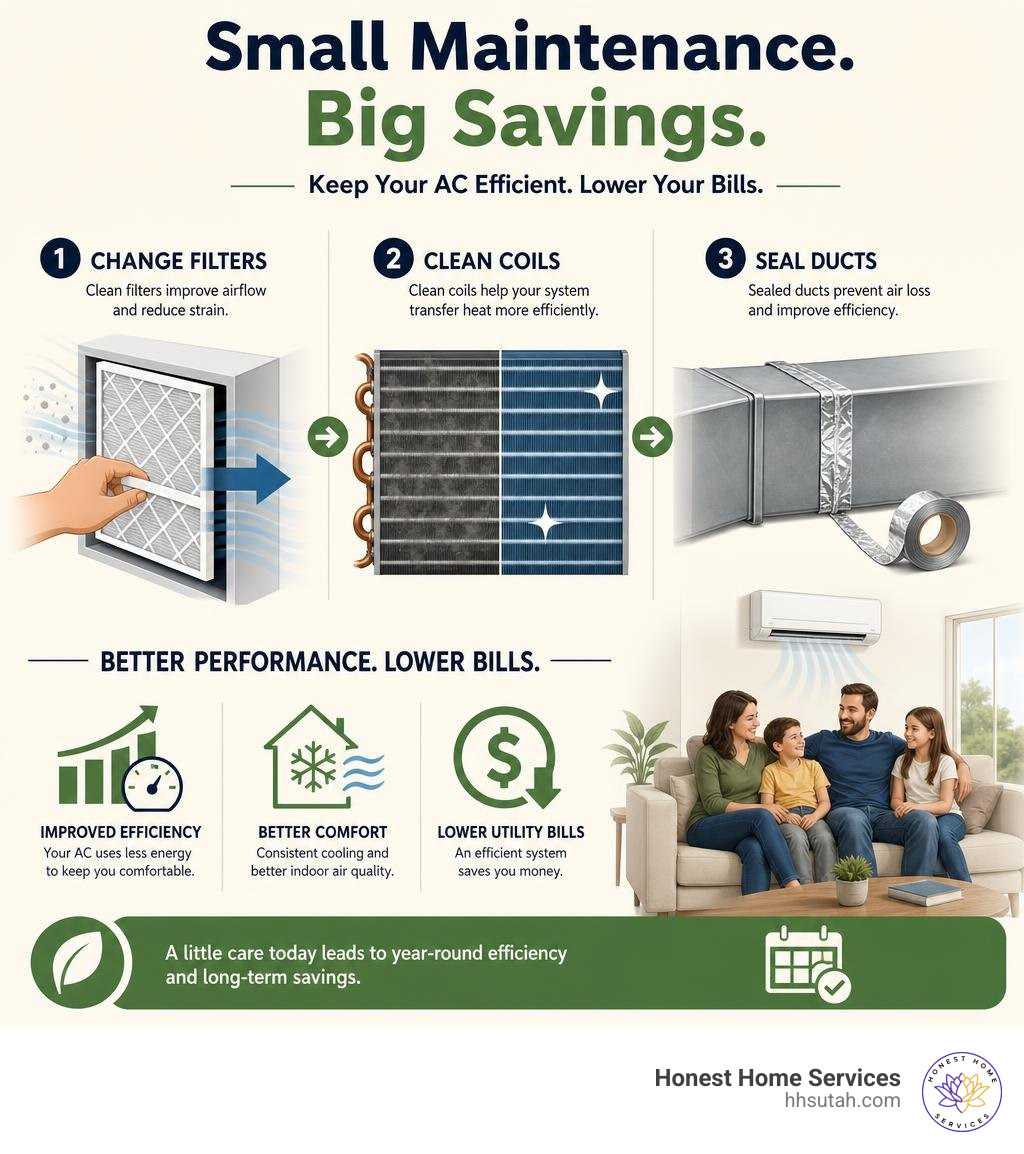
Why Prioritizing AC Repair Energy Efficient Practices Saves Money
When your air conditioner isn’t running optimally, it doesn’t just make your home less comfortable—it actively drains your bank account. Because heating and cooling make up nearly half of the average home’s energy consumption, even a slight drop in performance will show up on your monthly utility bills.
When components inside your air conditioner wear down, get dirty, or fall out of calibration, the system has to run longer and consume more power to achieve your desired indoor temperature. This extra work translates directly into mechanical strain. Think of it like driving your car with the emergency brake slightly engaged; you might still get to your destination, but you are burning a lot more fuel and destroying the engine in the process.
By prioritizing ac repair energy efficient practices, you reduce this unnecessary strain. This proactive approach saves you money in three distinct ways:
- Immediate Utility Bill Reductions: Restoring your system’s components to peak operating condition reduces the kilowatt-hours required to cool your home.
- Reduced System Strain: When your AC operates smoothly, individual parts experience less wear and tear, preventing expensive emergency breakdowns during the hottest Utah summer days.
- Smaller Carbon Footprint: Using less electricity means drawing less power from the grid, directly reducing your household’s environmental impact.
To understand how timely repairs prevent minor issues from snowballing into catastrophic system failures, check out our comprehensive resource on Air Conditioning Maintenance and Repairs: Your Total Guide.
Common Signs You Need AC Repair: Energy Efficient Warning Signs
Your air conditioner will usually tell you when it is struggling to maintain its efficiency. Recognizing these warning signs early can save you from a complete system breakdown and keep your energy bills from skyrocketing.
- Weak Airflow: If the air blowing from your registers feels lukewarm or weak, your system has to run much longer to cool your home. This is often caused by a failing blower motor, a clogged filter, or blocked ductwork.
- Frequent Cycling: If your AC turns on and off every few minutes, it is experiencing “short-cycling.” Starting up requires a massive surge of electricity. When your system short-cycles, it wastes enormous amounts of energy without ever reaching its peak operating efficiency.
- Rising Utility Bills: If your energy bills are significantly higher than they were during the same month last year, but your usage habits haven’t changed, your system’s efficiency has degraded.
- Strange Noises: Squealing, grinding, or banging noises often indicate loose belts, failing bearings, or motor issues. These mechanical problems increase friction, forcing the system to consume more electrical power.
If you are experiencing any of these issues in the Salt Lake City metro area, don’t wait for your system to fail completely. Learn how to handle these common issues with The Ultimate Salt Lake City HVAC Repair Survival Guide.
The Role of Professional AC Repair: Energy Efficient Maintenance Tips
While homeowners can easily handle basic tasks like swapping out an air filter, true energy efficiency requires professional expertise. A certified technician has the specialized diagnostic tools needed to identify hidden efficiency leaks that the untrained eye might miss.
During a professional tune-up, a technician will perform several critical tasks:
- Clean the Evaporator and Condenser Coils: Removing dirt and debris allows for optimal heat transfer.
- Check and Adjust Refrigerant Charge: An overcharged or undercharged system can reduce efficiency by up to 30% and cause compressor failure.
- Inspect Electrical Terminals: Loose or corroded connections cause voltage drops and force motors to work harder.
- Calibrate the Thermostat: Ensuring your thermostat reads temperatures accurately prevents your system from running longer than necessary.
Investing in a regular Air Conditioning Tune-Up ensures your system is calibrated to consume the absolute minimum amount of energy necessary to keep your home cool.
Key Maintenance Tasks That Restore AC Efficiency
To keep your air conditioner running as efficiently as possible, several key maintenance tasks must be performed regularly. Neglecting these tasks allows dirt to accumulate, airflow to restrict, and energy waste to compound.
Refrigerant Charge and Coil Cleaning
Your air conditioner cools your home by transferring heat from the inside of your house to the outdoors. This process relies entirely on two components: the indoor evaporator coil and the outdoor condenser coil.
If these coils are coated in dust, pollen, or grass clippings, they become insulated. This insulation blocks the heat transfer process, meaning your AC has to run much longer to cool your home. Straightening bent coil fins with a specialized fin comb is also vital to keep airflow moving freely across the coils.
Equally important is the system’s refrigerant charge. Refrigerant is the chemical medium that carries the heat. If your system has a leak and the refrigerant level drops, the system cannot absorb and release heat effectively.
As we navigate the environmental standards of June 2026, the industry is transitioning to more eco-friendly refrigerants like R-454B, which offers a 78% lower Global Warming Potential (GWP) than older refrigerants like R-410A. Ensuring your system has the correct charge and is free of leaks is essential for keeping your energy consumption low. To keep these critical elements in top shape, schedule a professional Air Conditioning Tune-Up.
Duct Sealing and Insulation
Many homeowners focus entirely on the AC unit itself while completely ignoring the network of ducts hidden in their crawlspaces, attics, and walls. This is a costly mistake. According to the U.S. Department of Energy, sealing and insulating ducts can improve the efficiency of your heating and cooling system by as much as 20 percent.
When ducts have cracks, loose joints, or disconnected sections, cooled air escapes into your attic or crawlspace before it ever reaches your living rooms. This means your AC has to work overtime to make up for the lost air.
Professionals seal these leaks using specialized mastic sealant or metal-backed foil tape (never standard duct tape, which degrades quickly under temperature fluctuations). Once sealed, wrapping the ducts in high-quality insulation prevents the cool air inside the ducts from warming up as it passes through hot attics. For more practical advice on keeping your home comfortable, explore our Tag: HVAC Tips.
If your system is already struggling and you need fast, reliable support, you can find expert Air Conditioner Repair in Greater Salt Lake City to restore your system’s efficiency before the summer heat peaks.
Navigating SEER2 Ratings, Tax Credits, and Replacement Decisions
Sometimes, no amount of ac repair energy efficient tuning can save an aging, inefficient system. If your air conditioner is more than 10 to 15 years old, it may be time to consider a replacement. When shopping for a new system, understanding efficiency ratings and financial incentives can help you save thousands of dollars.
Understanding SEER2 and ENERGY STAR Certifications
In 2023, the Department of Energy updated its testing standards to SEER2 (Seasonal Energy Efficiency Ratio 2), which better reflects real-world operating conditions and external static pressure.
A higher SEER2 rating means a more efficient system. For example, upgrading an old 8 SEER unit to a modern 16 SEER2 unit can slash your cooling bills in half.
| System Type | SEER2 Rating Range | Estimated Energy Savings | Best Suited For |
|---|---|---|---|
| Standard Efficiency | 13.4 – 14.3 SEER2 | Baseline | Budget-conscious homeowners with moderate usage |
| High Efficiency | 15.0 – 18.0 SEER2 | 15% – 25% Savings | Homeowners looking for a balance of cost and long-term savings |
| Ultra-High Efficiency | 19.0 – 23.5+ SEER2 | 30% – 50% Savings | Homeowners wanting maximum comfort, quiet operation, and lowest bills |
When choosing a new unit, always look for the ENERGY STAR certification. Replacing your old, inefficient cooling equipment with ENERGY STAR certified equipment can cut your annual energy bills significantly. Additionally, ensure your system carries an AHRI (Air-Conditioning, Heating, and Refrigeration Institute) certification, which provides third-party verified proof of the system’s performance.
To explore your options for upgrading to a modern, high-efficiency system, learn more about our Air Conditioning Services.
Leveraging Inflation Reduction Act (IRA) Tax Credits
To make high-efficiency upgrades more affordable, the federal government offers substantial tax incentives through the Inflation Reduction Act (IRA).
Homeowners who install qualifying high-efficiency air conditioners or heat pumps can claim federal tax credits under Section 25C:
- Heat Pump Upgrades: You may qualify for a tax credit of up to $2,000 (covering up to 30% of the total installation cost) for installing an ENERGY STAR certified heat pump that meets specific Consortium for Energy Efficiency (CEE) tiers.
- High-Efficiency Air Conditioners: Qualifying central air conditioning systems can earn a tax credit of up to $600.
These tax incentives make upgrading to an energy-efficient system highly accessible, allowing you to offset the initial purchase price while locking in lower utility bills for the next 15 to 20 years. If you are ready to make the switch, our team can guide you through the process of AC Installation to ensure your new system is sized and installed perfectly for maximum efficiency.
Frequently Asked Questions About Energy-Efficient AC Repair
How does regular AC maintenance improve energy efficiency?
Regular maintenance ensures that airflow remains completely unobstructed throughout your system. When air filters are clean and coils are free of debris, the blower motor doesn’t have to work as hard to circulate air.
Additionally, professional maintenance ensures that electrical connections are tight, moving parts are fully lubricated, and the refrigerant charge is correct. This eliminates mechanical friction and operational drag, allowing the system to cool your home in shorter, more efficient cycles. For more tips on keeping your system running smoothly, check out our Tag: Air Conditioning Maintenance.
What are the benefits of Comfort as a Service or maintenance plans?
Many homeowners dread the unpredictable costs of unexpected AC repairs. Maintenance plans and “Comfort as a Service” programs remove this stress by bundling regular maintenance, priority service, and repair coverage into a predictable, low monthly fee.
These programs ensure your system receives the consistent, professional care it needs to maintain peak energy efficiency year after year, preventing the gradual performance decline that leads to high utility bills. Discover how easy it is to protect your comfort with our Air Conditioning Services.
When should I repair versus replace my air conditioner?
As a general rule of thumb, if your air conditioner is over 10 to 12 years old and the cost of a single repair exceeds 50% of the system’s total value, replacement is usually the smarter financial decision.
Older units operate on outdated, less efficient technology. Even if you repair an old unit, it will still consume significantly more electricity than a modern SEER2-rated system. Upgrading not only lowers your monthly energy bills but also spares you from the cycle of frequent, costly breakdowns. Learn more about choosing the right system in our guide to Tag: Air Conditioners.
Conclusion
Keeping your home cool during the hot Utah summers shouldn’t require you to empty your wallet every time the utility bill arrives. By staying proactive with your ac repair energy efficient practices, keeping your ducts sealed, and utilizing professional maintenance, you can enjoy a perfectly comfortable home while keeping your energy consumption to an absolute minimum.
At Honest Home Services, we are proud to serve communities across Northern Utah—including Salt Lake City, Davis County, Layton, Kaysville, Farmington, and Bountiful. Our local, expert technicians are dedicated to providing honest, reliable, and affordable heating and air services with guaranteed customer satisfaction.
Whether you need a quick repair, a seasonal tune-up, or a complete high-efficiency system upgrade, we are here to help you breathe easy. Schedule your energy-efficient AC repair today and start saving on your energy bills!