
What Does Hot Water Heater Repair Actually Cost?
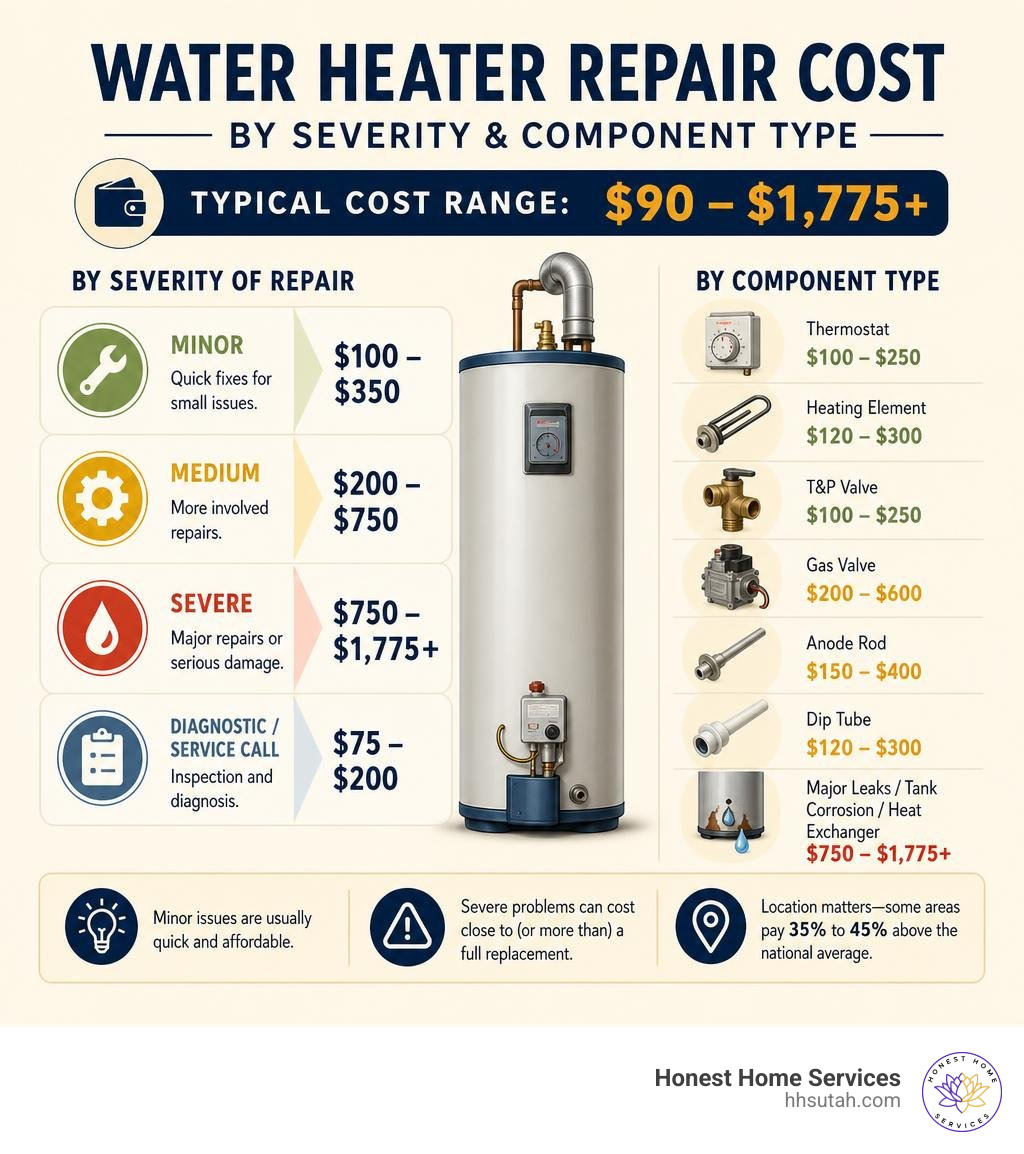
The cost of hot water heater repair typically falls between $90 and $1,775, with most homeowners spending around $600 for a standard repair in 2026.
Here’s a quick snapshot so you can size up your situation right now:
| Repair Severity | Typical Cost Range | Common Examples |
|---|---|---|
| Minor | $100 – $350 | Thermostat, heating element, T&P valve |
| Medium | $200 – $750 | Gas valve, anode rod, dip tube |
| Severe | $750 – $1,775+ | Major leaks, heat exchanger, tank corrosion |
| Diagnostic / Service Call | $75 – $200 | Initial inspection and diagnosis |
A few things to know upfront:
- Minor issues like a failed thermostat or a tripped breaker are often quick and affordable fixes.
- Severe problems — especially a corroded or leaking tank — can push costs close to (or past) the price of a full replacement.
- Your location matters. Utah homeowners typically pay 35% to 45% above the national average for tank water heater repairs due to regional labor rates and hard water conditions.
At Honest Home Services, our team has over 20 years of experience handling every type of water heater repair across Northern Utah — and we’re often asked about the cost of hot water heater repair before a technician even arrives. In the sections below, we’ll break down exactly what drives those costs so you can plan confidently.
Understanding the Average Cost of Hot Water Heater Repair in 2026
When your morning routine is rudely interrupted by a blast of freezing water, your first question is naturally going to be about your wallet. According to Angi’s 2026 Water Heater Repair Cost Guide, the national average water heater repair cost sits right around $615, with a typical range spanning from $228 to $1,017.
However, depending on what has actually failed inside your system, you could pay as little as $90 for a basic reset or up to $1,800 for complex, multi-component overhauls.
To help you visualize where your budget might land, let’s look at how these costs break down by repair severity. If you are trying to calculate how much your broken water heater will cost to fix, it helps to categorize the issue:
Water Heater Repair Cost Breakdown by Severity
- Minor Repairs ($100 – $350): These are straightforward, component-level swaps that a skilled plumber can complete in under an hour. Examples include replacing a faulty heating element in an electric unit, installing a new thermostat, or replacing a dripping temperature and pressure (T&P) relief valve.
- Medium Repairs ($200 – $750): These tasks require more diagnostic time, heavier labor, or pricier parts. This includes replacing a corroded sacrificial anode rod, swapping out a broken dip tube, or replacing a faulty gas control valve.
- Severe Issues ($750 – $1,775+): These are major system failures. If you have a tankless water heater with a cracked heat exchanger, or if a standard storage tank has suffered structural damage, the repairs will be extensive. In many of these severe cases, we will recommend a complete replacement because repairing a fundamentally compromised tank is physically impossible.
Key Factors That Drive Water Heater Repair Pricing
No two plumbing jobs are exactly alike, which is why phone estimates can sometimes vary. When we calculate the final cost of hot water heater repair for a homeowner in Salt Lake City, Layton, or Bountiful, we look at several core cost drivers.
According to the ConsumerAffairs Water Heater Repair Cost Analysis, several distinct factors dictate your final invoice:
- Labor Rates and Service Fees: Most professional plumbers charge between $50 and $150 per hour. Additionally, expect a diagnostic or service call fee ranging from $75 to $200. At Honest Home Services, we believe in transparent pricing, and we always outline these fees upfront so there are no surprises.
- Accessibility: Is your water heater easily accessible in an open utility closet, or is it crammed into a tight crawlspace, attic, or a poorly planned closet? If our technicians have to spend extra time simply reaching the unit or reconfiguring tight copper pipes to access a part, the labor costs will reflect that extra time.
- Utah’s Punishing Hard Water: Homeowners across Salt Lake County and Davis County know all about hard water. High mineral content leads to rapid sediment accumulation at the bottom of tank systems. This sediment acts as a thermal barrier, forcing the system to run hotter and longer to heat your water. This extra strain leads to premature failure of heating elements, gas burners, and the tank itself.
- Permits and Code Compliance: If a repair requires modifying your home’s gas lines, electrical wiring, or venting systems, local municipalities in Utah may require a permit, which typically adds $50 to $250 to the project cost.
To get a deeper understanding of how these variables interact, you can read our comprehensive guide on understanding hot water heater repair and replacement.
How System Type Impacts the Cost of Hot Water Heater Repair
The energy source and physical design of your water heater play a massive role in determining repair costs.
- Electric Water Heaters: These units are mechanically simpler than their gas counterparts. They rely on upper and lower heating elements and thermostats to warm the water. Because they have fewer moving parts and no exhaust venting, electric water heater repairs are generally more affordable, typically ranging from $150 to $400.
- Gas Water Heaters: Gas systems require burner assemblies, thermocouples, pilot lights, gas control valves, and dedicated flue venting to safely exhaust carbon monoxide. Because of these safety-critical components, repairing a gas system is more complex. Swapping out gas valves or venting pipes typically costs between $250 and $750. For a complete breakdown of what to expect, check out our guide on gas water heater service costs.
- Tank vs. Tankless Systems: Traditional storage tank repairs average $150 to $700. Tankless water heaters, while highly efficient, feature complex circuit boards, modulators, and compact heat exchangers. Repairing a tankless system requires specialized training, with average repair bills running from $300 to $1,300+.
- Hybrid Heat Pump Water Heaters: These advanced systems combine a traditional electric tank with an air-source heat pump mounted on top. Repairs on these hybrid systems can range from $150 to $900, depending on whether the issue lies in the electrical tank components or the heat pump compressor.
Component-Specific Cost of Hot Water Heater Repair
To give you the most accurate expectations before a plumber arrives at your home, let’s look at the average cost to repair or replace specific water heater parts in 2026:
- Thermostat Replacement ($150 – $300): While the physical part itself only costs $20 to $40, testing the electrical limits and safely installing the new thermostat brings the professional total to this range.
- Heating Element Replacement ($150 – $350): Over time, hard water minerals coat electric heating elements, causing them to burn out. Replacing them requires draining the tank below the element level, removing the failed part, and wiring in a new one.
- Sacrificial Anode Rod ($150 – $300): The anode rod is a magnesium or aluminum rod designed to attract corrosive elements in the water, sacrificing itself so your steel tank doesn’t rust. Replacing this rod every 3 to 5 years is the single best way to prolong your tank’s life.
- Gas Control Valve ($250 – $750): The gas valve regulates gas flow to the burner. Because a faulty valve poses a severe safety hazard, this is a repair that must always be handled by a licensed professional. The average cost for this service sits around $350.
- Temperature & Pressure (T&P) Relief Valve ($150 – $350): This valve is your system’s ultimate safety feature, releasing water if internal pressure or temperature climbs too high. If it is constantly dripping, it needs immediate replacement.
- Dip Tube Replacement ($150 – $400): The dip tube directs incoming cold water to the bottom of the tank to be heated. If it disintegrates, cold water mixes with hot water at the top of the tank, resulting in lukewarm showers.
If you are currently dealing with a system that is dripping or pooling water, we recommend reading our step-by-step guide on fixing your leaky water heater to prevent costly water damage to your home.
Repair vs. Replace: Making the Right Financial Decision
Every homeowner eventually faces the ultimate plumbing dilemma: do you keep patching up your old water heater, or is it time to bite the bullet and replace it?
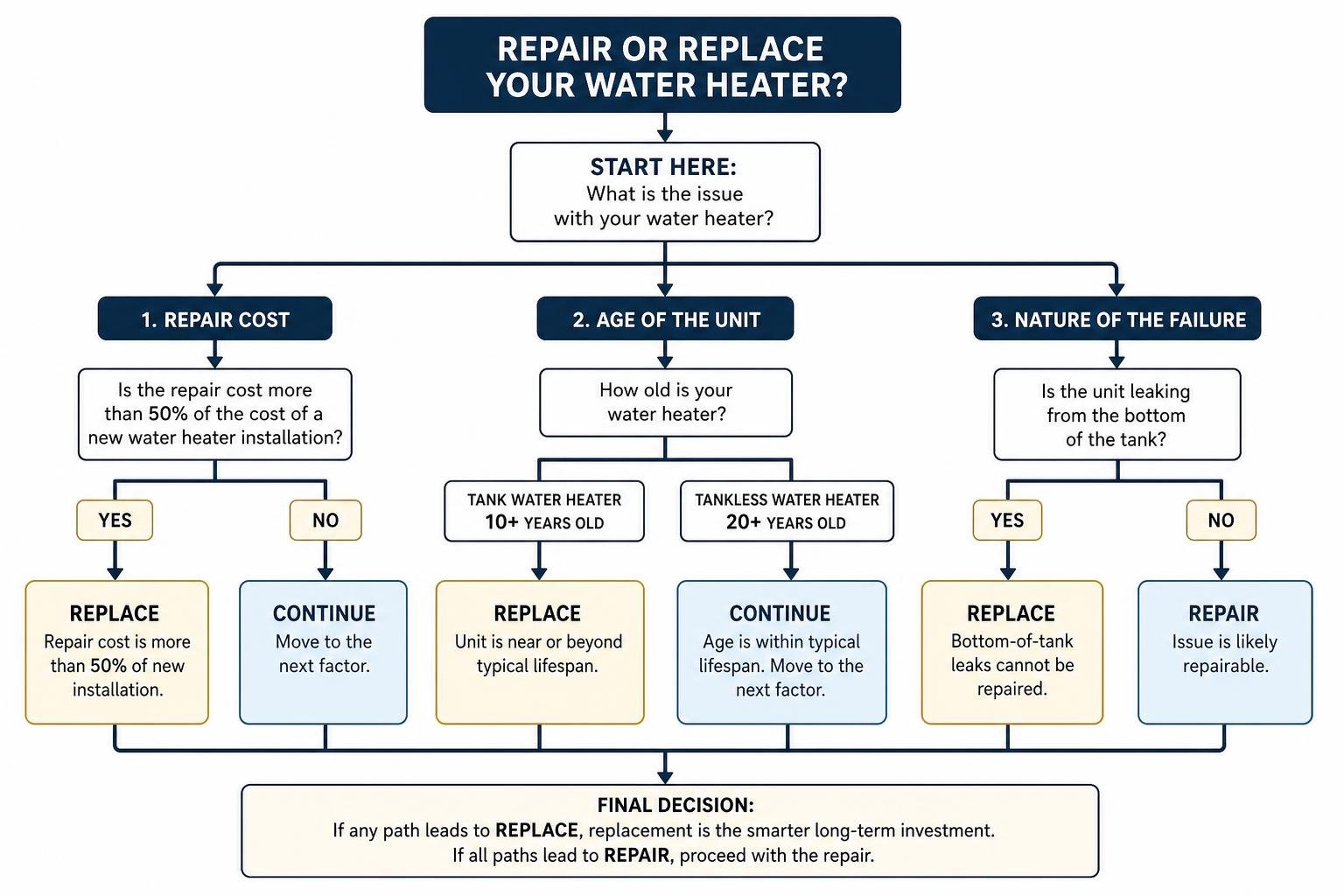
According to the Complete Water Guide on Repair vs. Replace, you should weigh three critical factors when making this choice:
- The 50% Rule: If a single repair quote exceeds 50% of the cost of a brand-new water heater installation, replacement is almost always the smarter long-term investment.
- The Age of the Unit: Standard tank water heaters have an average lifespan of 8 to 12 years. If your unit is over 10 years old and starts acting up, spending $400 on a repair is often throwing good money after bad, as other components are likely nearing the end of their operational life. Tankless water heaters, on the other hand, can last up to 20 years with proper maintenance.
- The Nature of the Failure: If your water heater is leaking from the bottom of the tank itself, the steel inner lining has corroded through. This cannot be patched, welded, or repaired. The only solution is a complete replacement.
To help you compare the long-term math, a standard residential tank replacement installed typically runs between $1,000 and $2,000, while a tankless replacement runs from $2,000 to $3,500+. You can explore these numbers in depth by viewing our breakdown of the real cost of water heater replacement with labor.
Frequently Asked Questions About Water Heater Repairs
What are the signs that my water heater is failing?
Your water heater will usually try to warn you before it quits entirely. Keep an eye out for these common warning signs:
- Rusty or Discolored Water: This indicates that either your anode rod has completely degraded or the interior steel tank is beginning to rust.
- Unusual Rumbling or Popping Noises: This is the sound of boiling water pockets struggling to escape from beneath a thick layer of hardened sediment at the bottom of your tank.
- Lukewarm or Cold Showers: A sudden drop in hot water capacity usually points to a broken dip tube or a failed heating element.
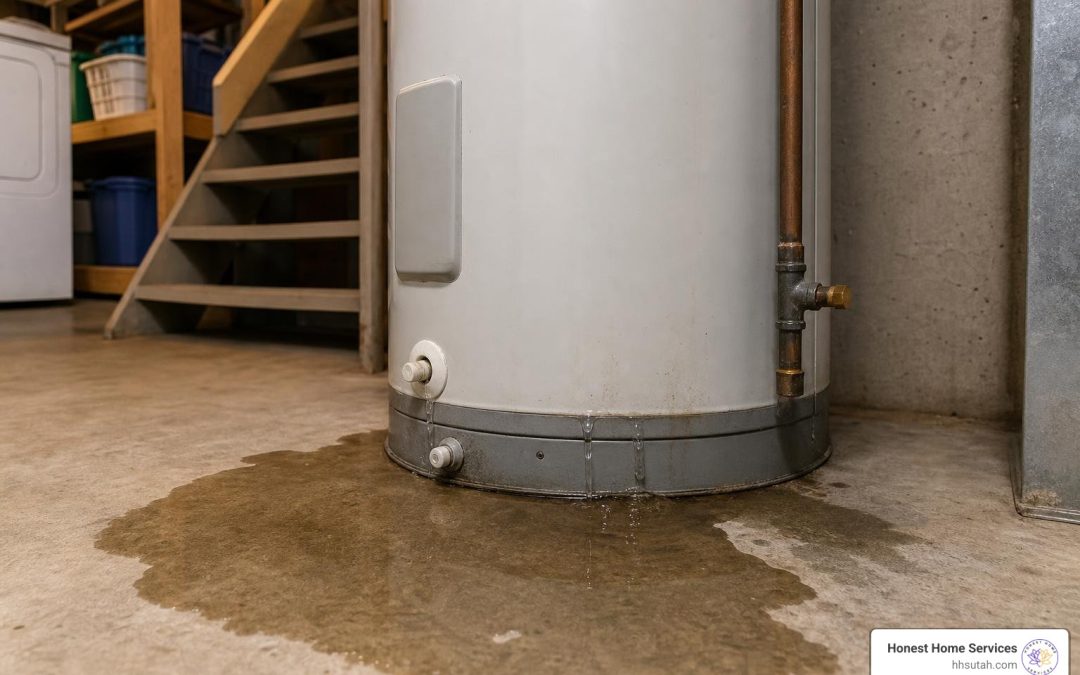
- Active Water Pooling: Any moisture or standing water around the base of your unit is an immediate red flag.
If your system has already stopped working, find immediate troubleshooting steps in our guide on what to do when your water heater quits.
Can I DIY a water heater repair to save money?
While we love a good weekend DIY project, water heaters are unique appliances that combine high-voltage electricity (240 volts), pressurized water, and natural gas.
A simple task like resetting a tripped high-temperature limit switch or checking a circuit breaker is perfectly safe to do yourself. However, attempting to replace gas valves, repair electrical wiring, or swap out heating elements without professional training can lead to severe safety hazards, including gas leaks, carbon monoxide poisoning, electrical shocks, or accidental home flooding.
If you want to understand what you can safely tackle yourself, read our resource on fixing broken water heater issues like a pro.
How often should I flush my water heater to prevent repairs?
To protect your system from Northern Utah’s hard water, we highly recommend flushing your standard tank water heater at least once a year—and up to twice a year if you live in an area with exceptionally high mineral content. Tankless systems should be professionally descaled once a year to prevent scale buildup from clogging the heat exchanger.
Regular flushing removes the accumulated sediment that causes your system to overheat and fail prematurely. To learn how to perform this vital maintenance safely, check out our guide on how to service your gas water heater.
Conclusion
A failing water heater doesn’t have to throw your entire household into chaos. By understanding the typical cost of hot water heater repair and catching the warning signs early, you can make smart, budget-friendly decisions that keep the hot water flowing safely.
If you live in Salt Lake City, Layton, Bountiful, or anywhere else in Northern Utah, you don’t have to face these plumbing choices alone. At Honest Home Services, we pride ourselves on delivering honest recommendations, fair upfront pricing, and expert repairs backed by our customer satisfaction guarantee.
Don’t wait for a minor drip to turn into an expensive household flood. Contact us today or visit our Honest Home Services Salt Lake City Water Heater Repair page to schedule your professional inspection and get your system running perfectly again!