

Why an Air Purifier with Charcoal Filter Makes a Real Difference Indoors
An air purifier with charcoal filter technology is one of the most effective tools for removing gases, odors, and chemical pollutants from the air inside your home or business. Here’s a quick summary of what you need to know:
- What it does: Uses activated carbon (charcoal) to trap gas molecules, VOCs, smoke, and odors through a process called adsorption
- Best for: Cooking smells, pet odors, cigarette smoke, wildfire smoke, formaldehyde, and other chemical off-gassing
- Works best when paired with: A True HEPA filter, which captures solid particles like dust, pollen, and pet dander that carbon alone cannot trap
- Filter replacement: Carbon filters typically need replacing every 3–12 months depending on the unit and usage
- Key buying factors: Room size coverage (sq ft), carbon weight, CADR rating, and noise level
Most people know that air purifiers exist, but fewer realize that not all air purifiers handle the same types of pollution. A standard HEPA-only unit won’t touch the chemical fumes coming off new furniture or the lingering smell after cooking. That’s where charcoal filtration changes the equation.
According to the EPA, indoor air can be two to five times more polluted than outdoor air — a sobering fact for homeowners who assume keeping windows closed means keeping pollutants out.
At Honest Home Services, we’ve spent over 20 years helping Utah homeowners and businesses solve HVAC and indoor air quality challenges, including helping clients choose and maintain the right air purifier with charcoal filter setup for their space. In this guide, we’ll walk you through everything you need to make a confident, informed decision.
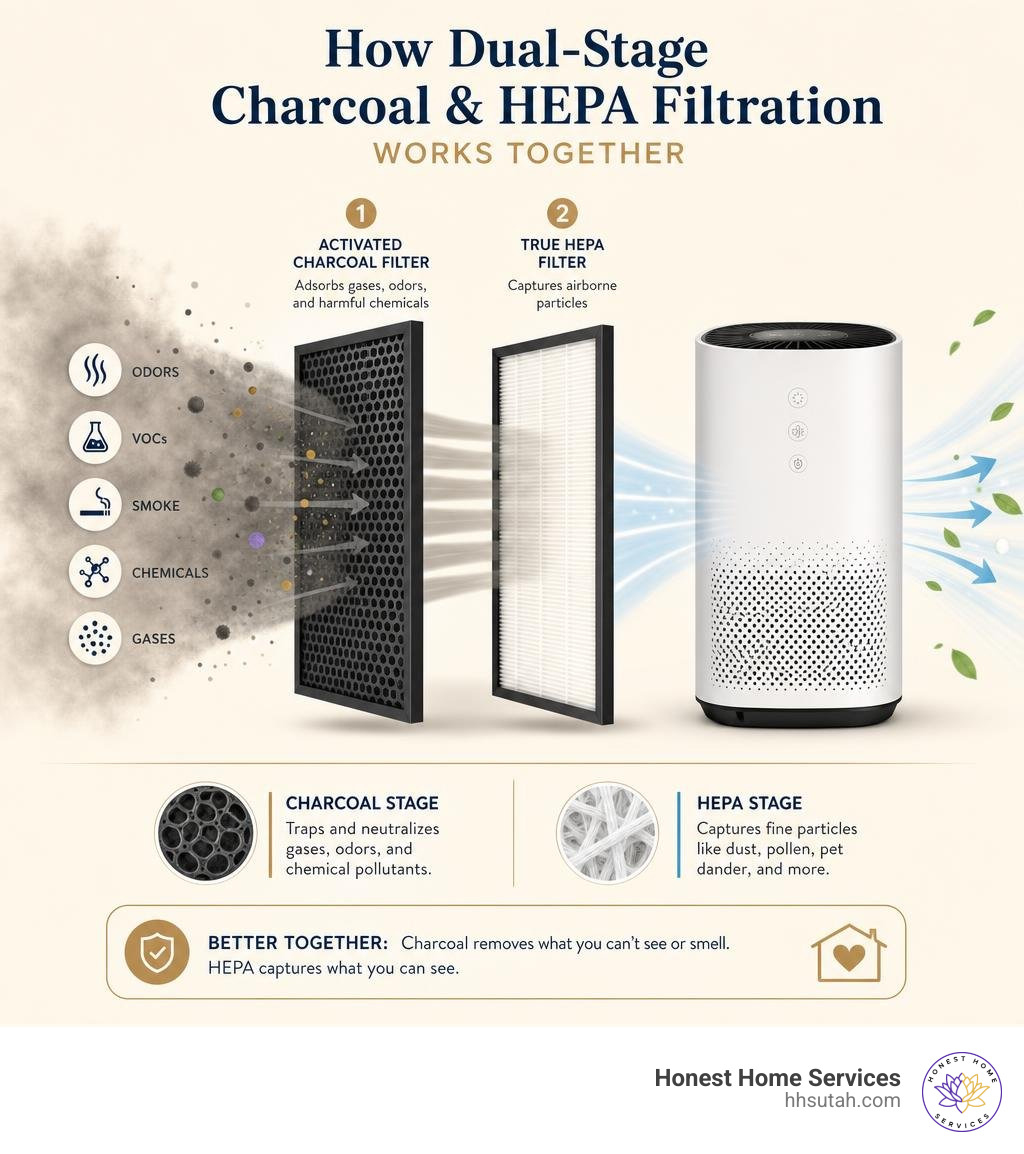
Important air purifier with charcoal filter terms:
Understanding Activated Carbon Technology and Adsorption
To understand why an air purifier with charcoal filter is so uniquely effective, it helps to take a look at what happens at the microscopic level. Activated charcoal—often referred to interchangeably as activated carbon—is not the leftover briquette charcoal you put in a backyard grill. Instead, it is carbon derived from natural sources like coconut shells, wood, or coal that has been processed with high heat and steam or chemical activation.
This thermal treatment creates a porous carbon structure riddled with millions of low-volume, microscopic pores. In fact, a single gram of high-grade activated carbon can have an internal surface area capacity equivalent to four tennis courts (over 10,000 to 15,000 square feet)! This massive surface area acts like a sponge for airborne chemicals and gaseous odors.
Mechanism of Action in an Air Purifier with Charcoal Filter
Unlike mechanical filters that catch dust using physical mesh, activated charcoal works through a physical-chemical phenomenon known as adsorption.
It is easy to confuse adsorption with absorption:
- Absorption is like a sponge soaking up water—the liquid moves inside the sponge’s physical body.
- Adsorption occurs when gas-phase contaminants, volatile organic compounds (VOCs), and odor molecules stick chemically and physically to the outer and inner surface walls of the charcoal pores as air flows past.
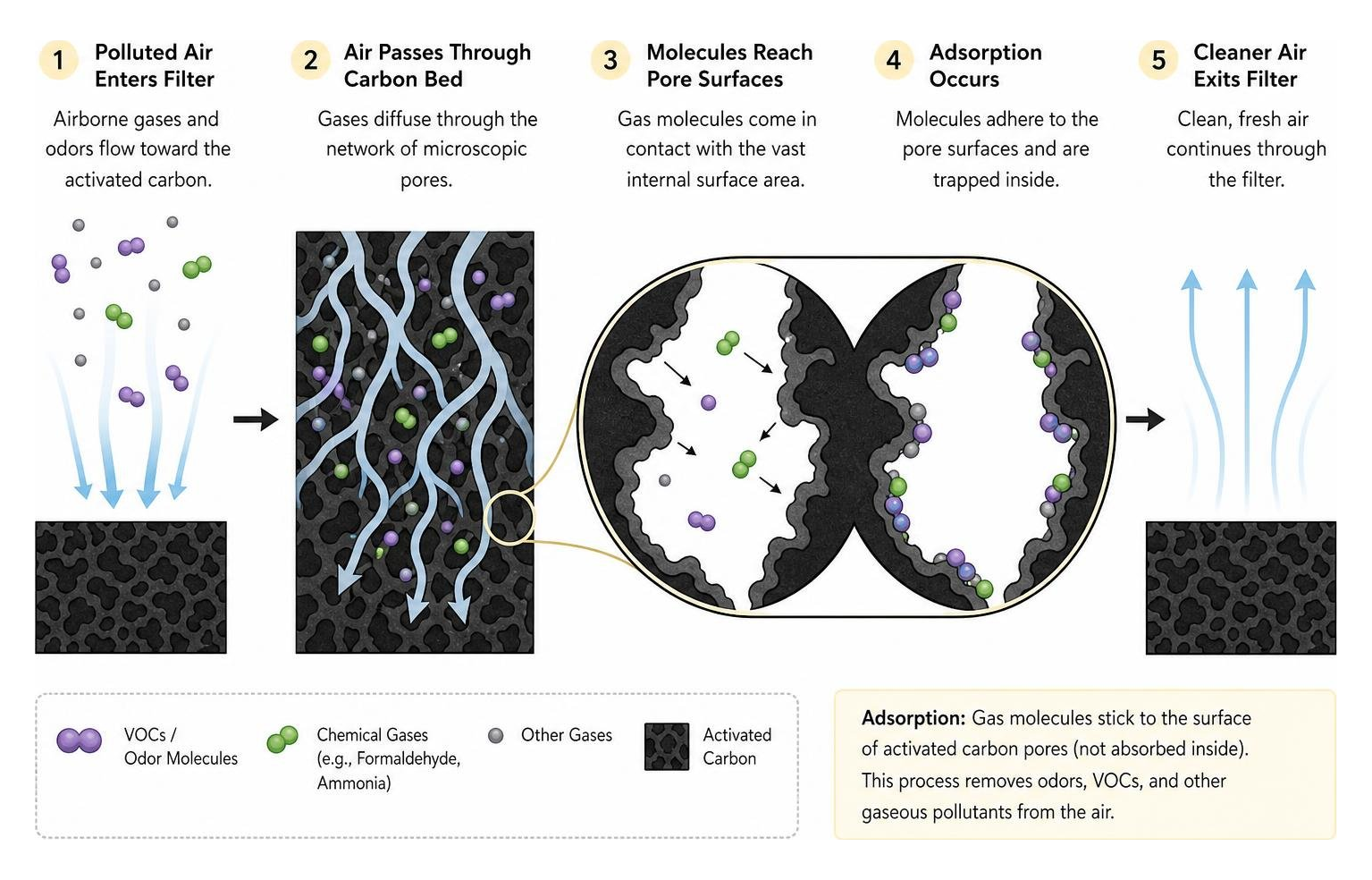
When organic chemical vapors or smoke molecules pass through a dense bed of activated carbon—especially high-purity coconut shell carbon—they become physically trapped inside these tiny pores. To enhance this molecular trapping capacity, some specialized systems add chemical treatments such as potassium permanganate or potassium iodide. These additives help neutralize specific tricky compounds like formaldehyde or sulfur compounds. To explore how this fits into broader indoor solutions, check out A Comprehensive Guide to Air Filtration Options.
Comparing HEPA Media and Activated Carbon Filters
A common misconception among homeowners across Salt Lake City, Sandy, and Bountiful is that a single filter type can clear all indoor air issues. In reality, mechanical filters and activated carbon filters do completely different jobs:
- HEPA Media (High-Efficiency Particulate Air): Designed purely for solid and liquid particulate removal. True HEPA filters capture 99.97% of airborne particles down to 0.3 microns in size—including dust mites, pollen, pet dander, mold spores, and fine dust. However, gas molecules and odors pass right through a HEPA filter like air through a screen door.
- Activated Carbon Filters: Specialized entirely for gas-phase pollutants, chemical vapors, smoke, and odors. However, carbon filters cannot trap physical dust or pet dander efficiently on their own.
Because gas and solid particles represent two entirely different states of matter, high-performing air cleaning systems always utilize combined filtration systems. A True HEPA filter handles the airborne particles, while a heavy-duty carbon filter captures the gases and smells. You can learn more about general filter categories on Air Purifiers with Charcoal or Carbon Filters.
Key Benefits of an Air Purifier with Charcoal Filter
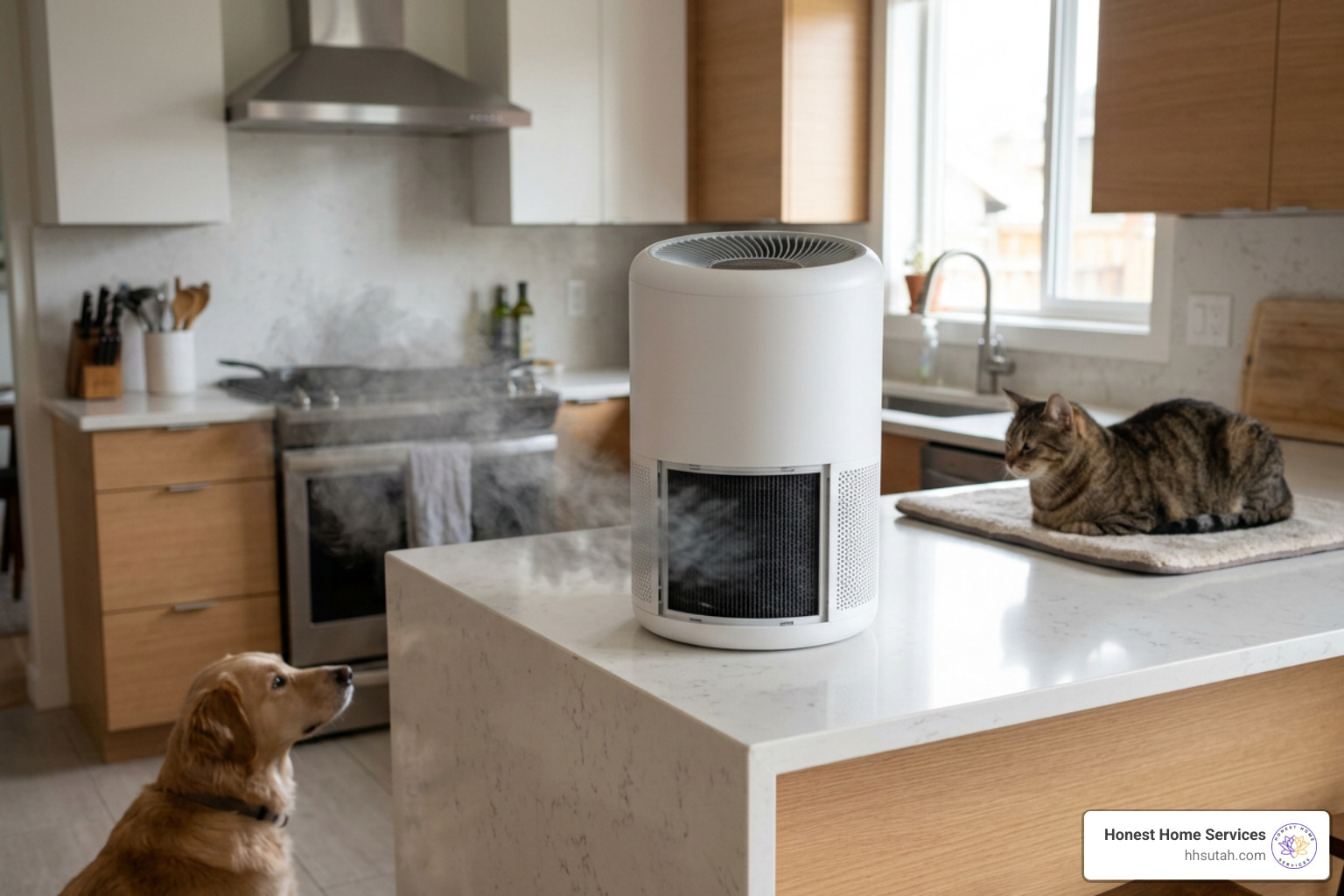
Whether you are dealing with winter air inversions along the Wasatch Front or summer wildfire smoke blowing through Davis and Salt Lake counties, an air purifier with charcoal filter addresses indoor air safety challenges that standard furnace filters simply miss.
Neutralizing VOCs, Smoke, and Chemical Off-Gassing
Volatile Organic Compounds (VOCs) are toxic gases emitted by common household items. Everything from new carpets, fresh paint, pressed wood furniture, and cleaning solvents to scented candles and aerosol sprays off-gas chemical fumes like formaldehyde, benzene, and toluene into your living room.
An activated carbon filter is the single most effective home technology for absorbing these invisible fumes. Additionally, carbon filtration offers vital wildfire smoke mitigation. Wildfire smoke is a hazardous mix of fine particulate matter and toxic combustion gases like carbon monoxide and chemical vapors. While HEPA handles the visible ash and soot, carbon traps the harmful gaseous vapors. To understand how VOCs impact your daily health, review Everything You Need to Know About Your Indoor Air Quality. For specialized heavy-VOC air purification options, see the V414 – VOCs and Chemicals- Good for Wildfires Air Purifier – Airpura Industries.
Tackling Household Odors from Pets and Cooking
We all love our pets and home-cooked meals, but few people enjoy waking up to yesterday’s fried fish smell or persistent cat litter tray odors. Odor neutralization is where charcoal filters deliver immediate, noticeable comfort:
- Pet Smell Elimination: Carbon adsorbs wet dog smells, litter box ammonia gases, and lingering dander odors.
- Food and Cooking Odors: Fish, spices, garlic, burnt toast, and bacon grease release volatile organic gases that stick to upholstery and walls unless trapped by carbon.
- Ambient Room Freshness: Instead of masking smells with synthetic floral sprays (which actually add more harmful VOCs into your air!), activated carbon purifies the room by physically removing the smell molecules.
To discover more about elevating home comfort, read about the Top 5 Benefits of High-Quality Air Filtration Systems. For eco-friendly passive options, check out Airova | 100% Natural Charcoal Air Purifier and Odour Eliminator.
Critical Sizing and Performance Factors for Air Purifiers
Buying an air purifier isn’t just about picking a stylish unit; it’s about matching the machine’s capacity to the physical volume of your room.
Sizing an Air Purifier with Charcoal Filter for Different Room Sizes
When reviewing models, you will encounter two primary industry performance metrics:
- Clean Air Delivery Rate (CADR): Measured in cubic feet per minute (CFM), CADR reflects how quickly an air cleaner filters dust, pollen, and smoke out of a specific room size.
- Air Changes per Hour (ACH): Indicates how many times the purifier completely cycles and filters the total volume of air in a room within 60 minutes.
For standard home comfort, an ACH rating of 2 (cycling air every 30 minutes) is the baseline minimum. However, for homes with severe allergies, asthma, or high sensitivity to chemical VOCs, aiming for 4 to 5 ACH is recommended.
When calculating square footage:
- Measure room length × width (e.g., 20 ft × 20 ft = 400 sq. ft.).
- Factor in standard 8-foot ceiling heights versus vaulted ceiling volume.
- Choose a unit rated slightly higher than your room’s actual square footage so you can run it quietly on lower fan settings.
For expert tips on calculating unit capacity, read Breathe Easy How to Choose the Best Air Filtration System. Modern options range from compact options like the Wyze Air Purifier | Affordable, Luxury Air Purifier up to high-capacity options such as the Shark BreatheClear™ Air Purifier Max with NeverChange™, Charcoal | SharkNinja or Shark BreatheClear™ with NeverChange™ Air Purifier, Charcoal | SharkNinja.
Carbon Weight, Depth, and Filter Lifespan
Here is a secret that many budget air purifier manufacturers don’t broadcast: not all carbon filters are created equal.
Many inexpensive air purifiers feature nothing more than a thin sheet of mesh sprayed with a dusting of carbon powder. These lightweight carbon sheets contain only a few ounces of charcoal. While they can catch light dust and temporary odors, their pore structure saturates in weeks.
For heavy smoke, pet smells, and chemical fumes, look for units built with pelleted carbon beds:
- Carbon Weight: Heavy-duty units utilize 3.2 lbs, 8 lbs, or even 15 lbs of solid activated carbon pellets. More carbon weight translates directly to longer pore life and higher molecular capacity.
- Filter Depth: A deep bed (2 inches or thicker) gives airborne gases longer contact time with the charcoal, yielding much higher single-pass efficiency. Devices like the TrueCarbon™ 270C Air Purifier prioritize dense, deep-bed carbon specifically for this reason.
Essential Features to Consider Before Buying an Air Purifier
Before purchasing an air purifier with charcoal filter, evaluate how its daily operation will fit your family’s routine and living space in Salt Lake, Davis, or Weber county.
Smart Sensors, Noise Output, and Energy Efficiency
- Automatic VOC and Particle Sensors: Premium purifiers include optical particle counters and gas-phase VOC sensors that continuously scan your air. When you cook dinner or open a bottle of chemical cleaner, the unit’s automatic fan regulation speeds up fan power instantly to clear the room, then slows back down to conserve energy.
- Decibel Levels and Quiet Operation: Noise matters, especially in bedrooms or home offices. Check the decibel (dBA) ratings across speeds. Low settings operate at 16–21 dBA (as quiet as a whisper or purring kitten), while maximum settings can reach 50–60 dBA (similar to a humming refrigerator or light conversation).
- Energy Star Compliance: Because air purifiers perform best when left running 24/7, choosing an Energy Star certified unit ensures minimal power draw (typically between 3.5W and 45W), keeping continuous running costs light.
Filter Maintenance, Costs, and Saturation Risks
To maintain clean indoor air, carbon filters must be replaced on time. Unlike a washable mesh pre-filter, saturated activated carbon cannot be washed with water—water clogs the microscopic pore structure permanently.
To help you plan maintenance schedules, here is a overview of standard air purifier filter layers:
| Filter Type | Primary Contaminants Targeted | Average Lifespan | Washable/Reusable? | Key Maintenance Task |
|---|---|---|---|---|
| Mesh Pre-Filter | Hair, lint, large dust particles | Permanent / 6–12 Mos | Yes | Vacuum or rinse every 2–4 weeks |
| Thin Carbon Sheet | Light odors, basic cooking smells | 3 Months | No | Replace every 90 days |
| Heavy Pelleted Carbon Bed | VOCs, smoke, formaldehyde, pet odors | 12 to 24 Months | No | Replace according to sensor or 12-mo mark |
| True HEPA / H13 Filter | Dust, pollen, pet dander, mold spores | 6 to 12 Months | No | Replace when discolored or indicated by unit |
Neglecting charcoal filter replacement leads to saturation risks. When every pore fills completely, the filter reaches its adsorption limit. At that point, it stops cleaning the air—and in warm rooms, saturated carbon can actually begin off-gassing trapped odors back into your room!
For municipal guidelines on healthy home air standards, check the local Indoor Air Quality Program. To dispel common misconceptions about home filtration, read Indoor Air Quality Myths Debunked What You Need to Know.
Frequently Asked Questions About Charcoal Air Filtration
How often does a charcoal filter need to be replaced?
For standard portable air purifiers running continuously, thin charcoal pre-filters usually need replacement every 3 months. High-capacity units containing thick beds of pelleted carbon (3 to 8+ lbs) can last between 12 to 24 months. Operating frequency, indoor smoke exposure, cooking habits, and pet counts directly impact your filter lifecycle.
Can a charcoal filter capture allergens like pet dander and pollen?
No, activated charcoal alone cannot trap physical allergens like pollen, dust mites, or microscopic pet dander. Those solid particles pass right through carbon pores. To eliminate allergens alongside odors, choose a multi-stage purification system that combines an activated charcoal filter with a True HEPA filter.
What happens when an activated carbon filter reaches full saturation?
Once an activated carbon filter hits its adsorption limit, its surface pores are entirely occupied by gas molecules. The filter loses its ability to pull additional VOCs or odors out of the air. If left in service under high humidity or temperature changes, a saturated filter can re-release trapped chemical odors back into your living space.
Conclusion
Creating a fresh, healthy indoor environment requires tackling both physical dust particles and invisible gas-phase pollutants. Investing in an air purifier with charcoal filter technology paired with True HEPA media gives your home comprehensive protection against everything from seasonal wildfire smoke and chemical VOCs to daily pet and kitchen smells.
While standalone portable purifiers do a great job in individual bedrooms or living rooms, a whole-home filtration solution integrated directly into your central HVAC system keeps clean air circulating through every square foot of your house seamlessly.
At Honest Home Services, our team of licensed technicians serves homeowners across Salt Lake City, Salt Lake County, Davis County, and surrounding communities from Layton and Kaysville down to Draper and Park City. We provide expert advice, whole-house air quality testing, and professional installation of advanced HVAC filtration systems with guaranteed customer satisfaction and transparent pricing.
Ready to clear the air in your Utah home? Contact us today to explore our full line of Air Filtration Services and schedule your indoor air quality assessment!