
Why Air Filtration Matters More Than You Think
Air filtration is the process of removing harmful particles, gases, and contaminants from the air you breathe indoors. Here’s a quick overview of what you need to know:
| Topic | Quick Answer |
|---|---|
| What it does | Removes dust, pollen, smoke, mold, VOCs, and other pollutants from indoor air |
| Main types | HEPA, activated carbon, electrostatic, UV-C, and MERV-rated HVAC filters |
| Key ratings | MERV (filter efficiency), CADR (airflow speed), and HEPA (99.97% at 0.3 microns) |
| When to replace | Every 30–90 days for most homes; monthly during high-pollution seasons |
| Why it matters | Americans spend roughly 90% of their lives indoors — air quality directly affects health |
Most people don’t think about the air inside their homes. But indoor air can actually be more polluted than outdoor air. In 2020, about 97 million Americans lived in counties with pollution levels above federal safety standards. According to the WHO, only 1% of people worldwide breathe truly clean air.
Poor indoor air quality is linked to allergies, asthma, respiratory infections, and long-term health problems. And common everyday sources — cooking, cleaning products, pet dander, and even furniture — constantly add pollutants to your home’s air.
The good news? The right air filtration system can make a real difference.
At Honest Home Services, we’ve spent over 20 years helping Northern Utah homeowners and businesses improve their indoor air quality through expert HVAC and air filtration services. We’re here to help you cut through the confusion and find the right solution for your home.
How Different Air Filtration Technologies Work
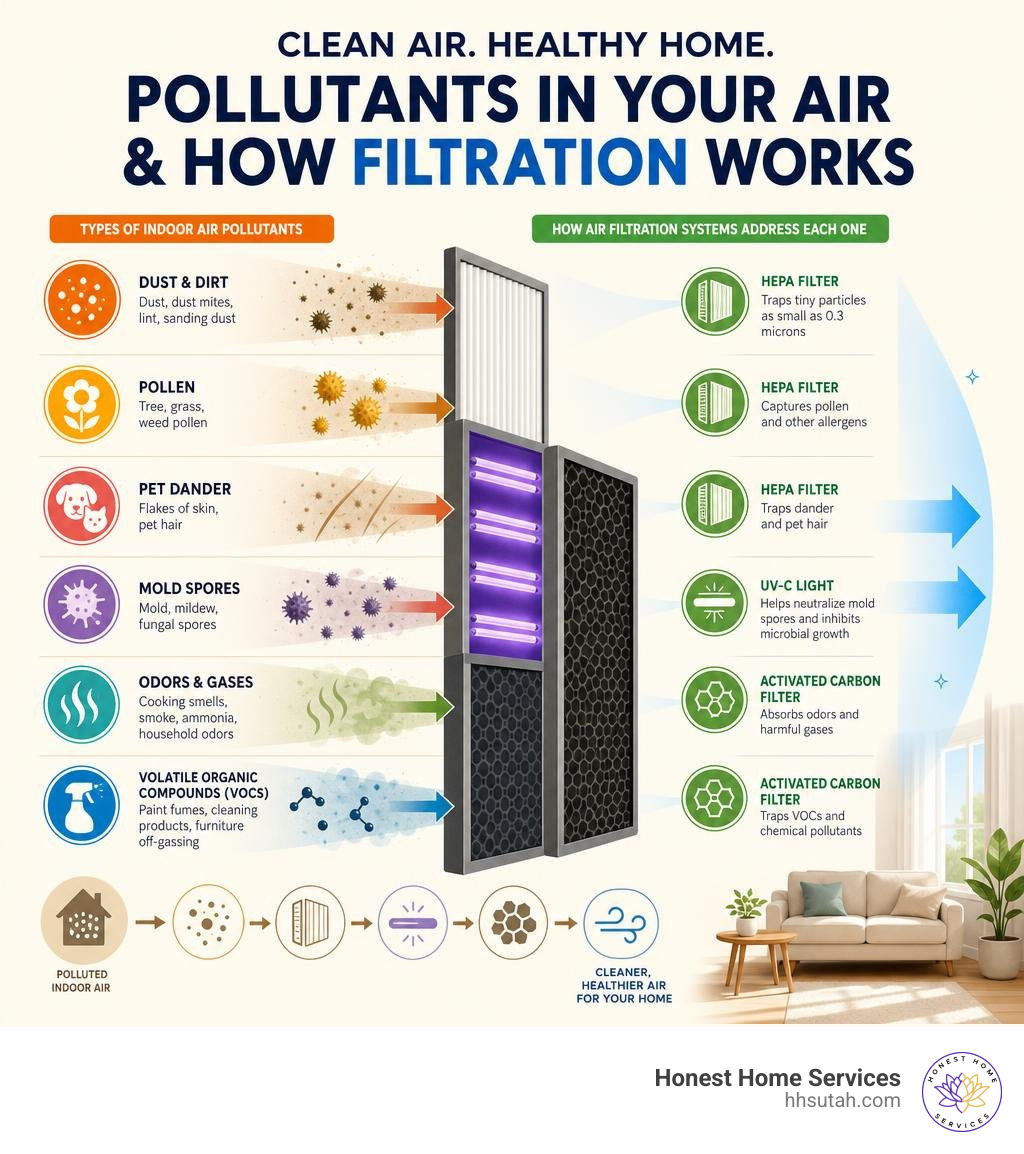
To choose the right system, it helps to understand how different air filtration technologies process the air. Filters are not just simple screens that block dust; they rely on sophisticated physical and chemical processes to capture particles of varying sizes.
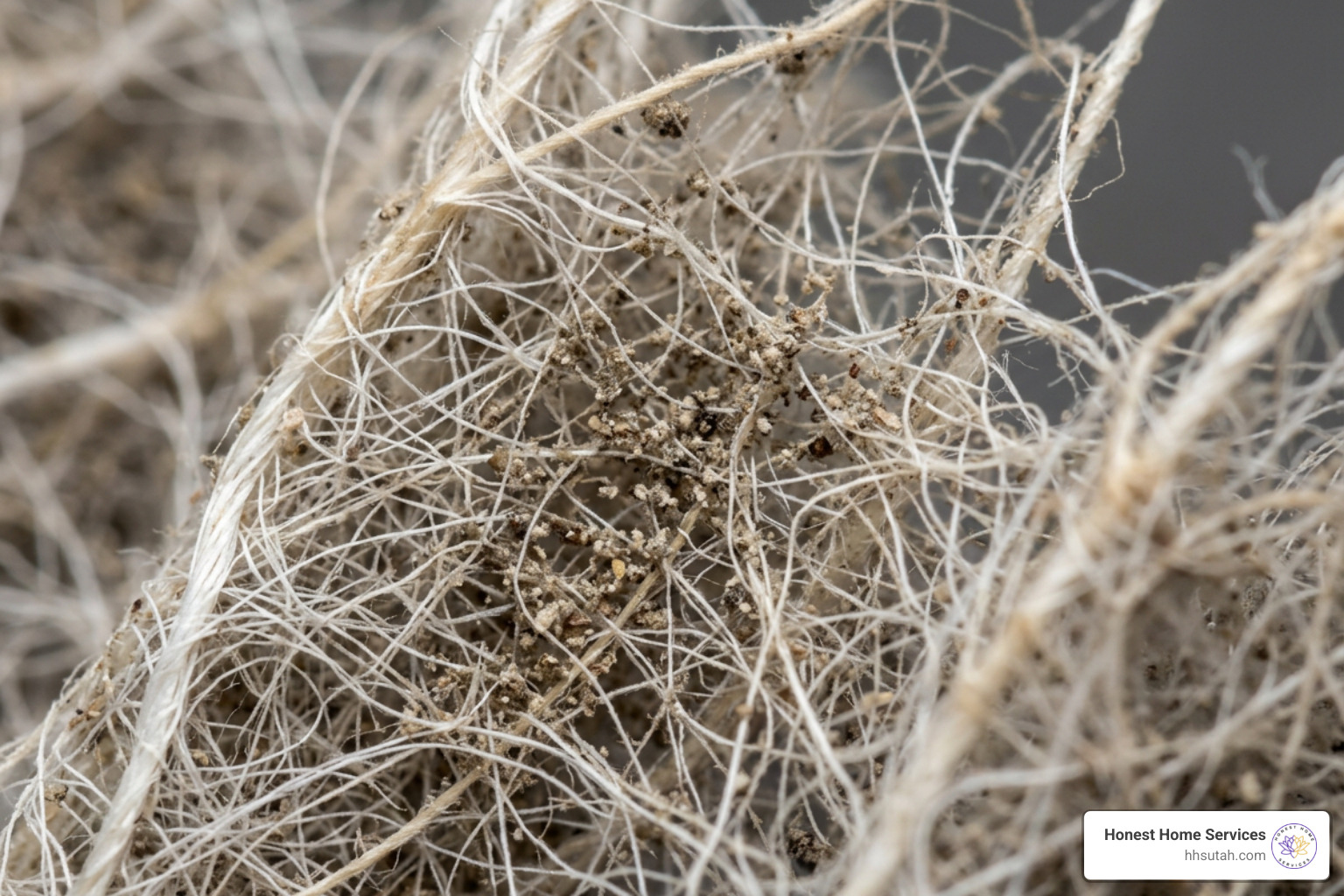
When we look at how mechanical filters trap particulate matter, we see five primary physical mechanisms at play:
- Straining (or Sieving): This is the most intuitive mechanism. It occurs when a particle is too large to fit through the spaces between the filter fibers and gets physically blocked. It is highly effective for large particles like hair and coarse dust but does little for microscopic contaminants.
- Inertial Impingement: Heavy, fast-moving particles cannot easily change direction when air flows around a filter fiber. Instead, their momentum carries them straight into the fiber, where they collide and stick. This is particularly effective for larger respirable particles.
- Interception: This happens when a particle follows the path of the airflow but passes close enough to a filter fiber that its edge touches and adheres to the fiber.
- Diffusion: Very small, lightweight particles (less than 0.1 microns) do not travel in straight lines. They are buffeted by gas molecules in a random, zig-zag pattern known as Brownian motion. This erratic path increases the likelihood that they will wander into a filter fiber and be captured.
- Electrostatic Attraction: Some filters use fibers with a permanent or induced static charge. This charge attracts oppositely charged particles, pulling them out of the airflow and securing them to the media.
Understanding these detailed mechanisms is essential for engineering effective climate solutions. For those interested in the deep engineering science behind these processes, the Scientific research on particulate contaminants provides a comprehensive breakdown of mechanical collection properties.
The Role of HEPA in Residential Air Filtration
High-Efficiency Particulate Air (HEPA) filters represent the gold standard of particulate filtration. Originally designed by the U.S. Atomic Energy Commission during World War II to capture radioactive particles, HEPA technology was standardized by the Department of Energy in the 1960s.
To qualify as a true HEPA filter, the media must remove at least 99.97% of airborne particles that are 0.3 microns in diameter. The 0.3-micron size is used as the benchmark because it represents the “most penetrating particle size” (MPPS) — particles of this size are the hardest to trap because they are too small for effective interception and too large for rapid diffusion.
For homeowners in Northern Utah, HEPA filtration is a game-changer. During our notorious winter inversions in the Salt Lake Valley, or when wildfire smoke drifts across the Mountain West, our air becomes saturated with fine particulate matter (PM2.5). Fine particulate matter makes up 80% of wildfire smoke, and these tiny particles can bypass the body’s natural defenses to settle deep in the lungs.
By installing a HEPA system, you can effectively capture these dangerous particulates, alongside common allergens like pollen, pet dander, and mold spores. If you want to learn more about how these systems physically transform your living space, read about how air filtration helps home air quality.
Activated Carbon and Gas-Phase Filtration
While mechanical filters like HEPA are outstanding at stopping solid and liquid particles, they are completely useless against gases, chemical fumes, and odors. This is because gas molecules are far too small to be trapped by mechanical fibers. To address these molecular contaminants, we use activated carbon.
Activated carbon filters work through a process called adsorption (not absorption). In absorption, a substance is pulled into the volume of another material (like water soaking into a sponge). In adsorption, gas molecules adhere to the surface of the carbon.
To maximize this effect, the carbon is treated with oxygen to open up millions of tiny pores between the carbon atoms. This process dramatically increases its surface area. In fact, a single gram of activated carbon can have a surface area of over 3,000 square meters!
Activated carbon is highly effective at capturing:
- Volatile Organic Compounds (VOCs): Chemical gases emitted by household items like paints, varnishes, cleaning supplies, new carpets, and cosmetics.
- Odors: Smells from cooking, pets, and tobacco smoke.
- Combustion Gases: Nitrogen dioxide and other byproducts from gas stoves and fireplaces.
Because no single technology can do it all, combining mechanical filtration with a dedicated gas-phase sorbent is often the best approach. If you are weighing these different options, take a look at our guide on choosing the best air filtration system to see how to build the perfect multi-stage setup.
Electrostatic and Electronic Air Cleaners
Electronic air cleaners, including electrostatic precipitators and ionizers, take a different approach to cleaning the air. Instead of relying solely on physical barriers, they use electricity to charge airborne particles.
In an electrostatic precipitator, air passes through an ionization section where particles receive a strong positive electrical charge. The charged particles then pass between closely spaced metal plates that are negatively charged. Because opposites attract, the positive particles are pulled out of the airstream and stick to the negative plates.
While these systems offer the benefit of washable collection plates (meaning no ongoing filter replacement costs), they do have drawbacks:
- Ozone Production: Many electronic air cleaners generate small amounts of ozone as a byproduct of the electrical ionization process. Ozone is a known lung irritant that can worsen asthma and other respiratory conditions.
- Maintenance Requirements: As the collection plates coat with dust, their efficiency drops rapidly. They must be cleaned frequently to maintain performance.
To protect consumer health, modern safety standards like the UL 2998 standard certify air cleaning devices that emit zero (or negligible) ozone. When choosing any electronic air cleaning device, ensuring it carries this certification is vital for your indoor safety.
Key Performance Metrics and Standards
When shopping for air filters or whole-home purification systems, you will encounter several ratings and standards. Understanding these metrics is the only way to make an objective, apples-to-apples comparison.
| Metric / Standard | What It Measures | Target Range / Best Score | Primary Application |
|---|---|---|---|
| MERV (ASHRAE 52.2) | Particle capture efficiency for sizes 0.3 to 10 microns | MERV 13 to 16 (residential high-efficiency) | HVAC filters & ducted systems |
| CADR (AHAM) | Volume of clean air delivered per minute (by pollutant type) | Higher is better (e.g., 300+ for large rooms) | Portable/in-room air purifiers |
| HEPA (DOE Standard) | Absolute efficiency for the hardest-to-trap particles (0.3 microns) | 99.97% or higher | Critical medical, residential, & cleanroom use |
| UL 2998 | Ozone emissions safety for electrical air cleaners | Zero ozone emission (< 0.005 ppm) | Electronic air purifiers & ionizers |
For a deep dive into the official industry recommendations regarding these standards, you can consult the ASHRAE Position Document on Filtration and Air Cleaning .
Understanding MERV and CADR Ratings
The Minimum Efficiency Reporting Value (MERV) is a rating system developed by the American Society of Heating, Refrigerating and Air-Conditioning Engineers (ASHRAE) under Standard 52.2. MERV ratings range from 1 to 16, with higher numbers indicating a greater ability to capture smaller particles.
- MERV 1–4: Typically cheap fiberglass filters. They only capture large particles (like carpet fibers and lint) and are designed purely to protect HVAC equipment from large dust buildup, not to clean the air for human health.
- MERV 5–8: Standard pleated filters. They can trap pollen, dust mites, and mold spores.
- MERV 9–12: High-quality residential filters. They capture finer dust, pet dander, and automotive emissions.
- MERV 13–16: Premium filters. They are highly efficient at capturing bacteria, virus droplets, and microscopic smoke particles. A MERV 13 filter, for example, is rated to remove at least 85% of particles in the 1 to 3-micron range.
However, higher MERV filters are denser, which increases airflow resistance (also known as static pressure or pressure drop). If a filter is too restrictive for your specific HVAC blower motor, it can reduce airflow, strain your heating and cooling system, increase energy bills, and potentially cause equipment damage.
On the other hand, the Clean Air Delivery Rate (CADR) is a metric developed by the Association of Home Appliance Manufacturers (AHAM) specifically for portable, in-room air purifiers. CADR measures the volume of clean air a unit can produce in cubic feet per minute (CFM) for three specific pollutants: smoke, dust, and pollen. The higher the CADR, the faster the unit can clean the air in a given room size.
Certifications and Safety Standards
Beyond performance ratings, several independent bodies certify air cleaners for safety and environmental compliance:
- CARB Certification: The California Air Resources Board regulates indoor air cleaning devices to ensure they do not emit ozone above safe levels. To be sold legally in California (and adopted as a standard of safety nationwide), portable air purifiers must pass rigorous electrical safety and ozone emission testing.
- UL 2998: Underwriters Laboratories developed this strict standard to certify devices that emit virtually no ozone (less than 0.005 parts per million). This is the gold standard for verifying that an electronic air cleaner is safe for continuous residential use.
- ASHRAE Standard 241: This standard establishes minimum requirements for control of infectious aerosols in buildings. It introduces the concept of Equivalent Clean Airflow (ECAi), which allows building operators to combine outdoor air ventilation with high-efficiency filtration to achieve safe breathing environments.
Selecting and Integrating the Best System for Your Environment
Selecting the right air filtration system depends heavily on your specific property, local environment, and lifestyle.

For instance, living in Northern Utah means dealing with unique geographical air quality challenges. During our winter inversions, cold air traps particulate pollution close to the valley floor across Salt Lake County and Davis County. During these periods, indoor air quality can degrade rapidly if your home is not properly sealed and filtered.
To help guide local efforts, you can review the Salt Lake City air quality guidelines, which outline community programs and commercial building standards designed to combat these localized pollution spikes.
Integrating Air Filtration with HVAC Systems
For comprehensive, whole-home air cleaning, integrating high-efficiency filtration directly into your existing HVAC system is highly effective. Rather than placing individual portable units in every room, a whole-home filter cleans all the air circulated by your furnace and air conditioner.
However, proper installation is critical. To ensure your system works as intended, our technicians focus on several key best practices:
- Filter Sealing and Bypass Prevention: If there are gaps around the edges of your filter rack, air will take the path of least resistance. This means dirty air will bypass the filter entirely. We ensure tight seals and custom filter racks so that 100% of the circulated air actually passes through the filter media.
- Pressure Drop Management: Before upgrading your system to a MERV 13 or higher filter, we test your HVAC system’s static pressure. This ensures your blower motor can handle the added resistance without overheating or reducing airflow to your home.
- In-Duct UV-C Systems: For homeowners looking to neutralize biological contaminants like bacteria, viruses, and mold spores, we often integrate in-duct UV-C germicidal lights. These systems damage the DNA/RNA of microorganisms as they pass through your ductwork, preventing them from multiplying.
If you are interested in exploring how these whole-home upgrades can protect your family from invisible biological and chemical hazards, check out our guide on the hidden dangers of indoor air quality.
Environmental and Energy Impacts
Running air filtration systems can affect your home’s energy consumption and carbon footprint, but choosing the right system minimizes these impacts.
For portable units, most standard HEPA air purifiers use between 50 to 100 watts of electricity per hour (W). For context, this is significantly less than major appliances like refrigerators (approx. 225W) or central air conditioners (3,500W). Using variable fan speeds, timers, and smart scheduling can lower this energy footprint even further.
For whole-home HVAC systems, the energy impact is tied to pressure drop. A highly restrictive, dirty filter forces your blower motor to work harder, which consumes more electricity and shortens the lifespan of your equipment. In commercial and industrial applications, energy represents up to 80% of an air filter’s Life Cycle Cost.
To optimize efficiency, we recommend choosing filters engineered with low resistance-to-airflow properties. For those interested in leading-edge industrial and commercial energy-saving filter designs, you can explore the Camfil air filtration solutions to see how modern engineering balances high-efficiency particulate capture with low energy consumption.
Frequently Asked Questions About Air Filtration
How often should I replace my air filters?
The simple answer is that most standard pleated filters should be changed every 60 to 90 days. However, this timeline can change significantly based on several local and lifestyle factors:
- The Northern Utah Inversion Season: During our winter inversions or active wildfire seasons, your filters work overtime to capture heavy outdoor particulate matter. We highly recommend checking your filter monthly during these periods and replacing it if it shows visible gray discoloration.
- Pet Ownership: If you have dogs or cats that shed dander and fur, your filters will clog much faster. Homes with multiple pets should change their filters every 20 to 45 days.
- Allergies and Asthma: If anyone in your home suffers from severe respiratory issues, keeping a fresh, clean filter in place is critical. Changing it every 30 to 45 days helps maintain peak filtration efficiency.
- Vacation Homes or Low-Use Properties: Properties with single occupants or vacation homes can often go 6 to 12 months between filter changes.
Neglecting filter changes leads to strained HVAC performance, poor indoor air quality, and higher utility bills. To read a complete breakdown of how to identify the signs of a clogged filter, check out our comprehensive guide on everything about indoor air quality.
What is the difference between an air purifier and an air scrubber?
While these terms are sometimes used interchangeably, they refer to different air cleaning methods:
- Air Purifiers (Passive Filtration): These units pull air through a physical filter (like a HEPA or carbon filter), trap the contaminants, and release the cleaned air back into the room. They are passive because they only clean the air that physically passes through the unit.
- Air Scrubbers (Active Purification): These systems are typically installed directly into your central HVAC ductwork. They use active technologies — such as photocatalytic oxidation (PCO) or specialized ionization — to send friendly oxidizers and charged ions out into your living spaces. These active agents seek out and neutralize airborne and surface-bound contaminants (like bacteria, viruses, and odors) throughout your entire home.
To learn more about how active and passive systems compare, and to clear up other common misconceptions, read our article debunking indoor air quality myths.
Can upgrading to a high-MERV filter damage my HVAC system?
Yes, it can if your system is not designed to handle the added airflow resistance.
Standard residential HVAC systems are engineered to operate within a specific range of static pressure. Cheap fiberglass filters offer very low resistance, while thick, high-efficiency MERV 13 to 16 filters are much denser. If you slide a high-MERV filter into a standard 1-inch slot without checking your system’s capacity, the blower motor may struggle to pull enough air. This can lead to:
- Frozen AC Coils: Reduced airflow in the summer can cause your air conditioner’s indoor evaporator coil to freeze over.
- Overheated Heat Exchanger: In the winter, restricted airflow can cause your furnace to overheat and cycle off prematurely, potentially cracking the expensive heat exchanger.
- Increased Energy Bills: The blower motor has to run longer and work harder to circulate air, driving up your power usage.
Before making a significant upgrade, we recommend having a professional HVAC technician assess your ductwork and blower capacity. Often, we can install a wider, media filter cabinet (usually 4 to 5 inches thick) that provides high-efficiency filtration with a much lower pressure drop than a dense 1-inch filter.
Conclusion
Investing in high-quality air filtration is one of the most effective steps you can take to protect your health, improve your sleep, and keep your home comfortable year-round. Whether you need a simple filter upgrade, a whole-home HEPA system, or an active air scrubber, finding the right fit for your property is key.
At Honest Home Services, we are proud to serve communities across Northern Utah, including Salt Lake City, Salt Lake County, Davis County, Clearfield, Layton, Kaysville, Farmington, Bountiful, West Valley, Murray, West Jordan, South Jordan, Bluffdale, Herriman, Draper, Park City, Tooele, Lehi, and Saratoga Springs.
Our team of local, expert technicians is dedicated to providing honest advice, fair pricing, and guaranteed customer satisfaction. We don’t believe in high-pressure sales pitches — just reliable, affordable solutions tailored to your family’s needs.
Ready to breathe easier? Schedule professional air filtration services with Honest Home Services today, and let us help you find the perfect clean air solution for your home!