

The Best Air Purifier Plus Fan Combos for Clean, Cool Air
An air purifier plus fan combo is a single device that filters airborne pollutants and circulates air — replacing two separate appliances with one. Here are the top options at a glance:
| Model | Best For | Price Range |
|---|---|---|
| Dyson TP07 | Best overall performance | Premium ($$$) |
| Coway Airmega Aim | Best budget pick | Under $150 |
| Dyson PH03 | Best with humidifier | Premium ($$$) |
| Honeywell HPA6000 | Best for large rooms | Mid-range ($$) |
| Crane 2-in-1 Desktop | Best for desks/dorms | Budget ($) |
| Philips Air Performer 9000 | Best 4-in-1 option | Premium ($$$) |
These units work best in rooms under 300 square feet. For larger spaces or severe allergies, a dedicated air purifier will outperform any combo unit.
Here’s what most people don’t realize: indoor air can be up to five times more polluted than outdoor air. Everyday sources — pet dander, cooking fumes, dust, and household chemicals — quietly build up while you’re going about your day. A combo unit tackles both the air quality problem and the comfort problem at once, which is why they’ve become so popular.
That said, not every combo unit is worth your money. Some are great fans but weak purifiers. Others purify well but move too little air to feel refreshing. This guide cuts through the noise.
At Honest Home Services, we’ve spent over 20 years helping Northern Utah homeowners improve indoor comfort — including advising on the right air purifier plus fan solutions that work with your home’s existing HVAC setup. We’ll help you find the right fit without the guesswork.
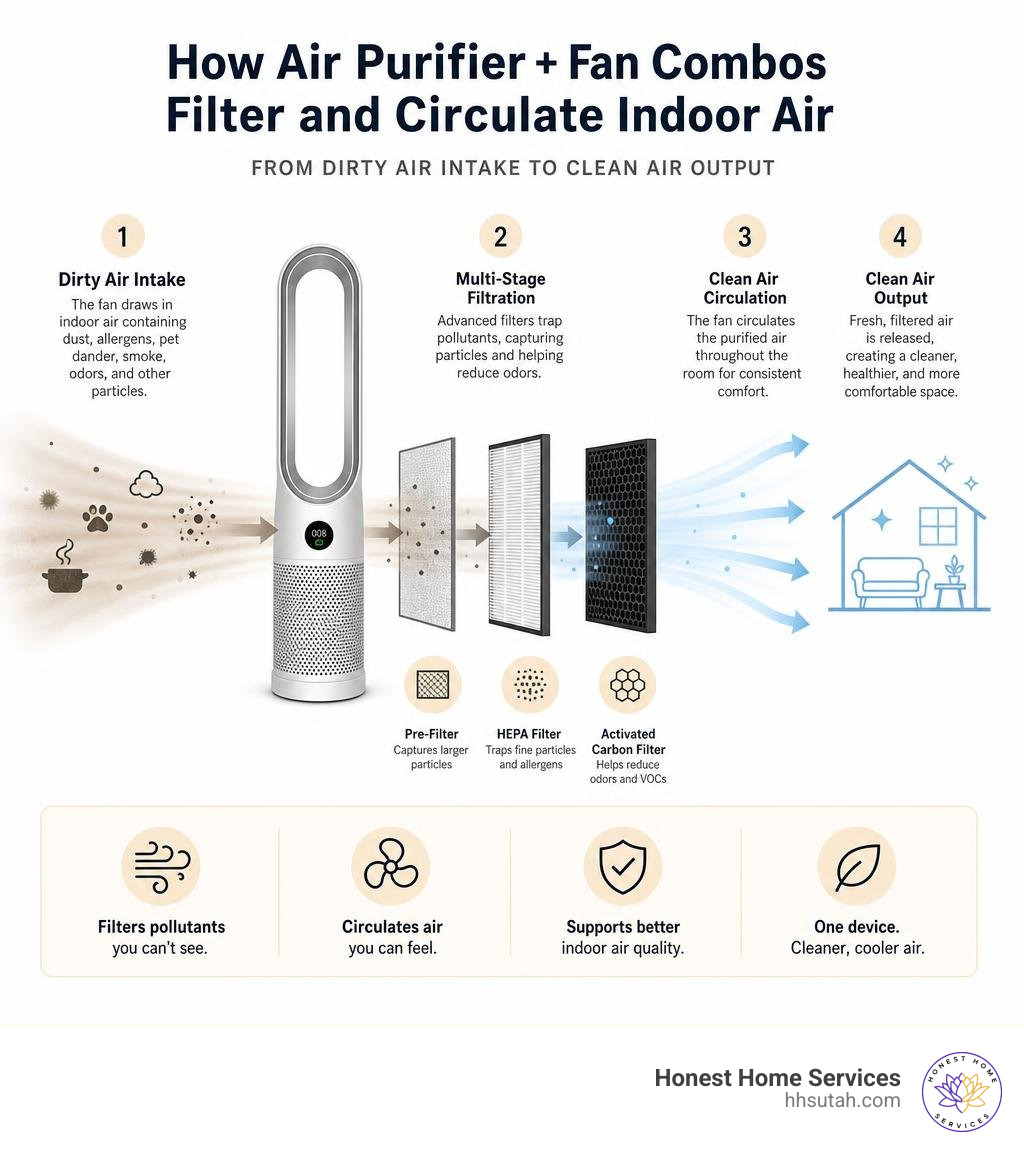
Easy air purifier plus fan word list:
What is an Air Purifier Plus Fan Combo?
An air purifier plus fan combo is a hybrid home appliance designed to do two jobs simultaneously. It houses a motor and fan blades (or a bladeless impeller system) to move air around your room, but before that air is projected outward, it is forced through a series of physical filters.
To really understand what makes these devices unique, it helps to look at how they differ from traditional, single-purpose appliances. A dedicated air purifier is built with one goal: to pull dirty air in, trap microscopic particles, and release the clean air back into the room as quietly as possible. Because they don’t need to double as cooling fans, dedicated purifiers often release air upward or in a diffused pattern that avoids creating a cold draft.
On the flip side, a standard household fan is purely an air mover. It does not clean your air. In fact, if your room is dusty, a traditional fan simply acts as a dust-circulator, blowing allergens directly into your breathing zone.
An air purifier plus fan combo attempts to bridge this gap. It provides a targeted stream of purified air directly toward you, creating a cooling “wind chill” effect. It is important to remember that these units do not actually lower the thermostat temperature of your room like an air conditioner does. Instead, they cool your skin through evaporation while ensuring that the breeze hitting your face is free of dust, pollen, and pet dander.
This dual-action mechanism makes them highly popular for year-round comfort. In the summer, you get a clean, cooling breeze. In the winter, some advanced units even allow you to reverse the airflow or use vertical circulation modes to push rising warm air back down to the living space, improving your home’s overall heating efficiency. Understanding this balance is the first step in mastering Everything You Need to Know About Your Indoor Air Quality.
Performance Trade-Offs: Combo Units vs. Separate Devices
While combining two appliances into one sleek footprint sounds like a no-brainer, it does come with engineering compromises. When manufacturers build a hybrid unit, they must balance fan blade aerodynamics, cooling airflow projection, filter thickness, and noise levels.
To help you visualize how these design choices impact real-world performance, let’s look at how a hybrid unit stacks up against running separate standalone devices:
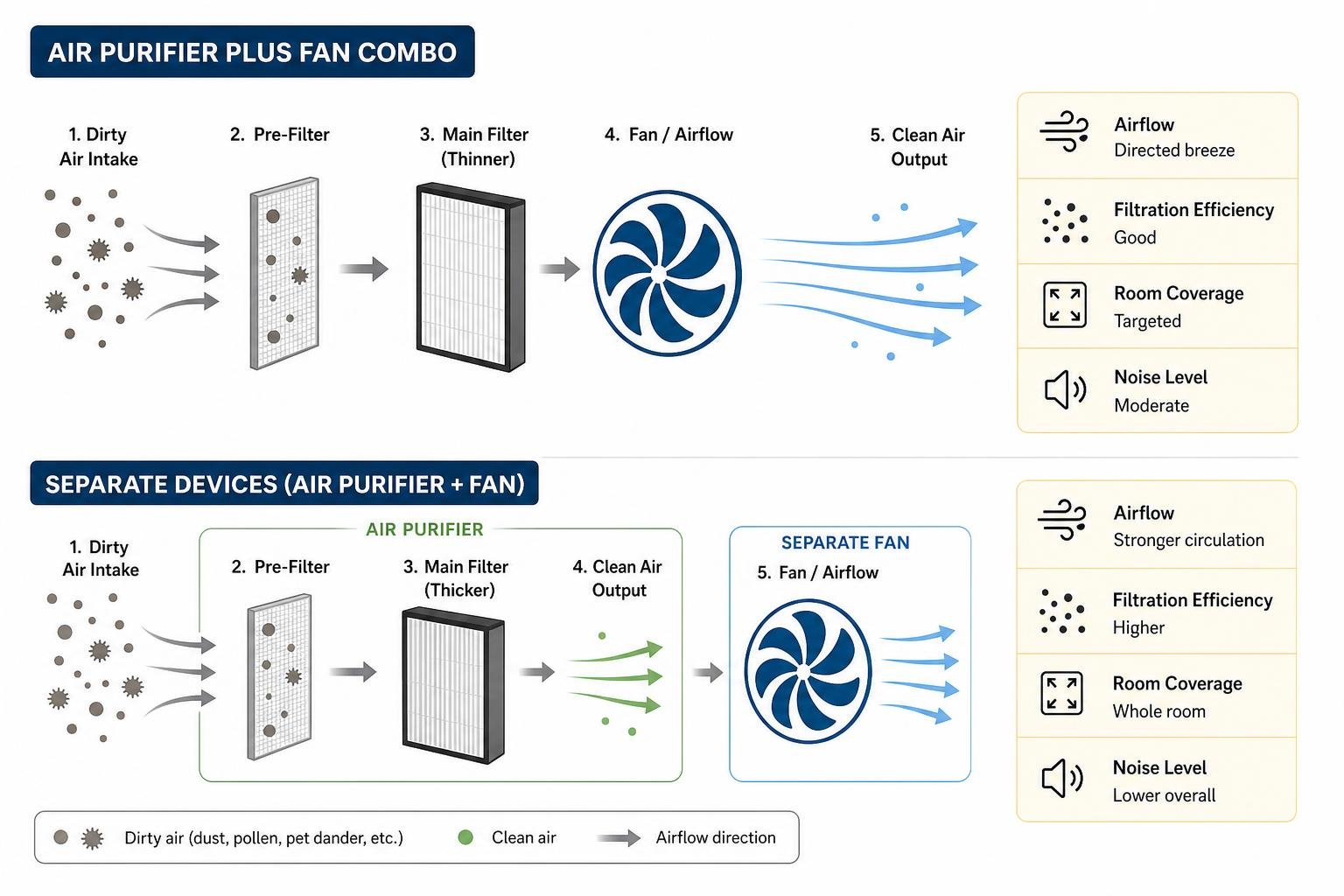
To get a deeper understanding of these dynamics, let’s break down the specific limitations in CADR, filtration, room coverage, and noise.
CADR and Filtration Limits of an Air Purifier plus Fan
The primary metric used to evaluate any air cleaner is the Clean Air Delivery Rate (CADR), which measures the volume of clean air a device can produce per minute. Because combo units must project air across a room like a fan, their filters are often thinner or shaped differently than those in thick, boxy, dedicated air purifiers. This design choice directly impacts their CADR.
For example, a premium dedicated air purifier might easily achieve a CADR of over 250 cfm (cubic feet per minute), allowing it to clean large living rooms rapidly. In contrast, even premium air purifier plus fan combos often have lower CADR ratings. The Dyson TP07, for example, delivers a PM1 CADR of 94 cfm, while the compact Coway Airmega Aim delivers a PM1 CADR of 80 cfm.
Despite lower CADR ratings, high-quality combo units still utilize excellent filtration technology. Most reputable models feature:
- True HEPA (H13) Filters: These are certified to capture up to 99.97% of airborne particles as small as 0.3 microns, including pollen, mold spores, smoke, and pet dander. This is vastly superior to “HEPA-type” filters, which lack standardized efficiency ratings.
- Activated Carbon Layers: Essential for neutralizing Volatile Organic Compounds (VOCs), household odors, cooking fumes, and gases.
If you are dealing with severe asthma or heavy wildfire smoke, understanding How Air Filtration Systems Can Help Your Home’s Air Quality will show you why a high-CADR dedicated unit or a whole-home system is often required.
| Feature | Combo Unit (e.g., Dyson TP07) | Separate Devices (Dedicated Purifier + Fan) |
|---|---|---|
| Average CADR | 80 – 140 cfm | 200 – 350+ cfm |
| Footprint | Small (Single device) | Large (Requires two wall outlets and floor spaces) |
| Initial Cost | Mid to High ($150 – $700+) | Low to Mid ($100 for purifier + $40 for fan) |
| 5-Year Filter Cost | High (Proprietary shaped filters) | Moderate (Standard flat filters) |
Room Size and Noise Considerations
Because of their lower CADR ratings, combo units are highly sensitive to room size. They perform beautifully in spaces under 300 square feet, such as bedrooms, home offices, or small dorm rooms. However, once you place a combo unit in a large, open-concept living room, it will struggle to achieve the recommended air exchange rates.
The Association of Home Appliance Manufacturers (AHAM) and the EPA recommend that an air purifier provide 4.8 air changes per hour (ACH) in the room it operates in. To achieve this with a combo unit, the room must be relatively small. For instance, the Dyson PH03 is best suited for rooms no larger than 141 sq. ft. to maintain five air changes per hour.
Noise is another critical factor. When running on low or “sleep” modes, premium combo units are incredibly quiet. The Philips Air Performer 9000 Series drops to an ultra-quiet 21 dB(A) in sleep mode, which is quieter than a whisper. However, if you run these units on maximum speed to quickly clear out cooking smoke or localized dust, noise levels can climb to 50 to 60 dB, which may disrupt your sleep or conversations.
Top Air Purifier Fan Combo Models on the Market
If you have decided that a hybrid unit fits your lifestyle, space, and comfort goals, the market in July 2026 offers several excellent options. Here is our detailed breakdown of the best premium, budget, and specialized models available. If you are still weighing your options, reading about how to Breathe Easy: How to Choose the Best Air Filtration System can help clarify your priorities.
Best Premium Air Purifier plus Fan Models
Dyson TP07
The Dyson TP07 remains one of the most popular tower-style purifying fans on the market. It features a sleek, bladeless design that projects smooth, powerful airflow across the room.
- Pros: Cleans the air quickly in real-world testing; fully sealed to HEPA H13 standards; quiet night mode; excellent smart integration via the MyDyson app.
- Cons: High initial price tag; lower CADR compared to dedicated purifiers in the same price tier.
Dyson Purifier Humidify+Cool™ PH03 (White/Silver)
For those living in dry climates—like our winter months here in Salt Lake City—this 3-in-1 machine is an absolute game-changer. It purifies, humidifies, and cools simultaneously.
- Pros: Uses Ultraviolet Cleanse technology (275nm UV light) to destroy 99.9% of bacteria in the water tank; provides a PM1 CADR of 141 cfm; scientifically proven to improve skin hydration over three hours compared to dry ambient air.
- Cons: Expensive ($949.99); requires regular monthly deep cleaning cycles in hard water areas to prevent mineral build-up.
- Note: You can also compare this model with its predecessor, the Dyson Pure Humidify+Cool , which laid the foundation for Dyson’s evaporative humidification technology.
Dyson Purifier Hot+Cool HP1 | (Black/Nickel)
If you want an appliance that handles winter heating, summer cooling, and year-round purification, the HP1 is a compact powerhouse.
- Pros: Projects over 76 gallons of air per second; amplifies intake airflow up to 15 times using Air Multiplier technology; includes 350-degree oscillation and a magnetized remote control that sits on top of the machine.
- Cons: Maximum sound level of 63 dB when running both the heater and fan on high.
- Note: For older model comparisons, see the Dyson Pure Hot+Cool™ .
Air Performer 9000 Series 4in1 Purifier, Fan, Heater & Humidifier AMF970/10 | Philips
An incredibly comprehensive 4-in-1 system designed for ultimate year-round comfort.
- Pros: Delivers a strong CADR of 185 m³/h; can clean a 20 m² room in less than 16 minutes; 3-layer HEPA NanoProtect filter traps 99.97% of particles down to 0.003 microns (smaller than the smallest known virus); quiet 21 dB sleep mode.
- Cons: Large physical footprint; high heating wattage (2200W) can impact your electricity bill if run continuously.
2-in-1 Purify+Humidify DH3i – Blueair UK
This unit focuses on delivering high-efficiency air cleaning combined with gentle, mist-free humidification.
- Pros: Purifies a 360 sq. ft. room in 12.5 minutes; features HEPASilent technology which combines electrostatic and mechanical filtration; “InvisibleMist” technology prevents the white dust and mineral residue common with ultrasonic humidifiers.
- Cons: Geofenced “Welcome Home” technology can occasionally be finicky with certain smart home setups; requires weekly rinsing of the humidification wick.
Honeywell Allergen Plus HPA6000
A robust, commercial-grade 3-in-1 air comfort system designed for larger spaces.
- Pros: Delivers HEPA-filtered air across spaces up to 1,928 sq. ft. at 1 air change per hour (or 4.8 ACH in a 398 sq. ft. room); vertical 90-degree circulator mode helps distribute rising warm air during winter.
- Cons: Lacks the sleek, modern aesthetic of blade-free models; can be bulky for small bedrooms.
Best Budget and Desktop Options
Coway Airmega Aim
If you want the performance of a premium brand without the steep price tag, the Coway Airmega Aim is a brilliant option under $150.
- Pros: Cleared a 728 cubic feet test room in 72 minutes—only 10 minutes slower than the much pricier Dyson TP07; compact, modern design; very low standby power consumption.
- Cons: Smaller coverage area; limited smart features.
Crane 2-In-1 Desk Top Air Purifier & Fan
Perfect for home offices, college dorm rooms, or nightstands, this compact hybrid unit is highly versatile.
- Pros: Extremely budget-friendly ($59.99); features a true H13 HEPA filter that captures 99.97% of pollen, smoke, and pet dander; 90-degree tilt mechanism allows it to convert from an air purifier to a direct desktop fan in seconds.
- Cons: No CADR rating provided; best used strictly for personal, localized spaces.
Frequently Asked Questions About Air Purifier Fans
Can you run a separate fan and air purifier together safely?
Yes, absolutely! Not only is it completely safe to run a separate fan and air purifier together, but it is actually highly beneficial.
When you run a dedicated air purifier alongside a high-velocity fan, the fan helps circulate the purified air much faster throughout the room. This synergy eliminates “dead zones” where stagnant air accumulates, ensuring a more even distribution of clean, cool air. It also allows you to position your air purifier in a central, optimal location while directing the fan’s cooling breeze exactly where you need it.
Do combo units use more electricity than separate devices?
In most cases, a combo unit draws similar or slightly less wattage than running a separate fan and air purifier simultaneously. For example, the Blueair 2-in-1 Purify + Humidify draws only 36 Watts of power during standard operation.
However, the real cost difference lies in the total cost of ownership over 3 to 5 years. While combo units save space, their proprietary, specialized replacement filters are often significantly more expensive than standard flat filters used in dedicated purifiers. Over a five-year period, these recurring filter replacement costs can add up, making separate devices or a whole-home filtration system more cost-effective in the long run.
How often do you need to replace the filters in a combo unit?
For optimal performance, most manufacturers recommend replacing the HEPA and carbon filters in a combo unit every 6 to 12 months, depending on your usage and indoor air quality.
To take the guesswork out of maintenance, modern units like the Honeywell HPA6000 and the Dyson line feature built-in filter check indicator lights that track actual hours of use. Blueair’s “RealTrack” algorithm goes a step further by calculating filter life based on real-time pollution levels and fan speeds. Regularly replacing your filters ensures your unit continues to run efficiently without restricting airflow or releasing trapped odors back into your home.
Conclusion
An air purifier plus fan is an excellent, space-saving solution for small bedrooms, home offices, and apartments under 300 square feet. It delivers localized, clean, cooling comfort exactly where you need it without cluttering your floor space with multiple seasonal appliances.
However, if you are dealing with severe seasonal allergies, Utah’s winter inversions, or have a larger home to manage, a portable combo unit might feel like a compromise. To achieve true, comprehensive indoor air quality, a dedicated high-capacity air purifier or a whole-home system is always the gold standard.
At Honest Home Services, we believe you shouldn’t have to compromise on the air your family breathes. Whether you need help selecting the perfect portable system, upgrading your HVAC filters, or installing a professional whole-home air filtration system, our local, expert technicians are here to help. We proudly serve Salt Lake City, Davis County, and the surrounding Northern Utah communities with fair pricing and guaranteed customer satisfaction.
Ready to breathe easier? Contact Honest Home Services today to find the perfect indoor air quality solution for your home!