

What to Do When Your Furnace Isn’t Heating
A furnace not heating your home is one of the most stressful things that can happen on a cold Utah winter night. The good news? Most causes are fixable — and many you can check yourself in minutes.
Here are the most common reasons your furnace isn’t producing heat:
- Thermostat set incorrectly — switched to “Cool” or “Fan Only” instead of “Heat”
- Dirty or clogged air filter — the single most common furnace problem
- Tripped circuit breaker or furnace power switch off
- Pilot light out or electronic igniter failure
- Gas supply issue — closed shut-off valve or utility outage
- Dirty flame sensor — causes the furnace to shut down after a few seconds
- Clogged condensate drain line — affects high-efficiency furnaces
- Faulty high-limit switch — triggered by overheating from poor airflow
- Blocked vents or leaky ductwork
Start with the thermostat and filter — these two checks alone resolve the majority of no-heat calls.
At Honest Home Services, we’ve spent over 20 years helping Northern Utah homeowners and businesses diagnose and fix every kind of furnace not heating problem — from a simple filter swap to a full ignition system repair. In this guide, we’ll walk you through exactly what to check, step by step, so you can get your heat back as fast as possible.
Easy furnace not heating glossary:
Immediate Steps for a furnace not heating
When the temperature in your Salt Lake City home starts to dip, panic can set in. Before you assume the worst, we recommend a “common sense” sweep of your system. Many service calls we receive in Davis or Weber County end up being simple fixes that were just overlooked in the heat (or cold) of the moment.

First, check your power supply. It sounds simple, but you’d be surprised how often a furnace is “broken” simply because it isn’t getting electricity. Even a gas furnace needs power to run the blower motor, the circuit board, and the ignition system. If there was a recent power flicker or a heavy load on your home’s electrical system, your furnace might have lost its connection to the grid.
If you find that your system is completely unresponsive, you may want to check out these Furnace Not Turning On? Try These Troubleshooting Tips – Trane® for more specific electrical insights.
Troubleshooting a furnace not heating via the Thermostat
The thermostat is the “brain” of your HVAC system. If the brain is confused, the body won’t work. We often see cases where a thermostat was accidentally bumped into “Cool” mode during a cleaning session or left on “Fan Only.”
- Mode Check: Ensure it is firmly set to “Heat.”
- Temperature Setpoint: Set the temperature at least 5 degrees higher than the current room temperature to trigger a heat call.
- Batteries: If the screen is blank or fading, replace the batteries immediately. Many thermostats use two AA or AAA batteries that should be changed annually.
- Fan Settings: If your furnace is blowing air but it isn’t warm, check if the fan is set to “On.” In the “On” position, the blower runs 24/7 even when the burners are off. Switch it to “Auto” so it only blows when the air is actually heated.
For a deeper dive into common thermostat glitches, read our guide on 10 Common Furnace Problems and How to Fix Them.
Verifying Power and Circuit Breakers
Next, head to your electrical panel. Look for the breaker labeled “Furnace” or “HVAC.” If it has migrated to the middle position, it has tripped. Flip it all the way to “Off” and then back to “On.”
Don’t forget the furnace’s own power switch! This usually looks like a standard light switch located on the side of the furnace unit or on a nearby wall in the utility room. It’s easy for someone to mistake this for a light switch and flip it off by accident. Finally, check the blower door panel. Most modern furnaces have a safety kill-switch that prevents the unit from running if the door isn’t seated perfectly flush. If you recently changed your filter and didn’t pop the door back on correctly, the furnace not heating issue is likely just a safety feature doing its job.
Airflow Obstructions and Filter Maintenance
In our experience serving Salt Lake and Utah Counties, a dirty filter is the #1 cause of furnace failure. It’s the “silent killer” of HVAC efficiency.
When a filter is caked with dust, pet hair, and dander, your furnace has to work twice as hard to pull air through the system. This creates “static pressure” that strains the blower motor and, more importantly, causes the heat exchanger to retain too much heat. When the heat exchanger gets too hot, the furnace’s safety sensors will shut the burners down to prevent a fire, while the fan keeps running to cool the unit off. This is why you might feel cold air blowing even though the furnace is “running.”
The Impact of a Clogged Air Filter
We recommend checking your filter once a month during the peak of the Utah winter. Depending on your home, you should replace it every 30 to 90 days.
Ignoring your filter leads to “short cycling,” where the furnace turns on and off rapidly. This wears out expensive components and spikes your energy bills. For more maintenance advice, check out our 5 Furnace Maintenance Tips to Keep Your Home Warm This Winter.
Clearing Blocked Vents and Leaky Ductwork
Airflow isn’t just about the filter; it’s about the path the air takes through your home. Walk through your rooms and ensure that no registers are blocked by heavy furniture, rugs, or curtains. Closing too many vents in unused rooms can actually cause your furnace not heating problem by increasing pressure within the ducts, leading to the same overheating issues mentioned above.
Leaky ductwork is another culprit. In older homes in Bountiful or Murray, ducts can pull apart at the seams, allowing up to 30% of your heated air to escape into the attic or crawlspace before it ever reaches your living room. For expert tips on duct integrity, read our Stay Warm: Expert Advice on Furnace Maintenance and Repair.
Ignition, Gas Supply, and Sensor Failures
If your power is on and your air is flowing, but you still have a furnace not heating, the problem is likely in the combustion process.
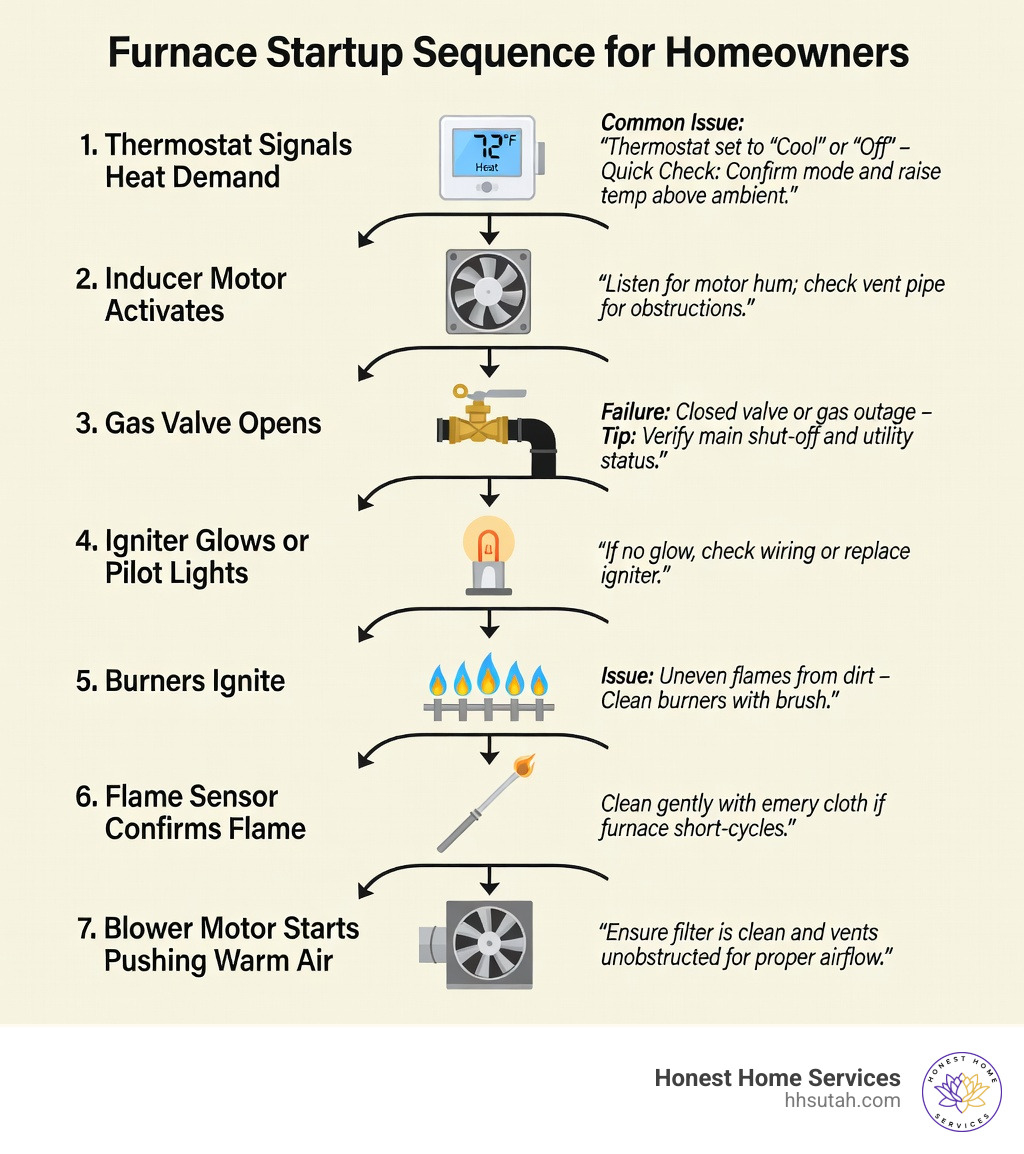
Modern gas furnaces use a complex sequence to start the fire. If any part of this sequence fails, the system will lock itself out for safety. You can learn more about these specific failure points in this guide on Furnace Fan Works but No Heat: Common Causes and Fixes.
Pilot Light and Electronic Ignition Issues
Older furnaces use a “standing pilot light”—a small, constant flame. If yours has gone out, you can usually relight it following the instructions on the furnace door. However, if it won’t stay lit, the “thermocouple” (a safety sensor) is likely worn out.
Most newer systems use an electronic “Hot Surface Igniter” (HSI). These glow bright orange to light the gas. If you hear your furnace clicking but never see a glow or hear the “whoosh” of flames, the igniter may be cracked. These parts are fragile and typically last 3-5 years. Learn how to spot these Common Furnace Problems before they leave you shivering.
Cleaning a Dirty Flame Sensor
The flame sensor is a small, thin metal rod that sits in the path of the burner flame. Its job is to tell the control board, “Yes, there is a fire, it’s safe to keep the gas valve open.” Over time, this rod gets coated in “carbon buildup” or oxidation.
When the sensor is dirty, the furnace will light for about 3 to 10 seconds and then abruptly shut off. This is a classic furnace not heating symptom. You can often fix this yourself by shutting off the power, removing the sensor, and gently rubbing the metal rod with a piece of fine steel wool or a clean dollar bill to remove the residue. For more DIY tips, see Extend Your Furnace’s Lifespan with These Furnace Repair Tips.
Verifying the Gas Supply for a furnace not heating
It sounds silly, but check your gas! If you have other gas appliances like a stove or water heater, check if they are working. If they aren’t, you may have a utility outage or a problem with your main meter.
Check the shut-off valve on the gas line leading to your furnace. The handle must be parallel to the pipe to be “on.” If it’s perpendicular, the gas is cut off. If you use propane in more rural areas like Tooele or Bluffdale, ensure your tank isn’t empty.
Advanced Components and Safety Switches
If the basics haven’t solved the issue, your furnace not heating may be due to internal safety components that require a professional touch.
The Role of the High-Limit Switch
The high-limit switch is a safety device that monitors the temperature inside the furnace cabinet. If the furnace gets too hot (usually due to that dirty filter we mentioned!), the switch pops and kills the burners. If this happens too many times, the switch can fail in the “open” position, preventing the furnace from ever starting again. If you notice your furnace fan running constantly but the air is stone cold, this switch is a likely candidate. Discover more Signs Your Furnace Needs Immediate Attention.
Clogged Condensate Drain Lines
If you have a high-efficiency furnace (the kind with white PVC vent pipes), your system produces water (condensate) as it runs. This water drains out through a small plastic hose. If this line gets clogged with dust or slime, or if the condensate pump fails, a “float switch” will trigger and shut the furnace down to prevent your floor from flooding.
If you see water pooling around the base of your unit, this is almost certainly why your furnace is blowing cold air.
When to Call a Professional for furnace not heating
We love a handy homeowner, but some things are best left to the experts at Honest Home Services. If you’ve checked the thermostat, the power, and the filter, and you still have no heat, it’s time to call us for a professional Furnace Repair.
As a general rule, we use the “50% Rule”: if your furnace is over 15 years old and the repair cost is more than 50% of the cost of a new unit, it’s usually time for a Furnace Installation. Modern units are much more efficient and can save you a fortune on those Salt Lake County winter heating bills. Check out our guide on How to Know If It’s Time for Furnace Replacement.
Safety Precautions and Gas Leak Protocols
Safety is our top priority. If you ever smell “rotten eggs,” hear loud booming noises when the furnace starts, or see a yellow/flickering pilot flame (it should be crisp blue), stop troubleshooting immediately.
- Leave the house.
- Do not flip any light switches or use your phone inside.
- Call your gas company and Honest Home Services from outside.
For after-hours emergencies in Layton, Draper, or Park City, our 24/7 Heating Repair team is always ready to help.
Benefits of Regular Professional Tune-Ups
The best way to fix a furnace not heating is to prevent the problem before it starts. An annual Furnace Tune-Up from our team includes cleaning the burners, testing safety switches, and lubricating moving parts. This not only prevents breakdowns but also keeps your manufacturer’s warranty valid.
Frequently Asked Questions about Furnace Issues
What is the most common reason a furnace stops producing heat?
By far, the most common reason is a dirty air filter. It restricts airflow, causes the system to overheat, and triggers a safety shutdown. Always check your filter first!
How do I know if my flame sensor is dirty?
If your furnace ignites and you see a flame, but it goes out after just a few seconds (and repeats this process several times), you likely have a dirty flame sensor.
Can a dirty air filter really cause my furnace to shut down?
Yes! A clogged filter causes the heat exchanger to reach dangerous temperatures. The high-limit switch will then cut off the gas to the burners to prevent damage or fire.
Conclusion
Dealing with a furnace not heating in Northern Utah is never fun, but you don’t have to face the cold alone. Whether you’re in Saratoga Springs, West Valley, or Bountiful, Honest Home Services is here to provide reliable, fair-priced, and expert care. We guarantee your satisfaction and won’t rest until your home is cozy again.
If your DIY troubleshooting hasn’t brought the heat back, don’t wait for the pipes to freeze. Contact us today for expert Furnace Repair and let us show you why we’re Utah’s most trusted name in home comfort.