

What You Need to Know About AC Installation
AC installation is one of the biggest home improvement investments you’ll make — and getting it right matters for your comfort, energy bills, and wallet for the next 15–20 years.
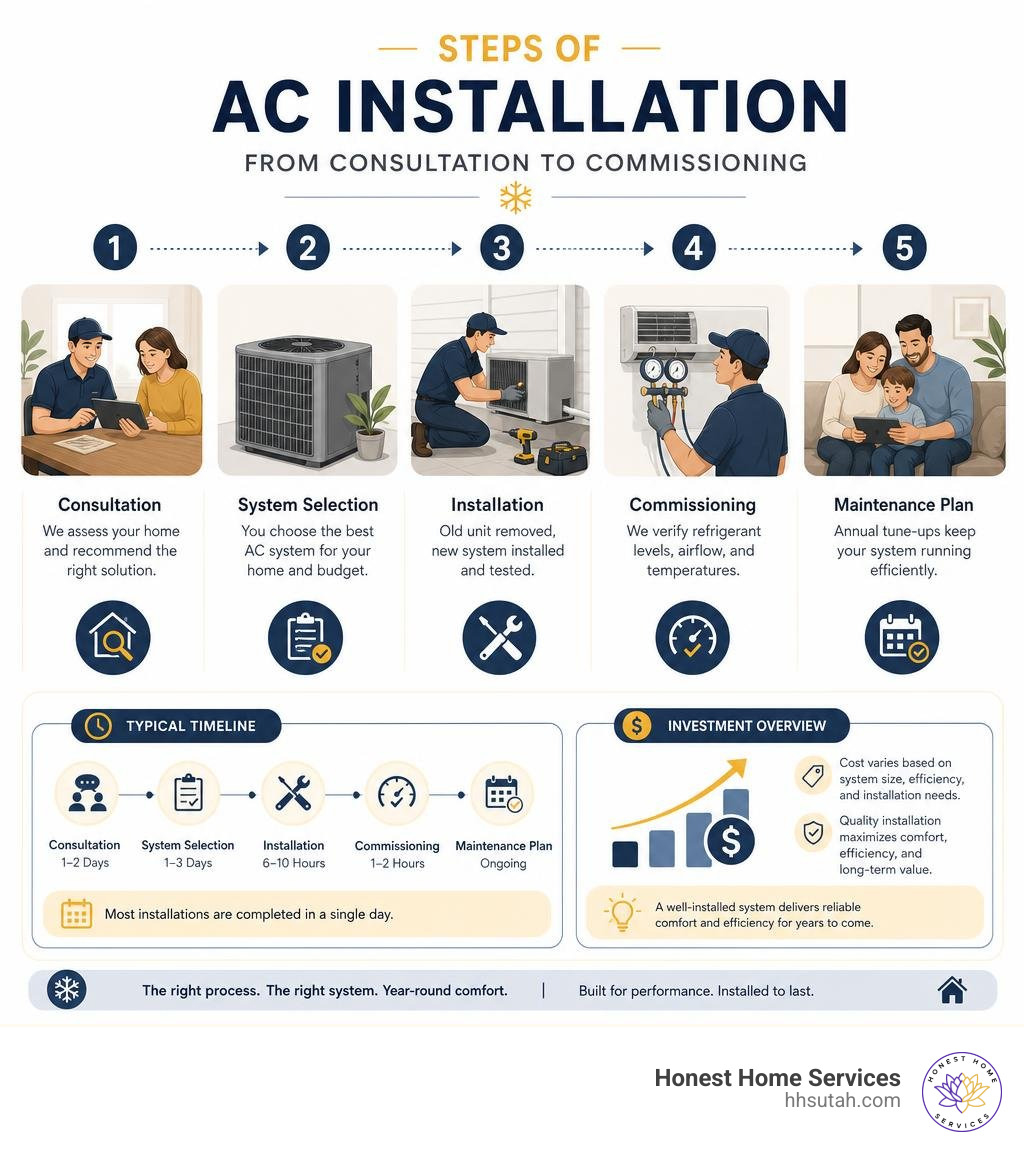
Quick Answer: What does AC installation involve?
| Step | What Happens |
|---|---|
| 1. Free consultation | Technician visits your home and calculates the right system size |
| 2. System selection | You choose a unit based on size, efficiency (SEER2), and budget |
| 3. Installation day | Old unit removed, new system installed and tested (typically 6–10 hours) |
| 4. Commissioning | Technician verifies refrigerant levels, airflow, and temperatures |
| 5. Maintenance plan | Annual tune-ups keep your system running efficiently |
Here’s the problem most homeowners face: a worn-out or wrong-sized AC costs you money every single month. High-efficiency modern systems use 20–50% less energy than older models. And a unit that’s over 15 years old is likely working harder than it needs to — and failing more often.
Whether you’re replacing a struggling system or installing AC for the first time, this guide walks you through everything — signs it’s time to replace, how to size your system, what installation actually looks like, and how much to budget.
At Honest Home Services, we’ve spent over 20 years helping Utah homeowners and small businesses with professional AC installation, repairs, and replacements across Northern Utah. We’re licensed, insured, and committed to transparent pricing with no surprises.
Signs It Is Time to Replace Your Air Conditioner
Summers along the Wasatch Front can be brutal, and the last thing you want is for your cooling system to give out during a scorching July afternoon. While we always try to fix issues first, there comes a point where repairing an old unit is simply throwing good money after bad.
If you are trying to decide whether to schedule another repair or invest in a brand-new system, keep an eye out for these telltale signs:
- System Age (The 15-Year Mark): A well-maintained central air conditioner typically lasts 15 to 20 years. If your unit is approaching or has passed this milestone, it is likely nearing the end of its operational life. Even if it is still running, it is operating at a fraction of the efficiency of a modern system.
- Frequent and Costly Repairs: Are you on a first-name basis with your HVAC technician? If you are constantly paying for leak repairs, fan motor replacements, or electrical issues, those bills quickly add up. A good rule of thumb is the “$5,000 Rule”: multiply the age of your system by the cost of the repair. If the result exceeds $5,000, replacement is usually the smarter financial move. For more tips on managing sudden system failures, check out The Ultimate Salt Lake City HVAC Repair Survival Guide.
- Rising Energy Bills: Have you noticed your monthly utility bills creeping up summer after summer, even though your usage habits haven’t changed? As mechanical components wear down, your AC has to run longer and work harder to achieve the same cooling output, wasting electricity.
- Uneven Cooling and Inadequate Comfort: If your upstairs bedrooms feel like a sauna while your basement is freezing, your aging system is likely struggling to distribute air properly. This could indicate a failing compressor or a system that was improperly sized from the start.
- Obsolete Refrigerant (R-22): If your air conditioner was installed before 2010, it likely uses R-22 refrigerant (commonly known as Freon). R-22 has been completely phased out due to environmental regulations. If an older system experiences a major refrigerant leak, recharging it is incredibly expensive and often impossible.
Sizing, SEER, and Choosing the Right System
Choosing a new air conditioner isn’t as simple as picking the most expensive model on the shelf. To get the best performance and lowest operating costs, you must select a system tailored to your home’s unique layout and insulation.
Sizing Your Home for AC Installation
One of the most common mistakes in our industry is “rule-of-thumb” sizing (such as assuming you need 1 ton of cooling for every 500 square feet). This outdated method routinely oversizes modern homes by 20% to 40%.
An oversized system will cycle on and off rapidly (called short-cycling), which wears out the compressor prematurely and fails to remove humidity from the air, leaving your home feeling clammy. Conversely, an undersized system will run continuously, driving up your energy bills and failing to keep you cool on the hottest days.
To prevent this, our expert technicians perform a comprehensive Manual J load calculation. This scientific assessment evaluates:
- The exact square footage and layout of your home.
- The quality and rating of your attic and wall insulation.
- The number, size, and orientation of your windows (sun exposure).
- Local climate demands from Salt Lake City to Park City.
- Your home’s existing ductwork capacity.
System Types: Central AC vs. Ductless Mini-Splits
Depending on your home’s structure, you have two primary options for cooling. If you already have a ductwork system in place (shared with a forced-air furnace), a traditional central split-system is highly efficient and cost-effective. However, if your home lacks ducts—common in older historic properties in Salt Lake City or home additions—a ductless mini-split system is an outstanding alternative. Ductless systems can save up to 30% to 40% on energy bills compared to traditional systems because they eliminate duct loss.
| Feature | Central Air Conditioning | Ductless Mini-Split Systems |
|---|---|---|
| Best For | Homes with existing ductwork | Older homes, additions, or zoned cooling |
| Aesthetic | Hidden vents, outdoor condenser | Small wall-mounted indoor blowers |
| Efficiency | High (Up to 20+ SEER2) | Extremely High (Up to 25+ SEER2) |
| Zoning | Difficult/Expensive | Built-in (Room-by-room control) |
| Installation Time | 1 day (standard replacement) | 1 to 2 days |
If you are researching local options, you can check out general Salt Lake City heating and AC installation resources or browse local directories for top-rated Salt Lake City HVAC providers to see what systems are popular in our region.
Understanding SEER2 and Energy Efficiency Ratings
When shopping for a new air conditioner, you will see a rating called SEER2 (Seasonal Energy Efficiency Ratio 2). This ratio measures the cooling output of the system divided by the total electric energy input over a typical cooling season.
- Federal Minimums: As of 2026, the federal minimum standard for new residential air conditioners is 15 SEER2.
- Mid-Range (16–18 SEER2): These units offer an excellent balance of upfront cost and long-term utility savings, often qualifying for local utility rebates.
- High-Efficiency (19–25+ SEER2): These premium, variable-speed systems adjust their cooling output in tiny increments. They run at lower, whisper-quiet speeds for longer periods, providing unmatched humidity control and energy savings.
According to the 2026 June Homeowner Guide, upgrading from an older 10 SEER unit to a modern high-efficiency system can reduce your cooling energy consumption by 20% to 50%, saving you hundreds of dollars annually.
What to Expect During Your Professional AC Installation

A high-quality air conditioner is only as good as the team that installs it. Even the most expensive, high-efficiency unit will underperform and fail early if it is installed poorly. Here is what you can expect when our professional, certified technicians arrive at your home for installation day:
- Home Protection: We treat your home with the utmost respect. Before any work begins, our technicians lay down protective drop cloths and wear shoe covers to keep your floors clean.
- Old System Removal: We carefully pump down and recover the old refrigerant in compliance with EPA regulations. The old condenser, evaporator coil, and electrical disconnect are then disconnected and hauled away for proper recycling.
- Line Set & Ductwork Preparation: We inspect your existing refrigerant line set. If we reuse it, we flush it clean of old oils and impurities. If needed, we install a new, properly sized line set. We also make custom sheet metal transitions to ensure a perfect, airtight seal between your new indoor coil and your existing furnace.
- Nitrogen Purging & Brazing: This is a critical step that cut-rate installers often skip. When brazing the copper refrigerant lines, we flow dry nitrogen through the pipes. This prevents harmful copper oxide scaling from forming inside the lines, which can destroy a modern scroll compressor.
- System Evacuation: Using a digital micron gauge, we pull a deep vacuum on the system to below 500 microns (and hold it to verify there are no microscopic leaks or moisture in the lines). This step is essential for system longevity, as detailed in standard manufacturer guides like the Trane installation manual.
- Commissioning & Testing: Once the system is charged, we don’t just turn it on and leave. We perform a complete commissioning process. We measure static duct pressure, verify correct airflow (CFM), test the electrical amp draw, and check the subcooling and superheat levels to ensure the system is operating exactly to manufacturer specifications.
Post-AC Installation Maintenance Tips
Once your new ac installation is complete, taking care of your investment will ensure it lasts for its full 15- to 20-year lifespan.
- Change Your Filters Regularly: This is the single most important thing you can do. Check your 1-inch pleated filters every 30 to 60 days, and replace them when dirty. If you have a thicker 4-inch media filter, replace it every 6 to 12 months.
- Keep the Outdoor Unit Clear: Your outdoor condenser needs to breathe to release heat. Keep grass clippings, leaves, and weeds cleared at least two feet around the unit. Gently spray the coils with a garden hose occasionally to remove dust and cottonwood.
- Schedule Annual Professional Tune-Ups: Just like your car needs oil changes, your AC needs annual maintenance. We check electrical connections, clear the condensate drain line, and verify refrigerant charges before the summer heat hits. If you ever experience issues with your system’s blower or fan, consult our Ac Fan Repair Complete Guide for expert troubleshooting.
Cost, Financing, and Rebates for New Cooling Systems
We believe in complete financial transparency. The cost of a new ac installation in Northern Utah typically ranges from $5,500 to $15,000+.
The final investment depends on several variables:
- System Capacity (Tonnage): Larger homes require larger systems, which naturally cost more.
- Efficiency Rating (SEER2): Higher SEER2 systems carry a higher upfront price tag but provide faster payback through lower monthly energy bills.
- Installation Complexity: Retrofitting older homes, upgrading electrical panels, or modifying existing ductwork can add to the labor costs.
To help make this investment manageable, we offer flexible financing options with approved credit, including low monthly payment plans and promotional interest-free periods.
Additionally, you can offset your upfront costs with several incentives:
- Federal Tax Credits (Energy Efficient Home Improvement Credit): Under the Inflation Reduction Act, homeowners can qualify for federal tax credits of up to $600 for qualifying high-efficiency central air conditioners, or up to $2,000 for qualifying heat pumps.
- Utility Rebates: Local Utah utility companies (like Rocky Mountain Power) frequently offer cash-back rebates for upgrading to energy-efficient cooling systems.
When choosing a partner for your project, it pays to do your homework. Read our Guide to finding honest HVAC in Salt Lake City to learn how to spot red flags and choose a trustworthy contractor.
Frequently Asked Questions about AC Replacement
How long does a professional system replacement usually take?
A straightforward residential AC replacement (where we are swapping out an existing outdoor condenser and indoor evaporator coil) typically takes 6 to 10 hours and is completed in a single day. If your project requires complex ductwork modifications, zoning systems, or electrical panel upgrades, it may take 1 to 2 days. We always clean up our work areas daily so your home remains comfortable.
What is the R-410A refrigerant phase-down?
To reduce environmental impact, environmental regulations have initiated a phase-down of R-410A refrigerant. Newly manufactured systems now utilize next-generation refrigerants like R-454B or R-32, which have a significantly lower global warming potential. If you install a system today, it will use these modern, eco-friendly refrigerants, ensuring your system remains serviceable and compliant for decades to come.
Do I need a permit for a new air conditioner?
Yes. Local building codes in Salt Lake County, Davis County, and surrounding Utah areas require mechanical and electrical permits for new AC installations. Pulling a permit ensures that a city inspector reviews the work to guarantee it meets safety codes. At Honest Home Services, we handle the entire permit application process and coordinate the inspection for you to protect your home’s safety and resale value.
Conclusion
Investing in professional ac installation is about more than just buying a piece of metal for your backyard — it is about securing reliable comfort, lower energy bills, and peace of mind for your family for the next two decades.
At Honest Home Services, we are proud to serve communities across Northern Utah, including Salt Lake City, Layton, Kaysville, Farmington, Bountiful, West Valley, Murray, West Jordan, South Jordan, Bluffdale, Herriman, Draper, Park City, Tooele, Lehi, and Saratoga Springs. Whether you need a quick repair or a complete system replacement, our local, expert technicians are here to provide honest answers and guaranteed satisfaction.
Ready to upgrade your home comfort? Schedule your AC installation today or call our friendly team to book your free, no-obligation in-home estimate!