
What Causes a Water Heater Pressure Relief Valve Leaking Issue?
When you notice a water heater pressure relief valve leaking, your first instinct might be to blame the valve itself. However, the Temperature and Pressure (T&P) relief valve is often doing precisely what it was designed to do: relieving dangerous internal stress before your tank suffers structural damage.
To pinpoint the underlying trigger, you have to look at the mechanical forces inside your water heater and household plumbing.
Is Your Water Heater Pressure Relief Valve Leaking or Just Weeping?
There is a major diagnostic difference between a valve that continuously discharges a heavy stream of hot water and one that intermittently drips or “weeps.”
- Intermittent Weeping: If the valve drops a few teaspoons or tablespoons of water only while the heating elements or gas burners are actively firing, you are likely experiencing thermal expansion.
- Continuous Discharge: If water pours out of the discharge pipe constantly—even when the heater hasn’t run in hours—you are dealing with a failed valve seat, severe sediment obstruction, or stuck mechanical components.
Understanding this distinction helps narrow down whether you need a quick system adjustment or a total valve replacement. You can learn more about these subtle differences by reading our guide on why your pressure release valve is dripping.
High Water Pressure and Thermal Expansion
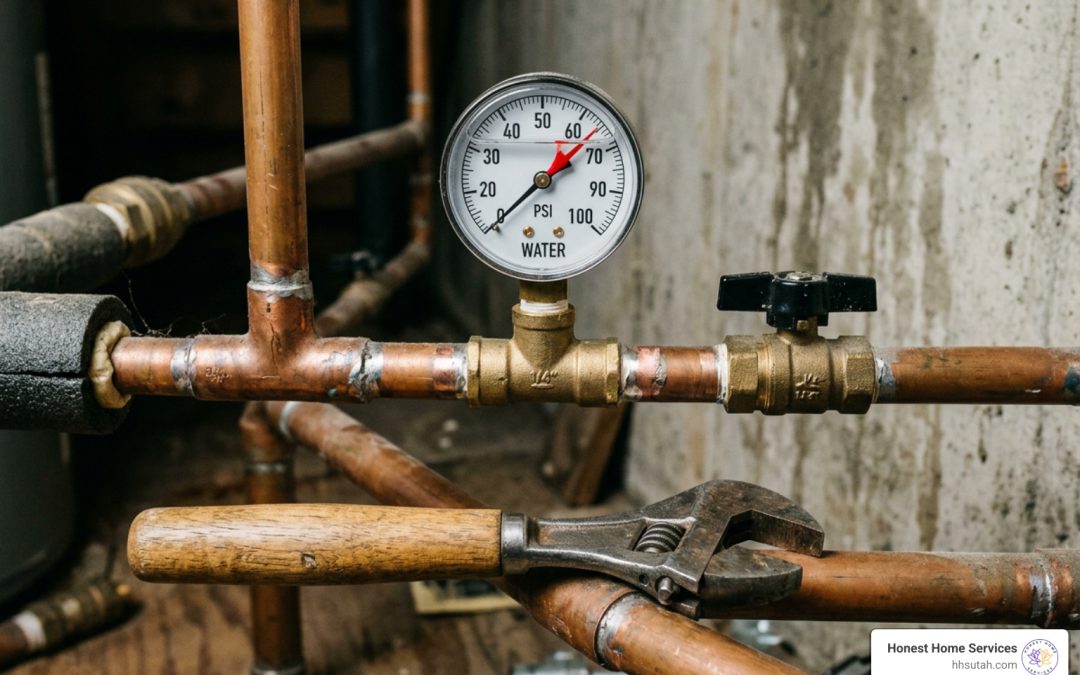
Residential plumbing systems are engineered to operate comfortably between 40 and 60 psi (pounds per square inch). In Northern Utah, municipal water supply lines can sometimes push water into homes at far higher pressures. Any static household pressure reading over 80 psi is a major red flag that puts extreme stress on all your fixtures, including your water heater.
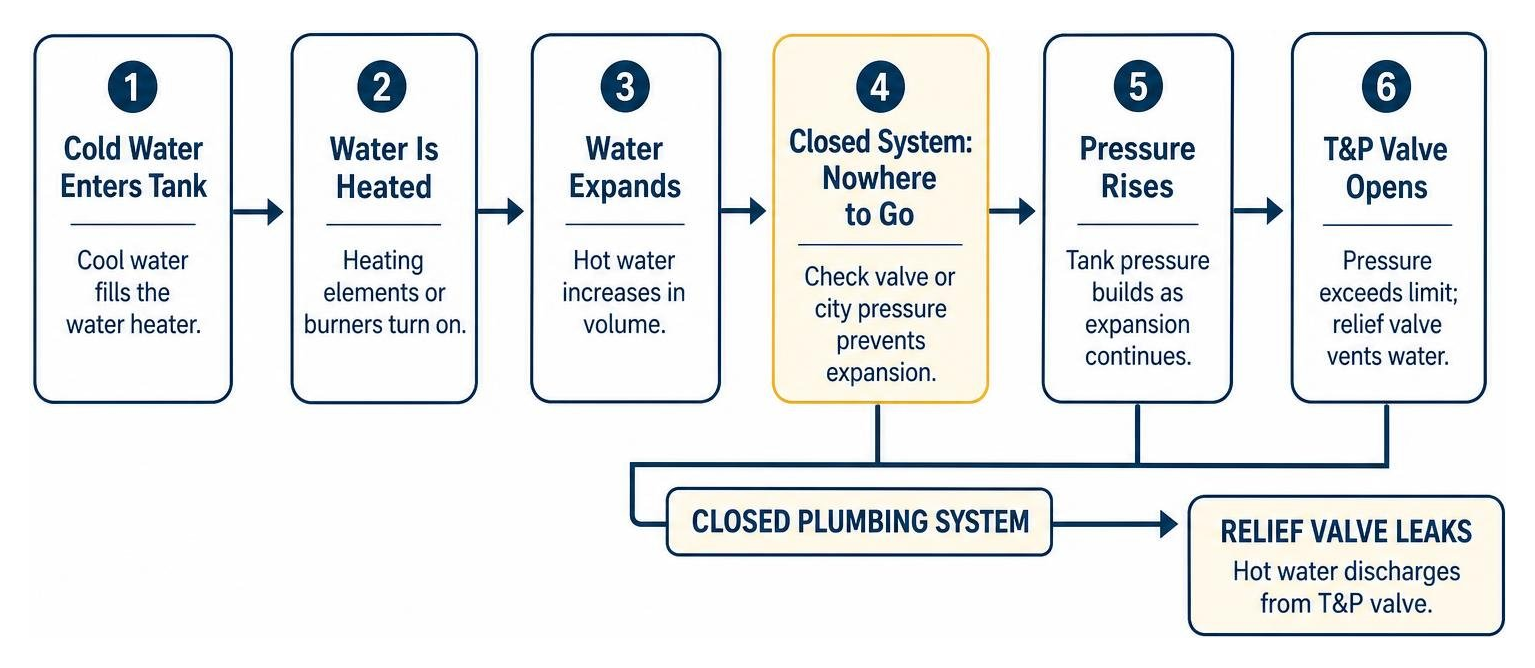
Thermal expansion compounds this issue. Physics dictates that when water is heated from 50°F to 120°F, its total volume expands by roughly 2% through thermal expansion. In older “open” plumbing systems, this expanded volume simply pushed backward into the public water main. Modern homes are equipped with backflow preventers or pressure-reducing valves (PRVs), creating a “closed loop” system.
With nowhere else for the expanding water to go, thermal expansion spikes internal tank pressure right up to the T&P valve’s 150 psi threshold, causing it to weep. If your home lacks a functional thermal expansion tank—or if its internal rubber bladder has ruptured—your T&P valve will leak during almost every heating cycle.
Temperature Settings and Sediment Accumulation
Your water heater’s thermostat plays a massive role in valve health. Keeping your water heater tank temperature set no higher than 120-125°F ensures energy efficiency, safety, and longevity for your T&P valve. Setting the thermostat higher forces the water closer to the valve’s 210°F thermal discharge limit, causing excessive thermal expansion and premature wear.
Sediment is another primary culprit. As minerals settle at the bottom of the tank, they create hot spots that cause localized boiling and rapid pressure surges. Furthermore, whenever the T&P valve opens to relieve pressure, tiny grains of calcium or sand can get trapped between the rubber seal and the valve seat. This microscopic gap prevents the valve from closing completely, turning a temporary safety release into a perpetual drip.
Risks and Hazards of Ignored Valve Leaks
A dripping valve might seem like a minor nuisance, but leaving a water heater pressure relief valve leaking ignored carries serious consequences for your home and family.
- Severe Water Damage and Mold Growth: Even a minor drip can release several gallons of water a day. Over time, this moisture ruins surrounding drywall, rots subflooring, destroys carpet, and fosters dangerous black mold underneath utility closet floors.
- Scalding Risks: Discharge water leaves the tank at blistering temperatures. If the valve opens forcefully while someone is nearby—especially if the discharge pipe was improperly installed or omitted—it can cause severe third-degree burns.
- Catastrophic Tank Over-Pressurization: If a valve is weeping due to high pressure and a homeowner attempts to plug or cap the discharge line, the safety release mechanism is completely compromised. Without an outlet for excessive pressure or runaway temperatures, a water heater can rupture or explode.
- Wasted Energy and Soaring Bills: A steadily leaking T&P valve constantly dumps heated water down the drain, forcing your gas burners or electric elements to run continuously.
| Leak Characteristic | Normal Thermal Expansion Weeping | Serious Continuous Valve Leakage |
|---|---|---|
| Water Volume | A few drops to a quarter cup per heating cycle | Continuous trickle, steady drip, or full stream |
| Timing | Occurs only while the water heater is actively heating | Happens 24/7 regardless of burner or element status |
| System Pressure | Temporarily spikes near 150 psi during heating | Static home pressure exceeds 80 psi or valve is broken |
| Primary Cause | Missing or waterlogged expansion tank | Sediment trapped in seat, failed valve, or broken thermostat |
| Action Required | Install/adjust expansion tank or drop thermostat | Flush valve seat, replace T&P valve, or call a plumber |
Step-by-Step Guide to Repairing and Replacing a T&P Valve
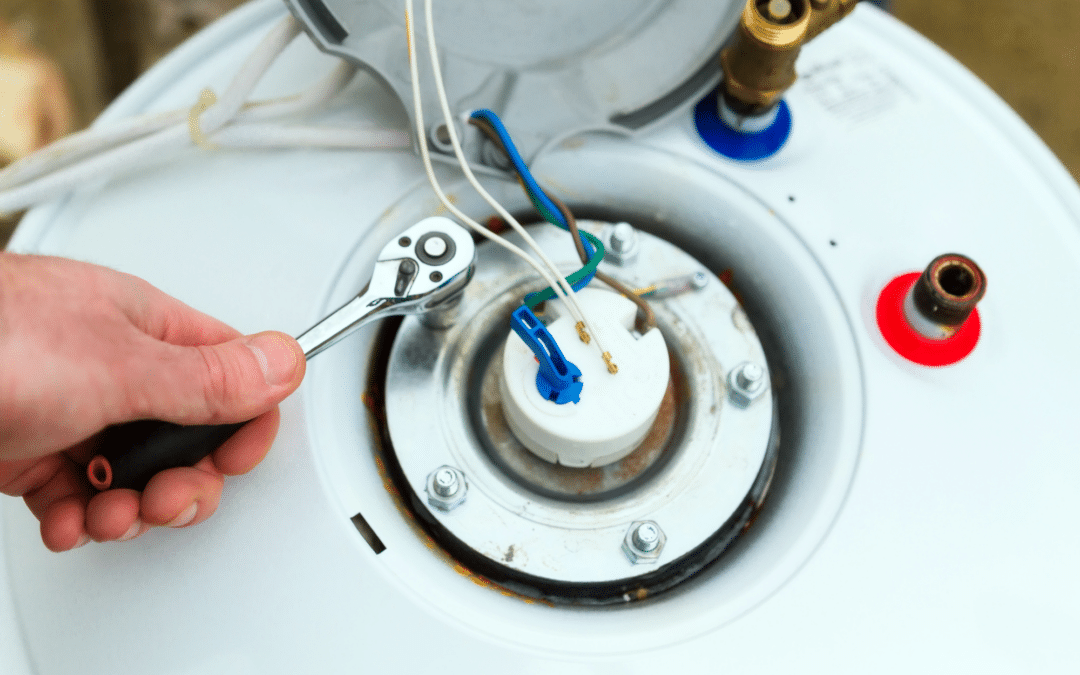
If you are comfortable performing basic DIY tasks, troubleshooting or replacing a leaky relief valve is straightforward. Follow this step-by-step procedure to resolve the issue safely.
Essential Safety Steps Before Beginning Repairs
Before touching any plumbing connections, safety must come first:
- Cut the Power or Gas Supply: For electric units, switch off the dedicated breaker at the main electrical panel. For gas units, rotate the gas control valve knob on the front of the tank to the “OFF” position.
- Shut Off the Cold Water Input: Turn the cold water shutoff valve located above the water heater clockwise until it stops completely.
- Depressurize and Cool the Tank: Open a hot water faucet inside your home (such as a bathroom sink) to bleed off leftover system pressure. Allow the water inside the tank to cool down to prevent scalding injuries during work.
For a deeper dive into electrical safety precautions, read our comprehensive guide on electric water heater pressure relief leak troubleshooting.
Diagnosing a Water Heater Pressure Relief Valve Leaking from Debris
Sometimes, a valve is simply holding onto a tiny piece of mineral grit. You can attempt a manual flush to clear it:
- Place a 5-gallon bucket directly under the end of the discharge pipe connected to the T&P valve.
- Gently lift the manual test lever on top of the T&P valve for 2 to 3 seconds, allowing a burst of hot water to flush through the discharge line.
- Release the lever and let it snap back into place smartly.
- Check if the drip stops. If the valve continues to leak steadily after three attempts, the internal rubber seal is compromised or damaged, and the entire valve must be replaced.
Replacing the Temperature and Pressure Relief Valve
If flushing fails to stop the leak, replace the valve following these simple instructions:
- Drain the Water Level: Connect a garden hose to the tank’s lower drain valve and run it outside or to a floor drain. Drain out roughly 5 to 10 gallons of water so the internal water line drops safely below the T&P valve port.
- Remove the Discharge Pipe: Unthread the vertical discharge pipe connected to the outlet of the old T&P valve using two pipe wrenches or adjustable pliers.
- Unscrew the Old Valve: Use an adjustable wrench to turn the hex nut body of the T&P valve counterclockwise until it unthreads completely from the tank spud.
- Prep and Install the Replacement: Purchase an exact replacement valve matching your tank’s rating (typically 3/4-inch NPT threads certified for 150 psi and 210°F). Apply 3 to 5 tight wraps of thread sealant tape (Teflon tape) clockwise around the male threads of the new valve. Screw it into the tank hand-tight, then tighten it with a wrench until the discharge outlet points straight down.
- Reconnect, Refill, and Test: Reattach the discharge pipe. Close the drain valve, turn the cold water supply back on, and keep a hot water faucet open nearby until water flows out smoothly without air pockets. Check all new connection points for drips, then turn your power or gas supply back on.
If you encounter additional drips around other fittings during this process, check our practical guide to fixing a leaky water heater.
Prevention Strategies and Professional Plumbing Solutions
Preventing future T&P valve failures involves maintaining balanced water pressure and keeping mineral buildup under control.
Preventative Maintenance and System Pressure Control
- Install an Expansion Tank: If you have a closed plumbing system, a properly calibrated thermal expansion tank is non-negotiable. Ensure its air charge matches your incoming static water pressure (typically 40 to 60 psi) while system pressure is zero.
- Flush the Water Tank Annually: Periodically draining and flushing the bottom of your water heater removes hard water sediment before it can float up into the T&P valve seat or overheat the tank bottom.
- Calibrate Your Thermostat: Verify that your thermostat dial reads between 120°F and 125°F. This reduces thermal stress and keeps water temperatures far below dangerous relief limits.
- Test the Valve Annually: Gently lift the manual test lever once a year to ensure the internal spring moves freely and does not stick shut due to corrosion.
Knowing When to Call a Licensed Plumber
While replacing a T&P valve is a manageable DIY job, certain scenarios require an expert hand:
- Severely Corroded Tank Spuds: If the threaded connection on the water heater tank itself is rusted, cracked, or leaking around the outer welding, replacing the valve won’t help—the entire tank must be replaced.
- Uncontrolled Main Line Pressure: If your home’s water pressure consistently measures over 80 psi, your primary Pressure-Reducing Valve (PRV) near your main water shutoff has likely failed and needs professional replacement.
- Gas System Complications: If you smell gas or suspect a bad thermostat on a gas water heater, safety requires immediate expert evaluation. Read our article on stopping leaks on gas water heaters to learn more about gas system safety.
When DIY fixes fall short, our team at Honest Home Services is always standing by to diagnose complex pressure issues and provide lasting solutions.
Frequently Asked Questions About Water Heater Relief Valves
Is it normal for a water heater relief valve to drip occasionally?
A tiny amount of occasional dripping can be normal during heavy water heating cycles if your home has a closed plumbing system without an expansion tank. As cold water heats up, it expands. If that expanded water has nowhere to go, pressure builds until the T&P valve discharges a small amount of water to protect the tank. However, if the dripping is continuous, streams steadily, or happens when the water heater is idle, there is an underlying problem that requires immediate repair.
Can I just plug or cap a leaking pressure relief valve?
No, never cap, plug, or reduce the size of a T&P relief valve discharge line. Capping a leaking pressure relief valve disables the absolute primary safety device protecting your home from an over-pressurized water tank. If pressure or temperature surges without a functional relief valve, the water heater can experience structural failure or explode. If your valve is leaking, you must address the root cause—such as high water pressure or a broken valve—rather than blocking the outlet.
How long do water heater pressure relief valves typically last?
T&P valves generally last between 5 and 10 years, though their lifespan depends heavily on local water quality. In areas with hard mineral water or heavy sediment buildup, valve seats can degrade or corrode much faster. Most water heaters last about 10 to 15 years before needing replacement, so if your unit is approaching its second decade and suffering from a leaking relief valve, installing a new, energy-efficient water heater is often the most cost-effective long-term option.
Conclusion
A water heater pressure relief valve leaking is a clear warning light from your home’s plumbing system. Whether caused by thermal expansion spikes, high municipal water pressure, sediment buildup, or simply age, taking swift action protects your home from costly water damage and preserves your equipment.
At Honest Home Services, we believe in delivering honest, reliable, and affordable plumbing solutions across Salt Lake City and Northern Utah. If you are uncomfortable working on your water heater, or if a persistent leak continues to baffle you, our local, expert technicians offer 24/7 emergency support with guaranteed customer satisfaction.
Don’t let a small drip turn into a major flood. Contact us today or visit our page on Salt Lake City water heater repair services to schedule an inspection and get your hot water system running smoothly again!