

When Your Furnace Breaks Down: What to Do First
Furnace repair is something most Utah homeowners will face at least once — and knowing what to do in the first few minutes can save you money, stress, and a very cold night.
Quick answer: How to fix a broken furnace
- Check the thermostat — confirm it’s set to “heat” and the batteries aren’t dead
- Inspect the air filter — a clogged filter is one of the most common causes of furnace failure
- Check the power switch and breaker — make sure the furnace is getting electricity
- Look at the pilot light or ignitor — a failed ignitor means no heat
- Call a licensed technician — if none of the above solves it, stop and get professional help
Most furnace problems show up at the worst possible time — during a cold snap, late at night, or on a weekend. A small issue ignored in the fall can become a full breakdown in January. That’s not just uncomfortable; in extreme cold, it can become a safety risk.
The good news? Many furnace problems have simple causes. And even when they don’t, knowing what to check first helps you explain the issue clearly when you call for service.
At Honest Home Services, we’ve spent over 20 years handling furnace repair for homeowners and small businesses across Northern Utah — so we know exactly what goes wrong, and how to fix it fast. Let’s walk you through it, step by step.
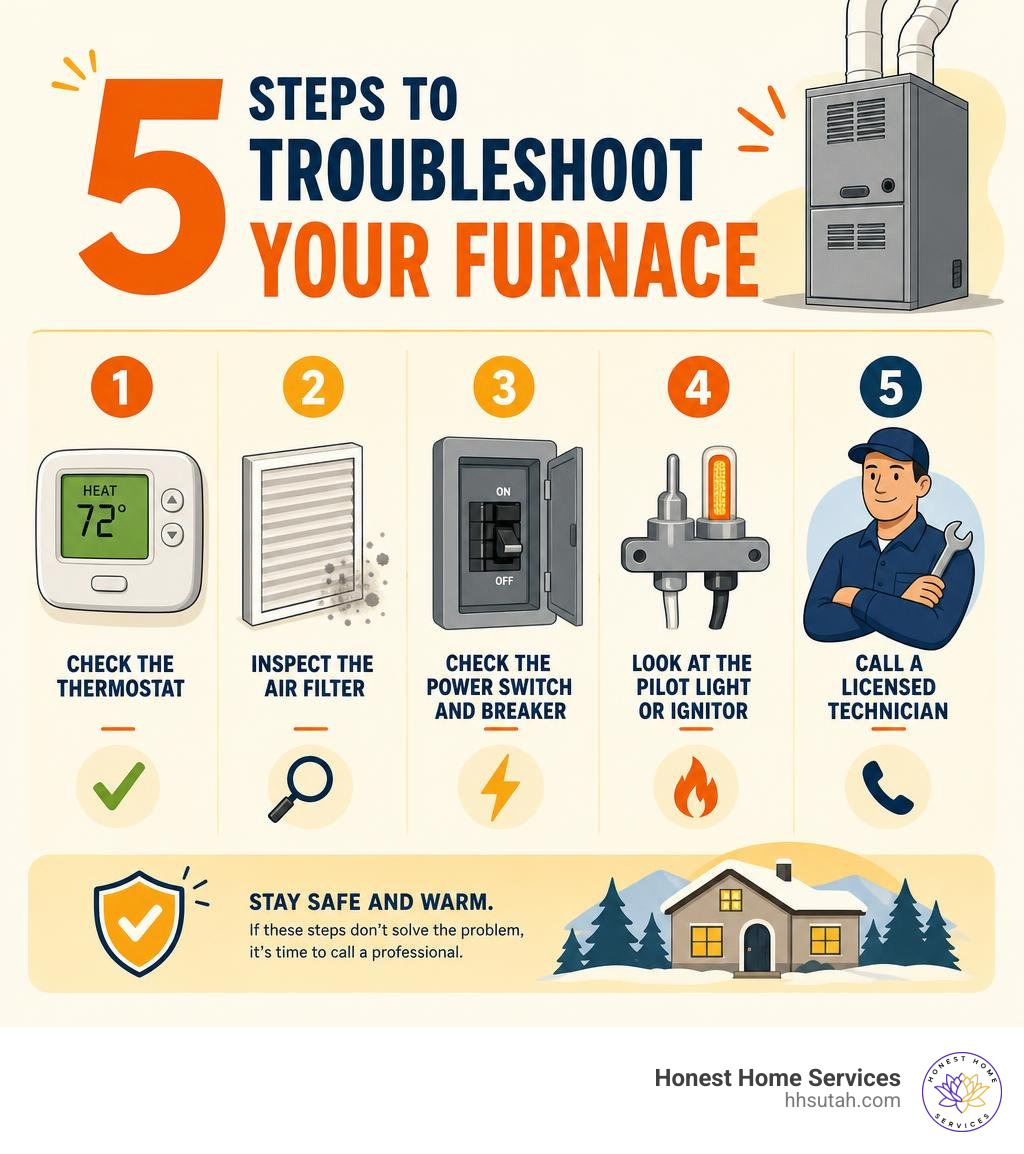
5 Steps to Troubleshoot and Prepare for Furnace Repair
When your heating system suddenly decides to take an unannounced vacation in the middle of a freezing Utah winter, your first instinct might be to panic. Before you call us wrapped in three layers of blankets, there are a few basic troubleshooting steps you can perform safely on your own.
Understanding these preliminary checks can help you resolve minor issues immediately or prepare you to explain the problem to a professional. If you want to dive deeper into what might be plaguing your system, check out our guide on 10 Common Furnace Problems And How To Fix Them.
Step 1: Check the Thermostat Settings and Batteries
It sounds almost too simple, but you would be amazed by how many emergency service calls boil down to a thermostat that was accidentally bumped, switched to “cool” by a curious toddler, or left with dead batteries.
First, ensure your thermostat is set to “Heat” and the temperature setting is at least five degrees above the current room temperature. If the screen is completely blank or flashing a low-battery warning, replace the batteries immediately. Modern digital thermostats rely heavily on steady battery power to send signals to your heating system.
Additionally, if you live in the Salt Lake Valley, local temperature fluctuations can sometimes throw off thermostat calibration. If you suspect your thermostat is reading the room temperature incorrectly, it may need to be professionally recalibrated or replaced by an experienced local technician.
Step 2: Inspect and Replace the Air Filter
If your thermostat is working but your furnace is blowing lukewarm air—or worse, turning on and off rapidly without heating your home—your air filter is the prime suspect.
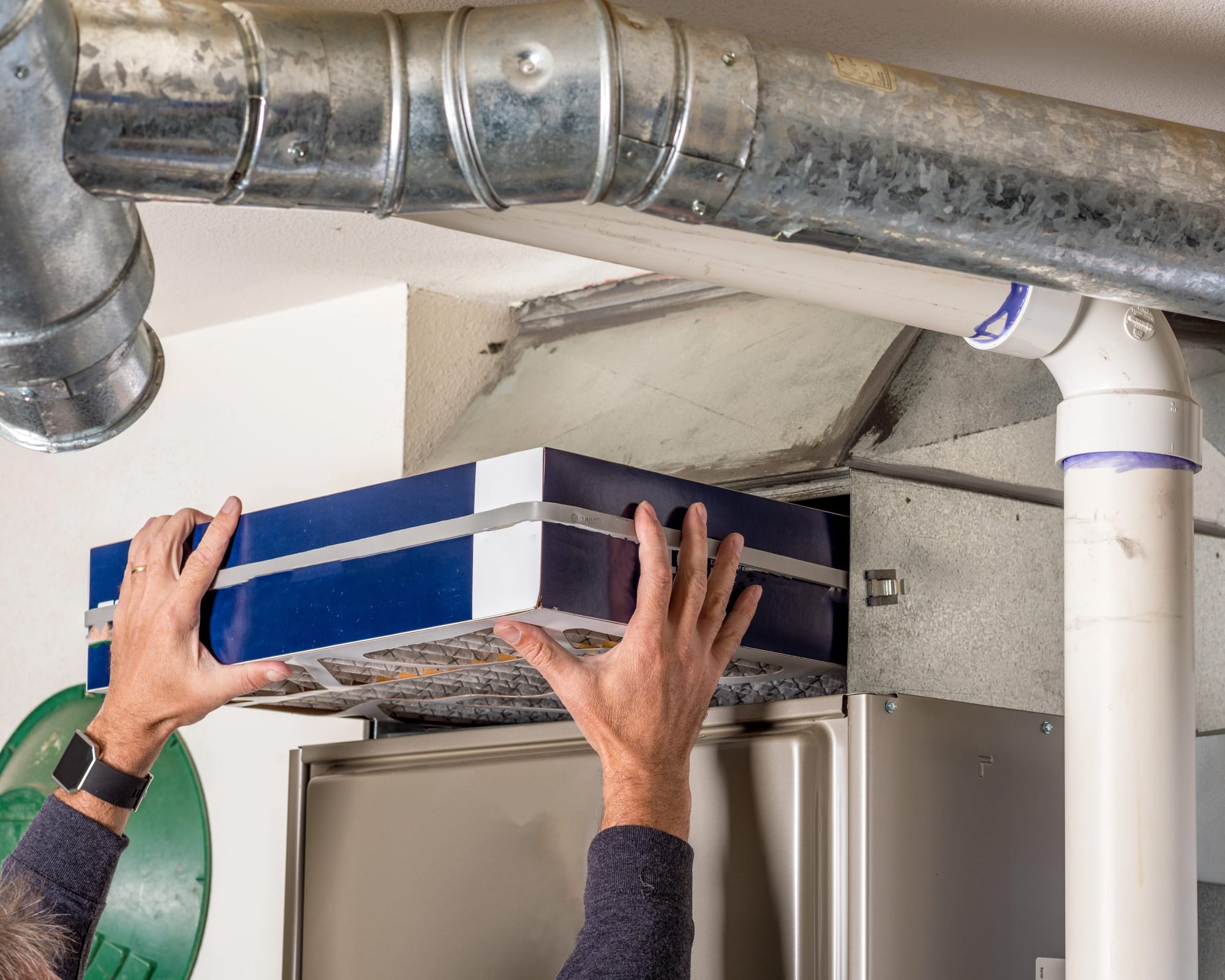
A heavily clogged air filter restricts the volume of air flowing through the heat exchanger. When airflow is choked, the internal temperature of the furnace skyrockets. To prevent the system from literally melting itself, a safety device called a “limit switch” trips and shuts down the burners. This cycle of starting up and quickly shutting down is known as short cycling.
We recommend replacing your furnace filter every 1 to 3 months, especially during heavy winter use. To keep your system in top shape before the snow starts falling, read our advice on How To Get Your Furnace Prepped For The Colder Months. If you are located in Davis County and need help resolving airflow issues, you can search for local assistance from trusted professionals in your area.
Step 3: Verify the Power Switch and Breaker Panel
Furnaces are complex appliances that require both fuel (like natural gas or propane) and electricity to run. Even a gas furnace needs electrical power to run the blower motor, draft inducer, and electronic ignition systems.
First, locate the furnace power switch. This looks exactly like a standard household light switch and is typically mounted on the side of the furnace cabinet or on a nearby wall in your utility room or basement. It is incredibly easy to flip this switch off accidentally while retrieving Christmas decorations or storage boxes.
If the switch is in the “On” position, head over to your home’s main electrical breaker panel. Look for the circuit breaker labeled “Furnace” or “Heating.” If the breaker has tripped to the middle position, flip it completely to the “Off” position first, and then switch it back to “On.”
Note: If the breaker trips again immediately, do not attempt to reset it a second time. This indicates a serious electrical short circuit within the furnace, and continuing to reset it could cause an electrical fire. Call for professional assistance right away.
Step 4: Examine the Pilot Light or Ignitor
Older furnaces utilize a standing pilot light (a continuous flame) to ignite the gas burners. If you have an older system, look through the small inspection window on the furnace burner door. If the flame is out, you can attempt to relight it following the manufacturer’s instructions printed on the cabinet.
Modern high-efficiency furnaces, however, use electronic ignition systems, most commonly a hot surface ignitor (HSI). These ignitors glow bright orange when they receive electricity, lighting the gas burners automatically. Hot surface ignitors are made of fragile silicon carbide or silicon nitride and typically need to be replaced every 5 to 7 years.
If you see your furnace cycle on, the draft inducer fan starts spinning, but you never see a warm orange glow near the burners before the system shuts down, your ignitor has likely cracked or burned out. If you are in northern Davis County and suspect an ignition failure, you can reach out to local specialists to get your heat back online quickly.
Step 5: Know When to Call a Professional for Furnace Repair
If you have completed the first four steps and your home is still freezing, it is time to put down the tools and call in the experts. Attempting to DIY complex repairs involving natural gas lines, high-voltage electrical wiring, or venting systems is highly dangerous.
Before you call us, write down your furnace’s brand, model number, and serial number. This information is usually found on a metal rating plate inside the front burner door. Having this ready helps our technicians arrive with the correct manufacturer-approved parts.
If you are noticing concerning issues like gas odors, loud metal-on-metal screeching, or a yellow burner flame, do not wait. Be sure to read 5 Signs Your Furnace Needs Immediate Attention Before Winter to understand when an issue is a true emergency. For residents in Layton, Clearfield, or Kaysville, finding a reliable specialist is easy when you know what signs to look for.
How Licensed Technicians Diagnose and Resolve Furnace Problems
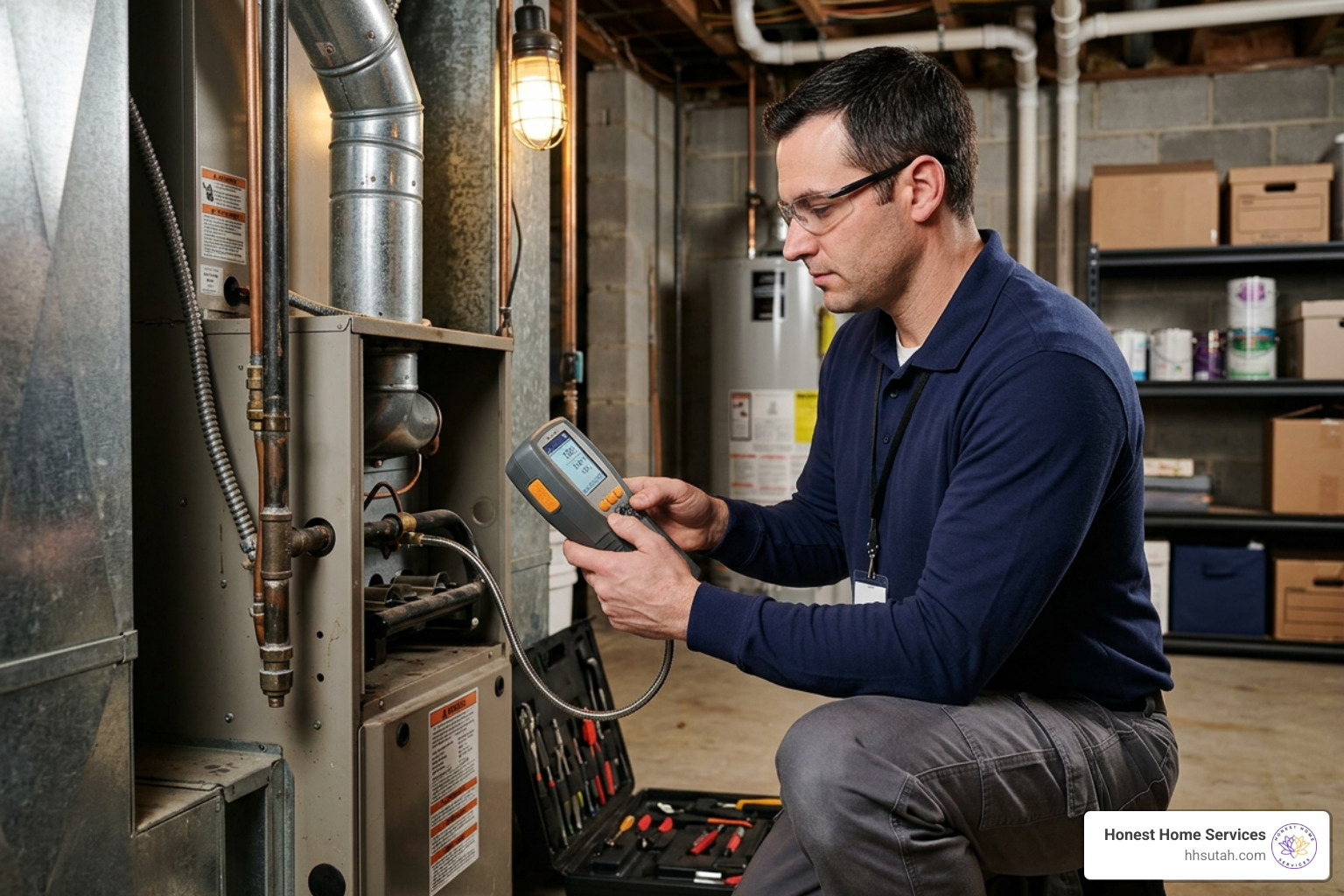
When a professional technician from Honest Home Services arrives at your home, they don’t just guess what’s wrong. They utilize advanced diagnostic equipment to pinpoint the exact failure while ensuring the entire system is operating safely. For a deeper look into our professional diagnostic process, check out our guide on Stay Warm Expert Advice On Furnace Maintenance And Repair.
How Technicians Diagnose Complex Issues During a Furnace Repair
When we perform a furnace repair on a system that is short cycling or making unusual sounds, we follow a rigorous, step-by-step diagnostic sequence:
- Static Pressure Testing: We measure the pressure inside your ductwork to determine if airflow is being choked by dirty coils, crushed ducts, or incorrect filter sizing.
- Electrical Multimeter Diagnostics: We test electrical currents, voltage, and resistance across components like the capacitor, blower motor, and control board to find hidden electrical faults.
- Flame Sensor Testing: We measure microamps on the flame sensor. If the sensor is dirty or corroded, it won’t detect the flame, causing the furnace to shut down within seconds of ignition.
- Draft Inducer Analysis: We verify that the draft inducer motor is pulling a proper vacuum to safely vent combustion gases out of your home.
If you are a resident of Salt Lake County and need a comprehensive diagnostic check, our Salt Lake City Furnace Repair Guide outlines what to expect. Homeowners in Farmington can also find local help through experienced area professionals.
For reliable, fast, and transparent diagnostics, you can always count on Honest Home Services.
Critical Safety Risks: Cracked Heat Exchangers and Carbon Monoxide Leaks
The single most critical part of any furnace inspection is evaluating the heat exchanger. The heat exchanger is a set of metal tubes or chambers that keeps the toxic gases produced by burning fuel separate from the clean air circulating through your home’s vents.
Over years of constant heating and cooling, the metal of the heat exchanger expands and contracts. This thermal stress can eventually cause cracks to develop. A cracked heat exchanger is an immediate, severe safety hazard because it allows carbon monoxide (CO) to leak directly into your household air.
Key Dangers of a Cracked Heat Exchanger:
- Carbon Monoxide Poisoning: CO is a colorless, odorless, tasteless gas that can cause headaches, dizziness, nausea, and even death.
- Flame Rollout: Cracks can disrupt the pressure inside the burners, causing flames to “roll out” of the cabinet and create a fire hazard.
- Incomplete Combustion: A compromised heat exchanger prevents fuel from burning cleanly, producing higher levels of soot and toxic gases.
If your carbon monoxide detector sounds, or if you suspect a gas leak, turn off your furnace immediately, exit your home, and call 911.
Deciding Between Fixing Your Heating System and Full Replacement
When faced with a major repair bill, every homeowner must ask themselves: Is it smarter to fix this old unit, or is it finally time to invest in a new, high-efficiency system?
| Factor | Furnace Repair | Furnace Replacement |
|---|---|---|
| Upfront Cost | Lower ($150 – $1,000+) | Higher ($4,000 – $8,000+) |
| System Lifespan | Extends life of current unit temporarily | Provides 15 – 20+ years of reliable operation |
| Energy Efficiency | Keeps unit running at original AFUE rating | Significantly lowers utility bills (up to 98% AFUE) |
| Warranty Coverage | Limited warranty on replaced parts only | 10+ year manufacturer parts & labor warranties |
Key Factors: Age, Repair Costs, and Efficiency
To make the best financial decision for your household, we recommend using the 50% Rule. If your furnace is over 15 years old and the cost of the repair exceeds 50% of the cost of a brand-new installation, replacement is almost always the more cost-effective choice in the long run.
Older furnaces typically have an Annual Fuel Utilization Efficiency (AFUE) rating of around 60% to 70%, meaning up to 40% of the fuel you pay for is wasted up the chimney. Modern high-efficiency systems boast AFUE ratings of 90% to 98%, which can drastically slash your monthly winter heating bills.
If you are wrestling with this decision, read our comprehensive article on How To Know If Its Time For Furnace Replacement. If you are located in Layton, you can also explore local options to find the right fit for your home.
Frequently Asked Questions About Furnace Maintenance and Costs
Keeping your heating system running efficiently shouldn’t be a guessing game. Here are the answers to some of the most common questions we receive from Utah homeowners.
How often should I schedule professional furnace maintenance?
You should schedule a professional furnace tune-up once every year, ideally in the late summer or early autumn before the cold Utah winter sets in. Regular preventative care can prevent up to 95% of unexpected winter breakdowns and keep your manufacturer’s warranty active.
To book your annual system check, visit our Furnace Tune Up service page. For residents in the capital city, you can also look into specialized local maintenance through trusted area professionals.
What factors affect the overall cost of heating system repairs?
The final cost of a furnace repair depends on several key variables:
- Diagnostic Fee: The base fee to cover the technician’s travel and time spent testing the system.
- Type of Parts Needed: Simple parts like a flame sensor or thermocouple are inexpensive, while major components like blower motors, gas valves, or smart control boards can cost hundreds of dollars.
- Labor Rates: Complex repairs that require several hours of labor will naturally cost more.
- Warranty Status: If your system is still under manufacturer warranty, the cost of replacement parts may be fully covered.
For practical advice on managing these expenses, explore our guides on Extend Your Furnaces Lifespan With These Furnace Repair Tips and Save Money This Winter With These Furnace Repair Tips.
How quickly can I expect emergency service during a winter breakdown?
In the dead of a Utah winter, a lack of heat is more than an inconvenience—it is a safety hazard that can lead to frozen pipes and dangerous indoor temperatures. At Honest Home Services, we prioritize no-heat emergencies and aim to have a technician at your door as fast as possible, often within 2 to 4 hours.
We offer true 24/7 emergency support across our entire service area. Learn more about how we protect your home in a crisis by reading 24 7 Heating Repair When Your Furnace Calls For Backup. If you live in Bountiful, you can also check out local service timelines to ensure prompt assistance.
Conclusion
A broken furnace during a freezing Northern Utah winter is a stressful experience, but you do not have to face the cold alone. By performing simple troubleshooting steps like checking your thermostat, replacing your air filter, and verifying your power switches, you can resolve minor issues yourself.
When the problem requires a professional touch, Honest Home Services is here to provide reliable, transparent, and affordable solutions. We proudly serve homeowners throughout Salt Lake City, Davis County, and the surrounding areas with expert technicians and a 100% satisfaction guarantee.
Don’t stay in the cold! Contact our team today for fast, friendly service at Honest Home Services.