

Why Gas Leak Detection Sensors Matter for Home Safety
Gas leak detection sensors warn you when fuel gas builds up before it can create a fire, explosion, or health risk. Choose a detector made for the gas in your property, place it at the correct height, test it regularly, and treat every alarm as urgent.
Natural gas and methane rise, so their detectors are usually mounted high on a wall. Propane and other LPG gases settle low, so detectors belong closer to the floor. Carbon monoxide is different: it is a toxic gas made by incomplete combustion, not a fuel leak, so it requires a dedicated CO detector or a properly certified combination alarm.
A sensor cannot repair a leak, but it can provide the early warning needed to get outside, avoid switches and flames, and call for qualified help. That matters because natural gas is naturally odorless; utilities add an odorant to help people notice it, but smell alone is not a reliable safety plan.
At Honest Home Services, we bring more than 20 years of plumbing, heating, and air-conditioning experience to Northern Utah homes and businesses. We help customers understand gas leak detection sensors, respond safely to suspected leaks, and restore gas and HVAC systems with licensed, insured service.

Core Technologies Behind Gas Leak Detection Sensors
Modern gas monitoring relies on distinct engineering principles to identify fugitive emissions before they accumulate to dangerous thresholds. Whether inside a residential utility closet or across an industrial compression facility, matching the sensing mechanism to the environment determines detection speed, accuracy, and longevity.
| Sensor Technology | Primary Target Gases | Typical Detection Limits | Response Time | Typical Lifespan | Primary Strengths |
|---|---|---|---|---|---|
| Metal Oxide Semiconductor (MOS) | Methane, Propane, Butane, Solvents | 50–10,000 ppm | < 10–30 seconds | 3–5 years | Cost-effective, broad sensitivity to multiple combustible gases |
| Catalytic Bead (Pellistor) | Combustible hydrocarbons, Hydrogen | 0–100% LEL (approx. 500+ ppm) | < 15 seconds | 2–4 years | Highly reliable linearity across flammable ranges, rugged |
| Non-Dispersive Infrared (NDIR) | Methane, Carbon Dioxide, Hydrocarbons | 0–100% LEL or ppm levels | < 10–30 seconds | 5–10+ years | Immune to chemical poisoning, failsafe, no oxygen required |
| Electrochemical | Carbon Monoxide, Toxic Gases ($H2S$, $Cl2$) | 1–1,000 ppm | < 30 seconds | 2–3 years | Highly selective to specific toxic molecules, low power draw |
| Ultrasonic Acoustic | Any high-pressure gas escape ($ge 2$ BAR) | Acoustic sound profile (12–25+ kHz) | Instantaneous (< 1s) | 7–10+ years | Unaffected by wind or gas dilution; monitors wide areas |
Solid-State, Catalytic Bead, and NDIR Optical Sensors
Consumer alarms and portable field tools frequently utilize Metal Oxide Semiconductor (MOS) sensors. These solid-state elements function by heating a metal oxide film (commonly tin dioxide). When ambient reducing gases like methane or propane interact with the heated surface, electrical resistance drops, triggering an internal alarm circuit. While highly responsive, MOS sensors can be sensitive to environmental changes such as high humidity.
Catalytic bead sensors, or pellistors, utilize a matched pair of treated ceramic beads containing platinum wire coils. One bead is coated with a catalyst that oxidizes combustible gas on contact, raising its temperature and electrical resistance, while the reference bead remains inactive. This resistance imbalance precisely measures gas concentration up to the Lower Explosive Limit (LEL).
For continuous monitoring without the risk of catalyst contamination, Non-Dispersive Infrared (NDIR) optical sensors are the gold standard. NDIR works by directing specific infrared wavelengths through a sampling chamber. Hydrocarbon gas molecules absorb narrow bands of IR energy—methane strongly absorbs light at the 3.3 to 3.4 micrometer wavelength. Highly engineered options, like the dual-channel optical design found in the Methasense XP, deliver continuous methane detection with over 10 years of battery autonomy and zero recalibration requirements.

Ultrasonic Acoustic Gas Leak Detection
Traditional sensors require gas molecules to physically drift into the sensing chamber. However, outdoor installations and high-draft industrial facilities encounter wind that quickly dilutes escaping gas plumes.
Acoustic instruments, such as the Ultrasonic Leak Detector Observer-i, bypass concentration tracking altogether. Instead, they listen for the airborne ultrasound generated by pressurized gas escaping through an orifice at pressures starting at 2 BAR (29 psi). By operating in the 12 kHz to 25+ kHz acoustic spectrum and utilizing onboard Artificial Neural Networks (ANN), these units distinguish real high-pressure gas leaks from industrial background noise across broad radiuses up to 28 meters.
Target Gases: Methane, Propane, and Carbon Monoxide
Gas monitors are not universal sniffers; their internal components must be calibrated to the specific chemical properties and vapor densities of their target hazards.

Natural Gas vs. LPG and Combustible Fuel Gases
The vapor density of a gas determines how it behaves when released into an enclosed room:
- Natural Gas (Methane – $CH_4$): Natural gas has a specific gravity of roughly 0.55 to 0.60, making it significantly lighter than air (air = 1.0). When an indoor line leaks, methane rises directly toward the ceiling, collecting in pockets along upper wall seams and rafters. The Lower Explosive Limit (LEL) for methane is approximately 5% gas-in-air concentration.
- Liquefied Petroleum Gas (LPG / Propane – $C3H8$): Propane is heavier than air, with a specific gravity of approximately 1.52. When an appliance fitting or tank fails, propane sinks to the floor, rolling into basement corners, drains, and crawl spaces. Its LEL is much lower, at roughly 2.15% volume in air.
Specialized fixed instruments, such as the multi-gas FGD-X Fixed Gas Leak Detector, allow technical operators to configure profiles across more than 50 different toxic and combustible gas types, ranging from hydrogen to heavier volatile organic compounds (VOCs).
Explosive Gas Alarms vs. Carbon Monoxide Detectors
A standard carbon monoxide alarm cannot detect an unburned fuel gas leak, and an explosive gas alarm cannot protect you from carbon monoxide.
- Explosive Fuel Leaks: Caused by pressurized pipes leaking raw fuel gas (methane or propane) into your living space. The immediate hazard is flash fire and atmospheric explosion.
- Carbon Monoxide ($CO$): An odorless, colorless toxic byproduct formed when fuel burns incompletely due to poor ventilation, cracked furnace heat exchangers, or clogged appliance flues. CO binds with blood hemoglobin, creating severe asphyxiation risks at minimal parts-per-million levels.
Dual-purpose combination alarms integrate both an electrochemical CO cell and an MOS or catalytic combustible sensor within a single chassis, maintaining separate audible alert patterns for toxic vs. explosive threats.
Key Features and Connected Safety Systems
Modern gas detection relies on rapid multi-channel notification and automated system responses.
Choosing Smart Gas Leak Detection Sensors for Home Automation
Connected residential detectors integrate directly with 2.4 GHz Wi-Fi networks without cumbersome third-party bridge hubs. Devices such as the Shelly GAS (LPG) monitor concentrations down to 6% LEL and emit localized alarms ($ge 70text{ dB}$) while pushing instant notifications to family smartphones.

Advanced home safety setups pair smart sensors with hardwired or wireless 12V mechanical valve manipulators. When a combustible gas threshold is crossed, the sensor signals the motorized valve arm to physically twist off the main interior gas line ball valve, cutting off fuel flow before gas volumes reach explosive concentrations.
Portable Sniffers vs. Fixed Industrial Monitoring
While fixed alarms protect specific rooms 24/7, field technicians rely on portable combustible gas detectors to pinpoint microscopic pinhole leaks during HVAC and plumbing service calls.
Professional-grade sniffers, such as the Combustible Gas Leak Detector for HVAC/R service, offer adjustable sensitivity down to 5 ppm for methane and 1 ppm for hydrogen. Equipped with long, flexible gooseneck probes, these battery-powered units access tight pipe joints behind water heaters, furnace burner manifolds, and tight manifold cabinets where fixed alarms cannot reach.
Installation, Safety Certifications, and Maintenance
A high-performance gas sensor installed in the wrong location provides false security. Ensuring continuous reliability requires proper placement and routine maintenance.
Installing and Positioning Gas Leak Detection Sensors Correctly
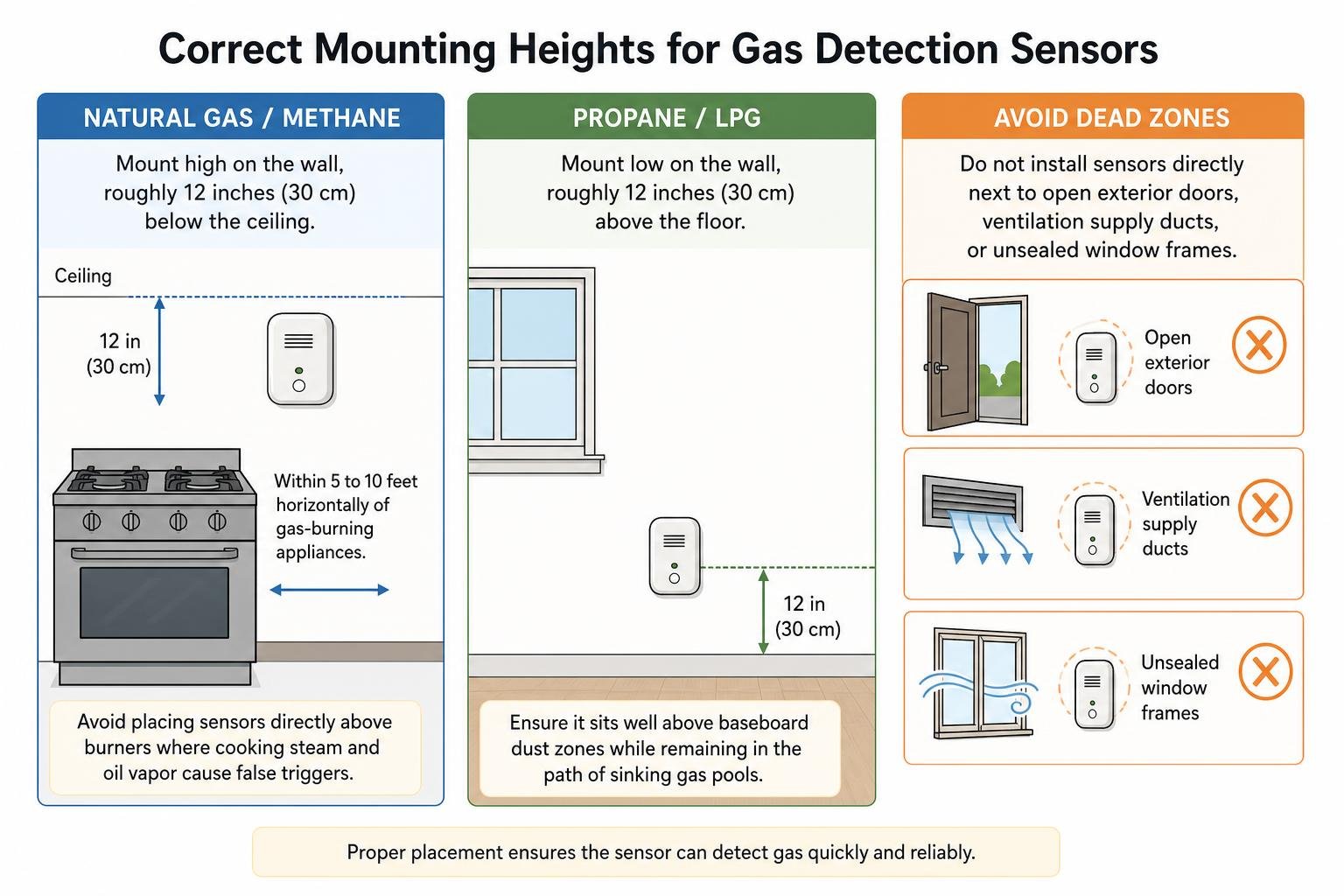
Placement rules depend on the fuel source supplying your appliances:
- For Natural Gas / Methane: Mount the detector high on the wall, roughly 12 inches (30 cm) below the ceiling, and within 5 to 10 feet horizontally of gas-burning appliances like stoves, boilers, or dryers. Avoid placing sensors directly above burners where cooking steam and oil vapor cause false triggers.
- For Propane / LPG: Mount the detector low on the wall, roughly 12 inches (30 cm) above the floor, ensuring it sits well above baseboard dust zones while remaining in the path of sinking gas pools.
- Avoid Dead Zones: Do not install sensors directly next to open exterior doors, ventilation supply ducts, or unsealed window frames where fresh airflow can blow gas plumes away from the sensor intake.
Calibration, Testing, and Sensor Longevity
Most residential gas detectors maintain an operating lifespan of 3 to 5 years. Over time, the internal sensing elements degrade due to continuous heating, ambient dust accumulation, and exposure to household chemicals like aerosol hairsprays, paint thinners, and silicone cleaners.
- Monthly Testing: Press the unit’s “Test/Reset” button monthly to verify internal circuitry, buzzer function, and LED status.
- Bump Testing & Calibration: Portable and industrial instruments require periodic bump testing with known gas mixtures to confirm sensor accuracy, following manufacturer instructions such as those detailed in the SENSIT GAS-TRAC Manual.
- End-of-Life Signals: Replace any detector immediately when its automated end-of-life chirping sequence begins or if the status light illuminates amber.
Frequently Asked Questions About Gas Detection
What is the difference between a natural gas detector and a carbon monoxide detector?
A natural gas detector senses raw, unburned combustible fuel (primarily methane) to prevent flash fires and explosions. A carbon monoxide (CO) detector senses a poisonous, odorless byproduct created when heating appliances burn fuel inefficiently. They use entirely different internal sensors and cannot substitute for one another unless built as a certified combination alarm.
Where should gas leak detection sensors be placed in a home?
Place natural gas sensors within 12 inches of the ceiling near your kitchen or furnace room, as methane rises. Place propane sensors within 12 inches of the floor, as propane sinks. Always keep detectors at least 5 feet away from cooking surfaces to prevent false alarms from harmless cooking grease and steam.
How often should gas leak sensors be replaced or calibrated?
Consumer plug-in and wall-mount gas leak detection sensors should be replaced every 3 to 5 years. Portable sniffers and industrial fixed monitors should receive professional calibration checks every 6 to 12 months using verified reference test gases.
Conclusion
A high-quality gas leak detector provides invaluable early warnings, giving your family the time needed to safely evacuate during a fuel line emergency. If you smell the rotten-egg odor of mercaptan or your detector sounds an alarm, evacuate your home immediately without operating electrical switches, and call your local emergency services or utility provider from outside.
For comprehensive fuel line inspections, new appliance hookups, and professional leak diagnostics across Northern Utah, our licensed technicians are ready to assist. Contact us today to schedule your professional Salt Lake City leak detection with Honest Home Services.