
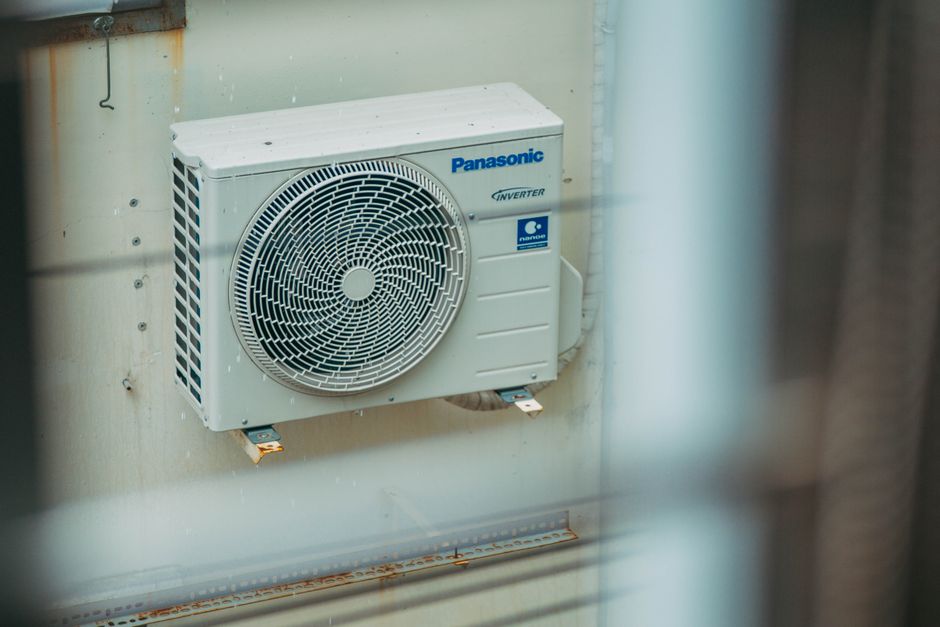
What You Need to Know Before Replacing Your AC Unit
Replacing an AC unit is one of the biggest home improvement decisions you’ll make — and one of the most expensive. Costs range from as little as $150 for a basic window unit to over $20,000 for a full central air system with new ductwork.
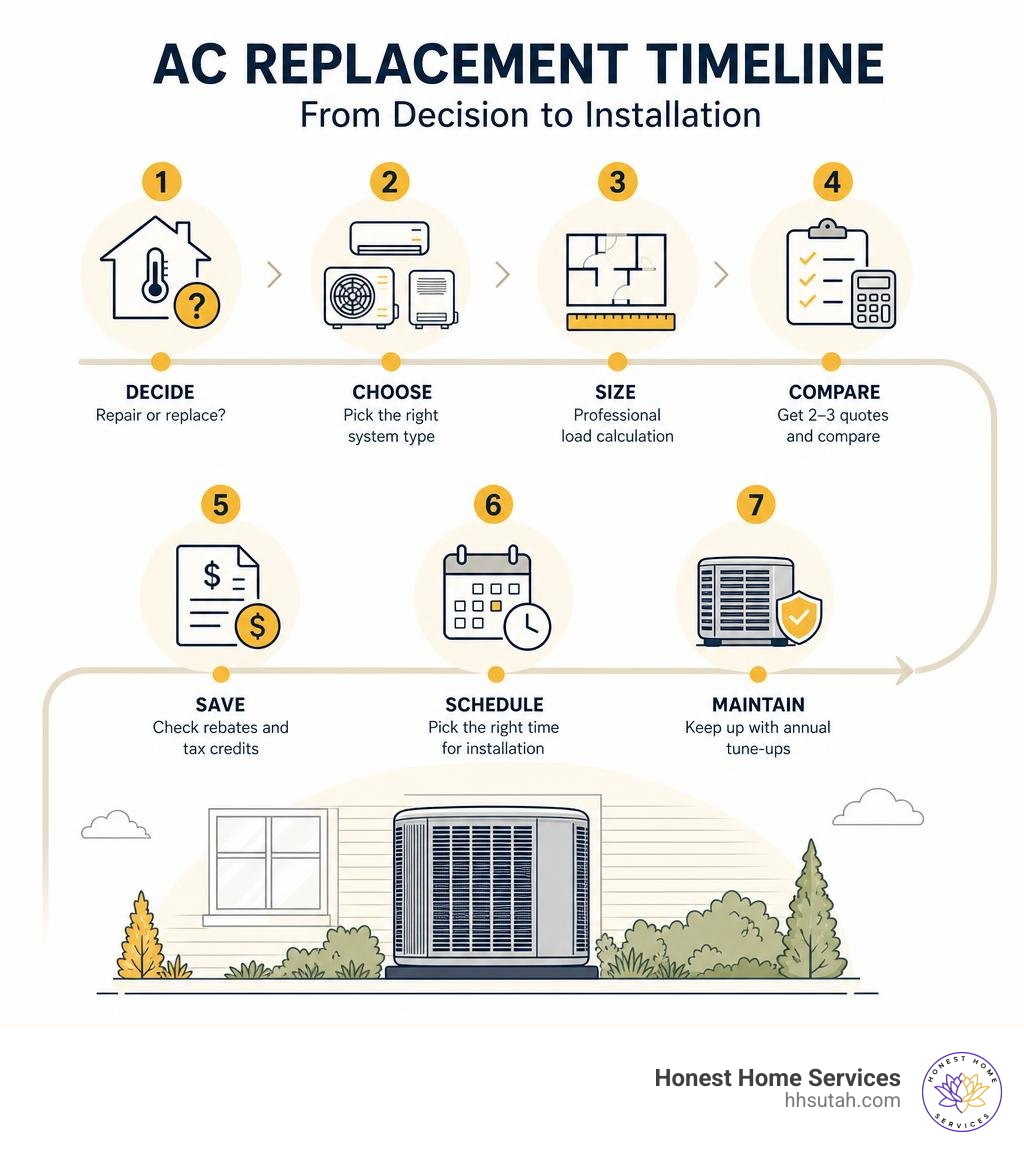
Here’s a quick overview of what to expect:
| Step | What It Involves |
|---|---|
| 1. Decide to repair or replace | Use the 50% rule and check system age |
| 2. Choose a system type | Central, mini-split, heat pump, or window unit |
| 3. Size the system correctly | Requires a professional Manual J calculation |
| 4. Get 2-3 contractor quotes | Compare line-by-line, not just the total |
| 5. Check for rebates and tax credits | Up to $2,000 in federal credits may apply |
| 6. Schedule installation | Off-season timing can lower labor costs |
| 7. Maintain your new system | Annual tune-ups protect your investment |
Most Utah homeowners pay between $4,000 and $12,000 for a full central AC replacement, including equipment, labor, and permits. The wide range comes down to system type, home size, efficiency rating, and whether ductwork or electrical upgrades are needed.
This guide walks you through every step — from deciding whether to repair or replace, to choosing the right system, to hiring a contractor you can trust.
At Honest Home Services, we’ve spent over 20 years helping Northern Utah homeowners navigate the process of replacing AC units — from first inspection to final commissioning. We’re a licensed, insured local team built on honest pricing and 5-star results.
Repair vs. Replace: Deciding When It’s Time for Replacing AC Unit

It is the middle of July on the Wasatch Front, and your air conditioner has decided to take an unscheduled vacation. As the indoor temperature climbs, you are faced with a classic homeowner dilemma: do you call for another patch-up repair, or is it finally time to commit to replacing the AC unit entirely?
To make an objective decision without letting the summer heat cloud your judgment, we recommend using a few industry-standard benchmarks:
- The 50% Rule: If the cost of a single repair meets or exceeds 50% of the value of a brand-new system, replacement is almost always the smarter financial move. Even if a repair bill is only 30% to 40% of the replacement cost, you should think twice if the system is showing signs of widespread wear.
- The 10-to-15-Year Lifespan: While some well-maintained air conditioners can stretch to 15 or 20 years, ENERGY STAR recommends preparing for replacement every 10 to 15 years. Older units run at a fraction of their original efficiency, meaning you pay more each month for less cooling power.
- Frequent Breakdowns: If you have your local HVAC technician on speed dial and are paying for multiple service calls every season, those “minor” fixes are quickly eating away at the budget you could use for a modern, reliable system.
- Rising Energy Bills: Have your utility bills spiked even though your household habits haven’t changed? An aging compressor has to work twice as hard to achieve the same cooling output, dragging down your system and your wallet.
- The R-22 Refrigerant Phaseout: If your system was installed before 2010, it likely runs on R-22 (Freon). Because R-22 has been entirely phased out due to environmental regulations, sourcing it for a leak repair is incredibly expensive. Modern units use eco-friendly, low-GWP (Global Warming Potential) refrigerants like R-454B or R-32, which are safer, highly efficient, and readily available.
If you are on the fence, starting with professional Air Conditioning Services can help you clarify your system’s health. A thorough inspection will determine whether a straightforward AC Repair can safely buy you another season or if investing in a new unit is the only logical path forward.
AC System Types and 2026 Replacement Costs
Once you decide that replacing the AC unit is the right move, you need to understand what type of system fits your home and what it will cost. In 2026, residential cooling options are more diverse and efficient than ever.
To help you visualize your options, we’ve broken down the most common systems, their typical 2026 price ranges (including equipment and professional installation), and their ideal use cases:
| System Type | Typical 2026 Installed Cost | Best Use Case | Key Advantage |
|---|---|---|---|
| Window Units | $150 – $1,000 | Single rooms, small apartments, or supplemental cooling | Low upfront cost, easy DIY setup |
| Central Air Conditioning | $7,500 – $15,000 | Whole-home cooling for houses with existing ductwork | Even temperature distribution, hidden equipment |
| Ductless Mini-Split Systems | $3,000 – $9,000 (per zone) | Older homes without ducts, home additions, or zoned cooling | Highly efficient, no ductwork required |
| Air-Source Heat Pumps | $11,000 – $17,500 | Homes looking to combine heating and cooling into one system | Excellent energy savings, eligible for major rebates |
| Geothermal Heat Pumps | $15,000 – $35,000+ | Long-term homeowners seeking maximum efficiency | Unmatched lifespan and lowest operating costs |
When reviewing these numbers, it’s important to understand where your money actually goes. A common misconception is that you are simply paying for a metal box that sits in your yard. In reality, equipment typically accounts for 35% to 55% of the total project cost, while professional labor, custom fabrication, permits, and electrical materials make up the remaining 45% to 65%.
To get a highly detailed look at how these price points shift based on your home’s layout, check out this comprehensive guide on How much does HVAC replacement cost in 2026? (By tonnage, SEER, and fuel type) .
Sizing, Efficiency, and Infrastructure: The Technical Details
Replacing an air conditioner is not a one-size-fits-all project. To get the best return on your investment, you must balance three critical technical pillars: cooling capacity (sizing), energy-efficiency ratings, and your home’s existing infrastructure.
Sizing Your System: Why Manual J Matters When Replacing AC Unit
The single biggest mistake a homeowner can make is choosing an AC unit based on guesswork or a simple square-footage “rule of thumb.” In the HVAC world, bigger is definitely not better.
To size a system correctly, an experienced contractor must perform a Manual J load calculation. This engineering calculation accounts for:
- The total square footage and ceiling height of your home.
- The local climate and elevation (which is especially important at Salt Lake City’s 4,300-foot elevation).
- The direction your home faces and its daily sun exposure.
- The quality and thickness of your wall and attic insulation.
- The number of windows, their frame materials, and whether they are double-paned.
If your system is oversized, it will turn on, blast the home with cold air, and shut off rapidly. This is called short-cycling. Because it doesn’t run long enough to pull moisture out of the air, your home will feel cold but incredibly damp and clammy. Short-cycling also places immense stress on the compressor, shortening its lifespan by 20% to 30%.
Conversely, an undersized system will run constantly, struggling to cool your home on hot July afternoons, leading to premature system failure and sky-high energy bills.
System capacity is measured in “tons” (where one ton equals 12,000 BTUs of cooling capacity per hour). For a deeper dive into how sizing and brand selection interact to affect your bottom line, take a look at this detailed breakdown of 4-Ton AC Replacement Cost 2026 | Installed Prices by Brand .
Efficiency Ratings: SEER2, EER2, and Long-Term Savings
When shopping for a new air conditioner, you will see labels displaying SEER2 and EER2 ratings. These are the updated efficiency standards introduced in 2023 to replace older testing methods with more rigorous, real-world simulations.
- SEER2 (Seasonal Energy Efficiency Ratio 2): This measures how efficiently an AC unit cools your home over an entire cooling season. It calculates performance across a wide outdoor temperature range (from 65°F to 104°F).
- EER2 (Energy Efficiency Ratio 2): This measures how efficiently the system performs at a single, fixed peak temperature (95°F outdoor, 80°F indoor, and 50% humidity). This rating is highly important in dry, hot climates where the system regularly runs under maximum load.
In northern states (including Utah), the federal minimum standard for new split-system air conditioners is 14.3 SEER2. However, upgrading to a higher-efficiency unit (16 to 20+ SEER2) can cut your cooling energy use by 20% to 50%.
While higher-efficiency systems carry a larger upfront equipment cost (often adding $1,500 to $4,000 over a baseline unit), they dramatically reduce your monthly utility bills. The payback period depends on how often you run your system, but choosing a variable-speed unit (which can scale its capacity down to 25% rather than turning completely on or off) ensures maximum comfort and whisper-quiet operation.
Hidden Infrastructure Costs: Ductwork, Furnaces, and Electrical Upgrades
When budget planning for replacing the AC unit, your air conditioner relies on a network of supporting infrastructure. If those systems aren’t up to par, your new AC won’t perform as advertised.
- Ductwork Modifications: Studies by the U.S. Department of Energy estimate that 25% to 40% of conditioned air leaks out of typical residential duct systems. If your ducts are falling apart, crushed, or leaking, installing a brand-new AC is like throwing money out the window. Minor repairs might run around $1,400, while a complete ductwork overhaul can range up to $17,000 for a 2,500-square-foot home.
- Furnace Compatibility: Your central air conditioner shares the same indoor blower motor and duct connection as your furnace. If your furnace is more than 12 to 15 years old, it often makes sense to replace both systems at the same time. Doing so can save you $1,500 to $3,000 in combined labor costs, resets the warranty clock for your entire HVAC system, and ensures your indoor blower is perfectly matched to your new AC’s airflow requirements.
- Electrical Panel Upgrades: Modern high-efficiency AC units and heat pumps may require different electrical breakers or increased amperage. If your home’s electrical panel is outdated, you may need to budget $1,500 to $3,500 for an electrical upgrade to safely handle the new load.
- Lineset Replacement: The copper lineset carries refrigerant between your indoor evaporator coil and outdoor condenser. Over time, these lines can collect acidic oil residue or develop micro-leaks. Replacing the lineset during installation ensures your new system remains clean and leak-free.
To learn more about how all these components work together in our local Utah climate, check out The Ultimate Salt Lake City HVAC Repair Survival Guide.
Timing, Incentives, and Professional Installation
Navigating the financial and practical aspects of an AC replacement is all about planning. By timing your installation correctly and taking advantage of available incentives, you can save thousands of dollars on your upgrade.
The Best Time of Year for Replacing AC Unit to Save Money
Timing is everything. If you wait until your system dies in the middle of a triple-digit July heatwave, you will pay premium rates, and you might have to wait days for an available installation slot.
The best times of year to replace your AC unit are the “shoulder seasons” — early spring (March to April) and mid-to-late fall (October to November). During these months, HVAC contractors are not swamped with emergency repair calls. Because their schedules are more flexible, you can often secure off-season equipment discounts, lower labor rates, and faster turn-around times.
Rebates, Tax Credits, and Financial Incentives in 2026
The upfront cost of a high-efficiency system or heat pump can be significantly offset by stacking federal, state, and local incentives. In 2026, the financial opportunities are substantial:
- The Energy Efficient Home Improvement Credit (Section 25C): Homeowners can claim a federal tax credit of up to 30% of the total cost (up to $2,000) for qualifying air-source heat pumps. Standard central AC units meeting specific Consortium for Energy Efficiency (CEE) highest tier requirements can qualify for up to $600 in tax credits.
- HEEHRA (High-Efficiency Electric Home Rebate Act): For low-to-moderate-income households, this state-administered program provides point-of-sale rebates up to $8,000 for heat pump installations.
- Local Utility Rebates: Utah utility providers like Rocky Mountain Power and Dominion Energy offer cash-back rebates ranging from $150 to $1,500+ for upgrading to smart thermostats, high-SEER2 air conditioners, or dual-fuel hybrid heating and cooling systems.
DIY vs. Professional Installation: Why Craftsmanship Matters
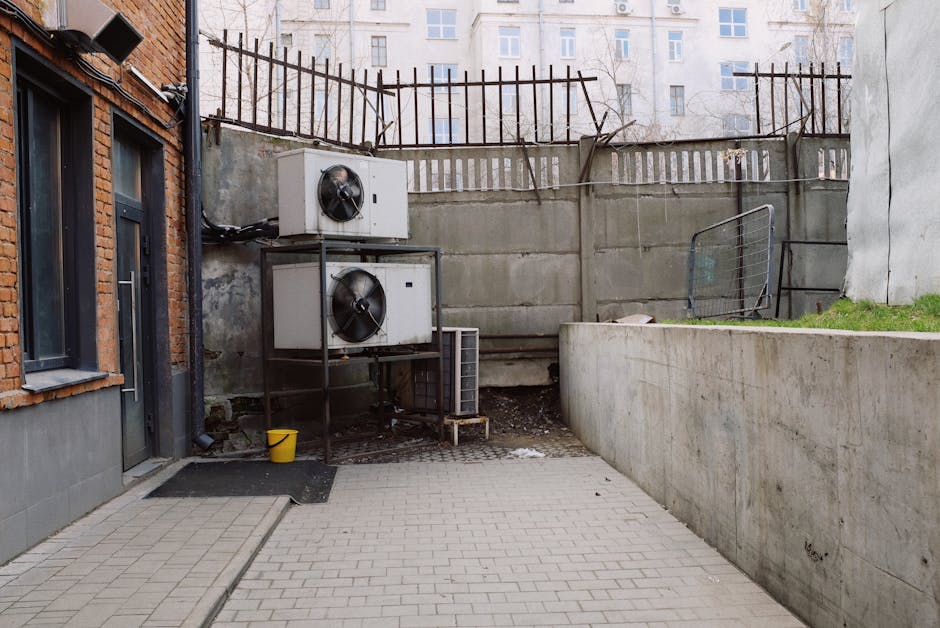
With the rise of online wholesale retailers and DIY tutorials, it can be tempting to try and install a new AC unit yourself. However, central air conditioning installation is not a weekend DIY project.
Legally, the EPA requires any individual handling, charging, or recovering chemical refrigerants to hold a valid Section 608 Certification. Handling these pressurized gases without proper training can cause severe injury, property damage, and heavy federal fines.
Furthermore, a high-quality installation is the single most important factor in how long your system will last. A poorly installed system can suffer from:
- Refrigerant leaks due to bad line connections.
- Electrical short-circuits from improper wiring.
- Premature compressor failure due to improper vacuuming of the lines before charging.
- Voided manufacturer warranties (nearly all major brands require professional installation to keep the parts warranty active).
To make sure your investment is protected, work with a reputable local contractor. If you are comparing your options along the Wasatch Front, you can check out local resources like the Top 10 Best Heating & Air Conditioning/HVAC Near Davis County … to see how regional companies stack up.
Whether you need AC replacement in Clearfield, Layton, Kaysville, Farmington, Bountiful, or Salt Lake City, choosing a licensed and insured professional ensures your system is installed safely and to local building codes. At Honest Home Services, we provide expert AC Installation across Northern Utah, ensuring your new system is perfectly calibrated for maximum efficiency and long-term reliability.
Conclusion
Replacing your home’s air conditioner is a major project, but with the right preparation, it doesn’t have to be overwhelming. By understanding the 50% rule, selecting the right system size through a Manual J calculation, and taking advantage of 2026 federal tax credits, you can secure a highly efficient system that will keep your home comfortable for the next 15 to 20 years.
At Honest Home Services, we are proud to serve communities throughout Northern Utah, including Salt Lake City, Salt Lake County, Davis County, and surrounding areas. Our local, expert technicians are dedicated to providing clear, transparent pricing, guaranteed customer satisfaction, and 24/7 emergency support when you need us most.
Ready to upgrade your home comfort without the stress? Schedule your professional AC installation with Honest Home Services today, and let us help you keep your cool all summer long!
FAQ 1: How long does a standard AC replacement take?
For a straightforward swap where the new indoor evaporator coil and outdoor condenser connect directly to your existing, well-maintained ductwork and electrical setup, the installation is usually completed in one day (typically 4 to 8 hours).
However, if your project requires extensive ductwork repairs, structural modifications, electrical panel upgrades, or the installation of a multi-zone ductless mini-split system, the timeline can extend to 2 to 3 days. An experienced contractor will always provide a detailed schedule before the work begins so you can plan accordingly.
FAQ 2: Should I replace my furnace at the same time as my AC?
While it is not strictly mandatory, we highly recommend replacing both systems at the same time if your furnace is more than 12 years old.
Because your furnace and AC share the same indoor blower motor, cabinet, and duct connections, installing them together allows the technician to perfectly match the airflow requirements of both units. This maximizes your overall energy efficiency, saves you $1,500 to $3,000 in redundant labor costs, and ensures your entire HVAC system is covered under a brand-new manufacturer’s warranty.
FAQ 3: What are the red flags of a bad HVAC installation?
When hiring an HVAC contractor, keep an eye out for these common warning signs of low-quality service:
- No Load Calculation: If a contractor quotes a system size based solely on your home’s square footage or simply matches the tonnage of your old unit without performing a Manual J load calculation, they are likely to install an improperly sized system.
- Phone-Only Quotes: A reputable company will never give you a firm, guaranteed quote over the phone without inspecting your home’s layout, electrical panel, and ductwork first.
- Missing Permits: Skipping local mechanical and electrical permits is a major red flag. Permits ensure an independent third-party inspector verifies the safety of the installation, and skipping them can void your homeowner’s insurance and manufacturer warranties.
- Extremely Low Bids: If one contractor’s quote is 25% to 30% lower than everyone else’s, they are likely cutting corners on licensing, insurance, permit fees, or utilizing low-grade, unmatched equipment.